




Volvo Participates in Successful ‘Road Train’ Project
ROCKLEIGH, NJ - Volvo said there are a number of advantages to the road train concept, also described as “platooning.” One includes improved fuel savings due to the cars following each other closely and benefiting from reduced air drag.

Volvo conducting its "road train" pilot program.
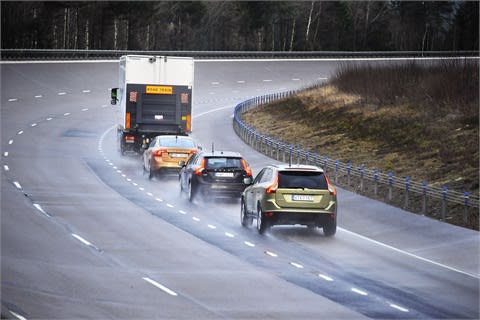
Volvo conducting its "road train" pilot program.
ROCKLEIGH, NJ - Volvo Car Corp. has been participating in the successful demonstration of what it calls a “road train” in Europe as part of the Safe Road Trains for the Environment (SARTRE) project. The automaker said the project involves successfully, and safely, driving a test fleet that consists of a lead truck, with a driver, closely followed by autonomously driven cars.
"The aim is for the entire road train to be completed in autumn 2012. By then we will have four vehicles after one lead vehicle driving at 90 km/h (56 mph)," said Erik Coelingh, technical project manager at the Volvo Car Corporation.
Volvo said there are a number of advantages to the road train concept, also described as “platooning.” They include improved fuel savings due to the cars following each other closely and benefiting from reduced air drag and increased safety, as the lead vehicle is driven by a professional driver and the rest of the vehicles are autonomous and have faster reaction times than humans. Volvo said energy savings can be as high as 20%.
The SARTRE project also includes a study to identify needed infrastructure changes to make road trains feasible.
More Operations

90% Use Telematics. Are Fleets Getting Safer? | AF News Recap
This week, we're breaking down which industries have the highest rates, how Jamie McKay manages 2,400 vehicles, what's happening with the 2027 fleet awards, and why software-defined vehicles could introduce new costs.
Read More →
What's Best Handled by an FMC, and What's Better Done Directly?
Fleet managers continue to rely on FMCs for essential services but are taking a closer look at where working directly with suppliers can improve efficiency and responsiveness.
Read More →
Fleet Meets: Erin Gilchrist
Meet Erin Gilchrist, the inaugural Mike Antich Spirit of Fleet Award winner, as she shares insights on leadership, mentorship, the power of industry connections, and why people remain at the heart of fleet's future.
Read More →

How 2026 Fleet Visionary Jamie McKay Manages 2,400 Vehicles Across 37 States
How do you keep 2,400 vehicles running across 37 states? Fleet Visionary Award winner Jamie McKay shares how collaboration, flexibility, and a few simple strategies help her tackle fleet management challenges at Aptive Pest Control.
Read More →
Managing Fleet Costs in an Era of Permanent Volatility
Fleet operating costs have risen more than 20% since 2020, raising a key question: When does extending a vehicle's service life stop making financial sense?
Read More →
The Next Evolution of Fleet Management: Autonomous Operations
This opening keynote session at the Fleet Forward Conference highlights the future of autonomous driving for fleets.
Read More →
How to Reduce the Total Cost of Risk From Catalytic Converter Theft
A stolen catalytic converter can cost fleets far more in downtime and lost productivity than in repairs. A total-cost-of-risk approach can help fleet managers quantify their exposure and prioritize theft prevention.
Read More →
Personal-Use Charges Rise as Vehicle Values Fall | AF News Recap
Personal-use charges are climbing, wholesale used-vehicle values are declining, and commercial fleet sales growth is slowing. This week, we're breaking down the latest fleet data, plus how Element Fleet Management is helping Waymo prepare for its first Canadian robotaxi market.
Read More →
Here's When You Should Make an Exception to Fleet Policy
Fleet policies are designed to create consistency, but not every driver or situation fits neatly within standard rules.
Read More →
AI-Native or AI-Acquired: What Should Fleet Managers Look for in an AI Platform?
Six questions can help fleet managers look beyond AI marketing claims to evaluate integration, data access, and real-world operational performance.
Read More →