




2018 F-150 Adds Power, Payload Capability
Ford has boosted the power and efficiency of its F-150 engines for the 2018 model year with improvements that increase payload, towing capability, and fuel economy, Ford has announced.

Photo of 2018 F-150 courtesy of Ford.

Photo of 2018 F-150 courtesy of Ford.
Ford has boosted the power and efficiency of its F-150 engines for the 2018 model year with improvements that increase payload, towing capability, and fuel economy, Ford has announced.
The 2018 F-150 will offer a more fuel-efficient second-generation 2.7-liter EcoBoost, a more efficient base engine in the 3.3-liter PFDI V-6, and a more efficient 5.0-liter EcoBoost V-8. The 2.7-liter engine will arrive with an EPA-estimated rating of 20 mpg city, 26 mpg highway and 22 mpg combined, according to Ford.
When it goes on sale later this year, the 2018 F-150 equipped with the 3.5-liter EcoBoost will arrive with a new, 13,200-pound tow rating. The F-150 equipped with the 5.0-liter V-8 will arrive with a payload capacity of 3,270 pounds. The pickup will offer standard auto start-stop and expanded availability of the 10-speed SelectShift automatic transmission.
When paired with the 10-speed, the second-generation 2.7-liter EcoBoost V-6 delivers the improved fuel economy performance, along with a power increase of 25 additional pound-feet of torque.
The 5.0-liter V-8 has also been enhanced with advanced dual-port and direct-injection technology so it makes an additional 10 horsepower and 13 lb.-ft. of torque. The rear-wheel F-150 with this powertrain adds 2 mpg (to 16 mpg) in city driving.
The 3.3-liter V-6 adds 8 hp and 12 lb.-ft. of torque over the outgoing engine. The rear-wheel model adds 2 mpg (to 20 mpg) in combined driving cycles.
New driver assisting features include Pre-Collision Assist with Pedestrian Detection and adaptive cruise control with stop-and-go functionality. Ford is also offering an available Wi-Fi hotspot.
More Operations
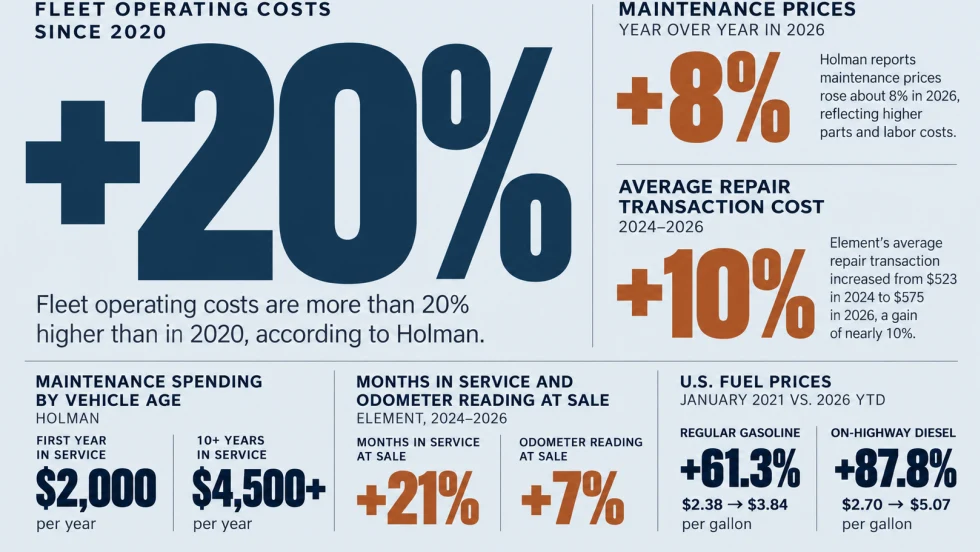
Managing Fleet Costs in an Era of Permanent Volatility
Fleet operating costs have risen more than 20% since 2020, raising a key question: When does extending a vehicle's service life stop making financial sense?
Read More →
The Next Evolution of Fleet Management: Autonomous Operations
This opening keynote session at the Fleet Forward Conference highlights the future of autonomous driving for fleets.
Read More →
How to Reduce the Total Cost of Risk From Catalytic Converter Theft
A stolen catalytic converter can cost fleets far more in downtime and lost productivity than in repairs. A total-cost-of-risk approach can help fleet managers quantify their exposure and prioritize theft prevention.
Read More →

Personal-Use Charges Rise as Vehicle Values Fall | AF News Recap
Personal-use charges are climbing, wholesale used-vehicle values are declining, and commercial fleet sales growth is slowing. This week, we're breaking down the latest fleet data, plus how Element Fleet Management is helping Waymo prepare for its first Canadian robotaxi market.
Read More →
Here's When You Should Make an Exception to Fleet Policy
Fleet policies are designed to create consistency, but not every driver or situation fits neatly within standard rules.
Read More →
AI-Native or AI-Acquired: What Should Fleet Managers Look for in an AI Platform?
Six questions can help fleet managers look beyond AI marketing claims to evaluate integration, data access, and real-world operational performance.
Read More →
A buyer's guide to fleet management software in 2027
Buying fleet management software in 2027 means looking beyond features and price. As fleet operations, technology and expectations evolve, this guide explores what today’s fleet professionals should consider when choosing a system that can deliver value now and adapt to what comes next.
Read More →
What Will Shape the Next Era of Fleet Management?
EVs, AI, and autonomous vehicles are reshaping fleet management. Discover what’s ahead—and how fleet leaders can prepare for the next era.
Read More →
How Fleets Can Recruit and Train Veterans for Technician Roles
Here's how the technician shortage has affected uptime for fleets, and what to do about it.
Read More →
Avis Budget Group Deploys Neology Toll Management Technology Across Major Brands
Neology’s neoFleet platform will manage toll transactions and toll-authority operations for vehicles across Avis, Budget, Payless, Budget Truck and Zipcar.
Read More →