




Cadillac Rolls Out Fourth-Gen 2015 Escalade
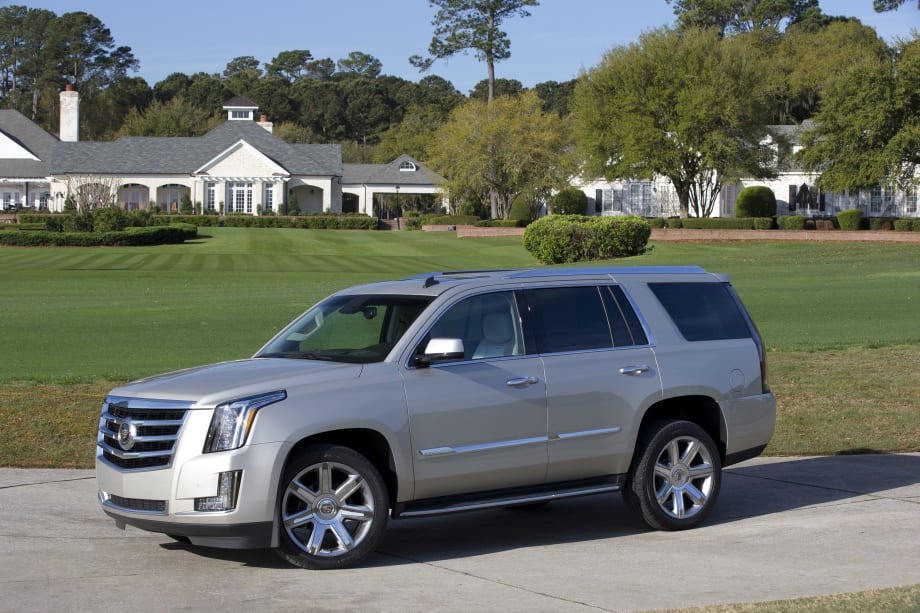
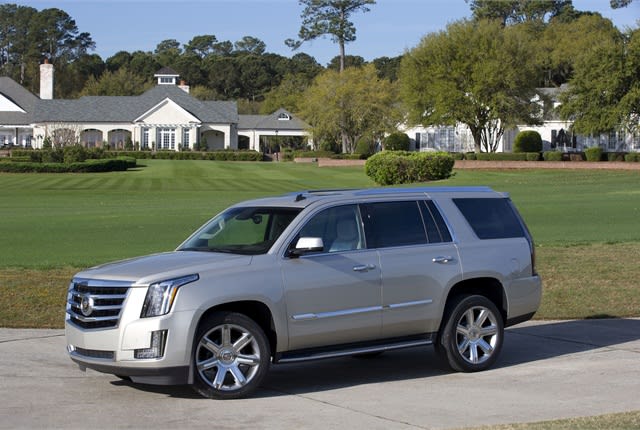
Cadillac's fourth generation Escalade has rolled into dealer showrooms as a top to bottom revamp of the full-size SUV, which debuted in 1999.

Photos: Cadillac
Photos: Cadillac
Cadillac's fourth generation Escalade has rolled into dealer showrooms as a top to bottom revamp of the full-size SUV, which debuted in 1999.
In addition to an update in its styling, which company officials told automotive journalists is an "evolution" of Cadillac's design, the all-new Escalade features a number of content updates and additions, many of them standard.
Among the updates are the addition of LED front lighting, fold-flat second- and third-row seats with power folding feature, and a 12.3-inch high-resolution driver information center display.
Under the hood, every Escalade model comes standard with a new EcoTec3 6.2L V-8 with direct injection, variable valve timing, and cylinder deactivation is about 17-percent more efficent on the highway, according to the automaker. During the press briefing, company officials said that at this time there is no plans to offer a hybrid version of the vehicle, owing to the fact that the previous generation, which did offer a hybrid model, saw sales of only about 2 percent.
The 6.2L V-8 produces 420 hp and 460 lb.-ft. of torque with an EPA fuel mileage rating for the Escalade 2WD is 15 mpg city/21 mpg highway and the Escalade 4WD gets 14 mpg city/21 mpg highway. The Escalade ESV 2WD gets 15 mpg city/21 highway and the 4WD model gets 14 mpg city/20 mpg highway. The engine is mated to a 6-speed automatic transmission.
The 2015 Escalade and Escalade ESV has a towing capacity ranging from 7,900 pounds (for the Escalade ESV 4WD) to 8,300 pounds (Escalade 2WD). Escalade has 94.2 cu-ft of interior cargo volume and the ESV has 120.4 cu-ft of interior cargo volume. Payload maximums range from 1,460 pounds (Escalade and ESV 4WD) to 1,506 pounds (Escalade 2WD).
Company officials noted that among the interior improvements are better access to the second and third row seats. The third row can be lowered and raised electronically, while the second-row seats can be lowered with the touch of a button, but need to be raised back into position manually. The tailgate can also be raised and lowered electronically.
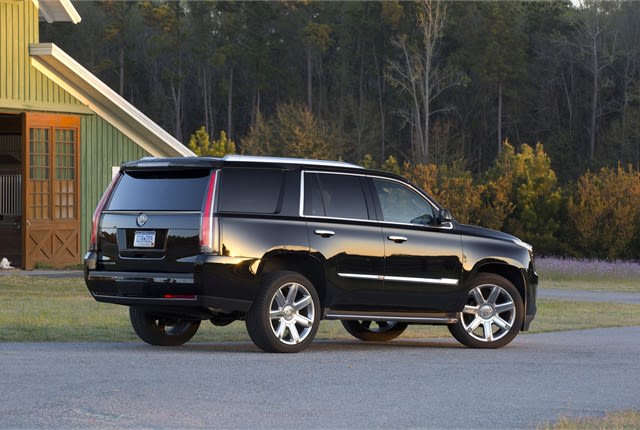
The Escalade fits well into executive fleets and is among the top 10 luxury SUVs in fleet registrations, according to Automotive Fleet's research. For the livery market, the 2015 Escalade will not be getting a livery version. This is primarily because of contenting, according to Cadillac officials, who said the standard packages on the Escalade fit the needs of most livery fleets.
Among the Escalade's new safety features are a front-seat center air bag and front and rear automatic braking. The Escalade's Driver Awareness package includes forward collision alert, lane departure warning system, and the safety alert seat feature. The Driver Assist pacakge adds full speed range adaptive cruise control, front and rear automatic braking, automatic collision preparation, and automatic safety belt tightening. Additionally, side blind zone alert, rear cross traffic aleart, and lane change aleart are standard on the luxury and premium models.
The Escalade also features a number of security features, including glass breakage sensors, motion detectors, and a self-leveling inclination sensor that sounds an alarm if a thief attempts to steal wheels or tires, or tow or lift the vehicle onto a flatbed truck.
By Chris Wolski
More Operations

Fleet Has a Talent Pipeline Problem. What Comes Next? | AF News Recap
Where will fleet’s next generation of leaders come from? This week, we’re looking at the industry’s talent pipeline, what certification can add to a fleet career, how to build an award-worthy track record, and the return of Automotive Fleet’s Personal Use Survey.
Read More →
Smith System Launches Driver Risk Management Program
Fleets have more driver data than ever, but identifying risky behavior doesn't necessarily correct it. Smith System's new Driver Risk Management program combines monitoring, training, and follow-up coaching to help fleets connect risk signals with driver intervention.
Read More →
Automotive Fleet Opens 2026 Personal Use Survey for Commercial Fleet Managers
Less than two weeks left! Commercial and corporate fleet managers are invited to share how their organizations handle company vehicle personal-use policies, charges, and driver eligibility.
Read More →
From AI Prompts to AI-Generated Safety Songs | AF News Recap
Can better prompts make AI more useful for fleet managers? This week, we’re breaking down smarter fleet analysis, an AI-assisted experiment that turned safety training into music, and what happened to fuel prices in August.
Read More →
How to Write Better AI Prompts for Fleet Analysis
Include these six elements in your fleet prompts to generate more relevant analysis and accurate answers.
Read More →
Fleet Meets: Eric Kilgore
This edition of the Fleet Meets series features one of the industry's best leaders driving multi-market and national operations.
Read More →
Why Reactive Fleet Management Is Becoming Too Expensive to Sustain
Research highlights a growing need for proactive management strategies to address rising costs in fleet operations effectively.
Read More →
What Your Fleet KPIs Aren’t Telling You
Tracking fleet metrics is only useful when the data leads to better decisions. This guide helps fleet leaders assess cost, utilization, and downtime more accurately, identify performance gaps, and prioritize the actions that can improve operational results.
Read More →
Hidden in Plain Sight: Fleet Compliance Risks
Fleet compliance isn't just about having policies — it's about consistently enforcing them. This practical guide reveals six hidden compliance risks common in public sector and shared fleet operations and outlines proven strategies to improve visibility, accountability, and audit readiness
Read More →
Turning Fleet Payment Data into Executive Insights
Does data alone drive results in operations?
Read More →