




How Do Distracted Drivers Physically Respond?
Texting while driving is much riskier than driving while emotionally upset or daydreaming, according to a new study from the University of Houston and the Texas A&M Transportation Institute.
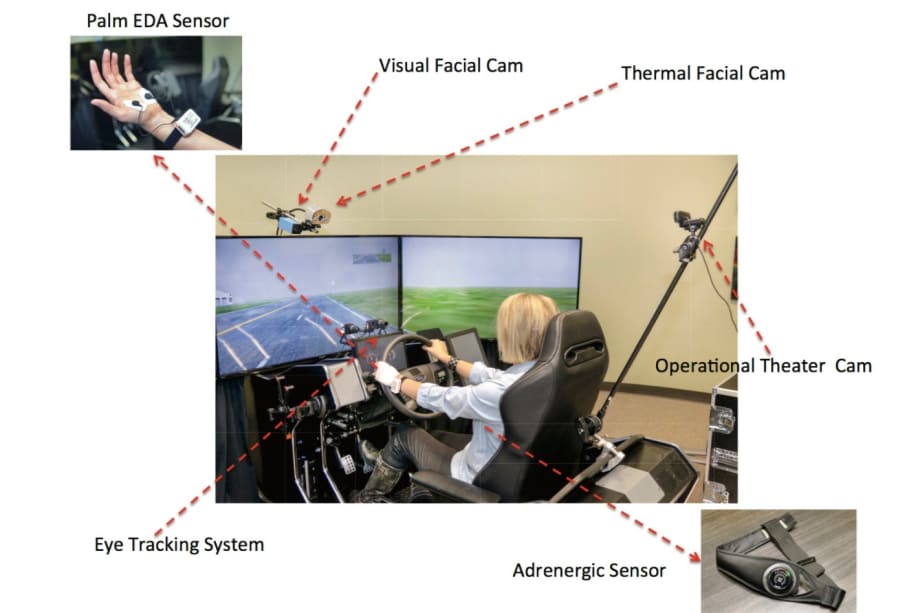
Study volunteers were monitored via standoff and wearable sensors. Graphic courtesy of the University of Houston.
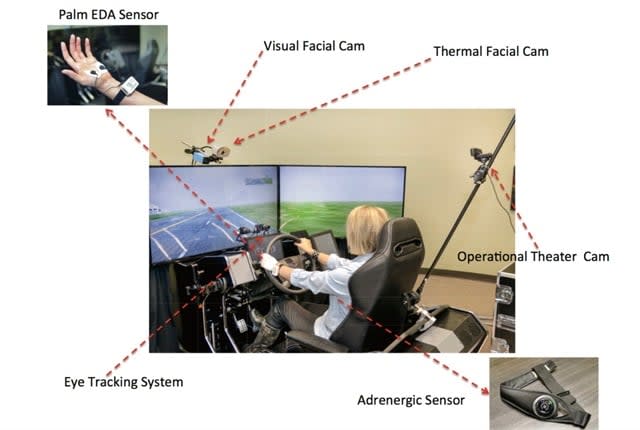
Study volunteers were monitored via standoff and wearable sensors. Graphic courtesy of the University of Houston.
Texting while driving is much riskier than driving while emotionally upset or daydreaming, according to a new study from the University of Houston and the Texas A&M Transportation Institute.
Researchers also found that all forms of distraction produce certain physical reactions in drivers — such as perspiration or accelerated heart rate — and cataloging these responses can help devise better strategies for making driving safer.
The study’s researchers produced extensive data examining how drivers react to different types of distractions and published the findings in Scientific Data.
Researchers conducted the study with 68 volunteers using a driving simulator. The volunteers had a valid driver’s license and normal or corrected-to-normal vision. They drove the same segment of highway four times in the high-fidelity driving simulator with no distraction and with cognitive, emotional and physical distraction. They were monitored using standoff and wearable sensors that recorded perspiration, heart rate, breathing rate, gaze and facial expressions to capture the drivers state as they were overloaded by multitasking. Tracking by thermal and visual cameras was also conducted.
The simulator's computer recorded driving performance variables, including speed, acceleration, braking force, steering angle and lane position, according to a University of Houston press release about the project.
The study split driver distractions into three categories, including sensorimotor, such as texting; cognitive, such as absorbing thoughts; and emotional distractions. Researchers discovered that texting led to far more dangerous driving, while a sixth sense appeared to protect those drivers suffering emotional distress or absent-mindedness. Texting interfered with that sixth sense, and drivers drifted out of their traffic lanes.
Further investigation revealed that "eye tracking and breathing rate proved useful metrics for measuring the impact of texting while driving," said Ioannis Pavlidis, a professor and director of the computational physiology lab at the University of Houston. "But that wasn't helpful in cases of emotional or cognitive distractions."
Nonetheless, researchers discovered that heart rate signals, which were captured using wearable sensors, and perspiration near the nose, which was detected using miniature thermal imagers, could track all forms of distraction, Pavlidis noted.
Such research can provide the groundwork for future safety systems, said Robert Wunderlich, the institute's director of the Center for Transportation Safety. Many drivers already wear smart watches and exercise trackers capable of measuring heart rate. The research paves the way for universal sensing of distraction.
The potential market for distracted-driving intervention is enormous. According to the National Highway Traffic Safety Administration, 3,477 people were killed and 391,000 were injured in motor vehicle crashes involving distracted drivers in 2015.
More Safety
IIHS Crash Avoidance Tests Reveal Safety Gaps in Cargo Vans and Work Trucks
New crash-avoidance ratings from the Insurance Institute for Highway Safety reveal inconsistent performance among commercial vehicles, with several popular cargo vans and heavy-duty pickups struggling to avoid collisions with other vehicles and pedestrians.
Read More →
What’s Next for Fleet? Safety, AI & Industry Recognition | AF News Recap
Could your company's culture be encouraging distracted driving? This week, we're exploring how workplace expectations affect driver safety, what AI, EVs, and autonomous vehicles could mean for the future of fleet management, and how fleet professionals can strengthen their award nominations.
Read More →
Does Your Fleet's Culture Encourage Distracted Driving?
What happens when the people responsible for enforcing safety rules are the ones setting the wrong example? The answer may reveal why some of the biggest risks to fleet drivers have little to do with what's written in the employee handbook.
Read More →
Fleet Manager’s Ultimate Playbook: Navigating the New Standard in OEM Connectivity
Rising operating costs, driver safety concerns, and unplanned downtime are putting unprecedented pressure on modern fleets. Discover how fleet managers use embedded OEM connectivity and real-time vehicle data to cut TCO, prevent downtime, and protect drivers without aftermarket telematics hardware.
Read More →
From Driver Well-Being to EV Charging | AF News Recap
Mental health belongs in the fleet safety conversation. This week, we’re looking at five ways fleets can support employee well-being before a crisis, plus Holman’s expansion in Mexico, new one-day Fleet Forward passes, and why EV charging demand is outpacing infrastructure growth.
Read More →
Nexar-Nauto Merger Aims to Give Fleets Better Safety Intelligence Through Larger Driving Dataset
Stefan Heck tells Automotive Fleet that combining more than 10 billion miles of driving history with Nexar's AI models will give fleets deeper insights into driver risk and roadway conditions than either company could provide independently.
Read More →
Don't Wait for a Crisis: 5 Ways to Build Mental Health Into Your Fleet Safety Program
For Suicide Prevention Month, fleet and safety leaders have an opportunity to put mental health where it belongs: at the center of workplace safety.
Read More →
How Camera Data Can Strengthen a Fleet’s Insurance Renewal
Insights from a commercial insurance carrier and a broker show how fleets can turn video telematic data, driver coaching, and improved claims results into a stronger case at insurance renewal.
Read More →
The Safest Fleets Aren’t the Ones with the Most Technology
You’ve made the telematics investment. Here’s how to capture the other half of its value and build the safest fleet on the road.
Read More →
Hidden in Plain Sight: Fleet Compliance Risks
Fleet compliance isn't just about having policies — it's about consistently enforcing them. This practical guide reveals six hidden compliance risks common in public sector and shared fleet operations and outlines proven strategies to improve visibility, accountability, and audit readiness
Read More →