




Bills Seek to Advance Autonomous Vehicle Tech in Mich.
In hopes of making the state a leader in this evolving technology, state senators have introduced legislation to update laws affecting testing and development of self-driving vehicles.
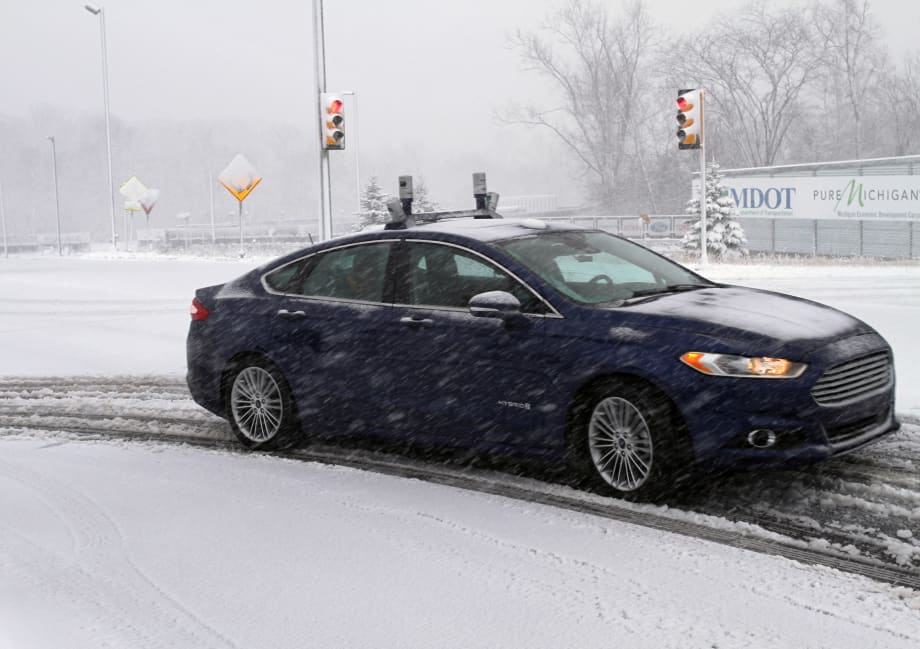
A Ford autonomous vehicle navigates snowy roads during a Michigan winter storm. Photo courtesy of Ford.
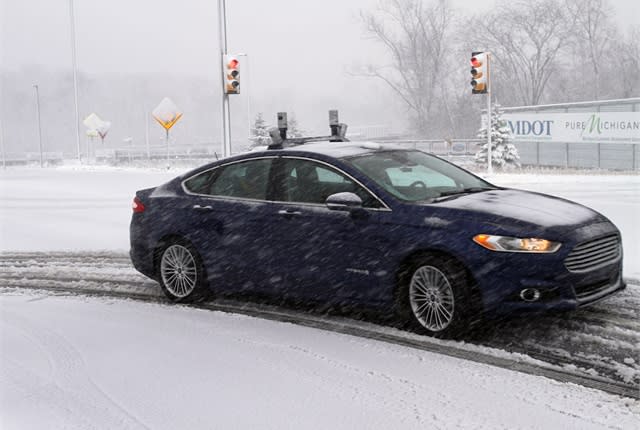
A Ford autonomous vehicle navigates snowy roads during a Michigan winter storm. Photo courtesy of Ford.
Michigan state senators have introduced a package of four bills aimed at making the state a leader in autonomous vehicle testing and development.
In contrast to California law, the legislation would establish guidelines for the legal operation of self-driving vehicles on public roads without the presence of a human driver behind the wheel. Supporters of the legislation hope this difference will provide the state with a competitive edge.
Also permitted under Senate Bill 995 would be vehicle platoons and on-demand automated fleet networks. Further, the bill would create the Michigan Council on Future Mobility — a group dedicated to keeping the state at the forefront of mobility technology.
“Advances in autonomous technology will allow Michigan drivers and their passengers to be safer on the road,” said Senate Majority Floor Leader Mike Kowall (R-White Lake), who introduced two of the bills. “In addition, a robust and free environment for testing and development will ensure the Michigan economy benefits from this new technology and changes in mobility.”

Michigan State Senator Mike Kowall, who sponsored two of the bills.
Google this week announced plans to open a self-driving test center in Novi, Mich. — a move that Kowall called "very exciting news for the 15th Senate District and all of Michigan."
Senate Bill 996 would establish standards for on-demand vehicle networks, and also spell out requirements for data collection that will help researchers further refine the technology.
Sponsored by Senator Rebekah Warren (D-Ann Arbor), Senate Bill 997 would create the American Center for Mobility at the old Willow Run factory site. The center is expected to play a vital role in research and education on autonomous vehicle technology.
Senate Bill 998, sponsored by Senator Ken Horn (R-Frankenmuth), would extend the liability protection in current law — which shields manufacturers from liability when an unauthorized person attempts to modify autonomous technology — to licensed mechanics who follow manufacturer specifications.
To secure a leadership position in autonomous vehicle technology, Michigan must make certain its regulations don’t lag behind and hinder progress, Kowall said. Michigan’s current law regulating autonomous vehicles went into effect in March 2014.
“The law is becoming more outdated day by day as technology advances and other states seek the new automotive industry for themselves,” Kowall said in a released statement. “Michigan’s dominance in auto research and development is under attack from several states and countries who desire to supplant our leadership in transportation. We can’t let that happen.”
More importantly, Kowall added, is that the legislation package seeks to promote road safety. A total of 94% of traffic accidents are caused by human error, according to the National Highway Traffic Safety Administration.
The four bills have been referred to the Senate Committee on Economic Development and International Investment.
More Safety

Does Your Fleet's Culture Encourage Distracted Driving?
What happens when the people responsible for enforcing safety rules are the ones setting the wrong example? The answer may reveal why some of the biggest risks to fleet drivers have little to do with what's written in the employee handbook.
Read More →
Fleet Manager’s Ultimate Playbook: Navigating the New Standard in OEM Connectivity
Rising operating costs, driver safety concerns, and unplanned downtime are putting unprecedented pressure on modern fleets. Discover how fleet managers use embedded OEM connectivity and real-time vehicle data to cut TCO, prevent downtime, and protect drivers without aftermarket telematics hardware.
Read More →
From Driver Well-Being to EV Charging | AF News Recap
Mental health belongs in the fleet safety conversation. This week, we’re looking at five ways fleets can support employee well-being before a crisis, plus Holman’s expansion in Mexico, new one-day Fleet Forward passes, and why EV charging demand is outpacing infrastructure growth.
Read More →
Nexar-Nauto Merger Aims to Give Fleets Better Safety Intelligence Through Larger Driving Dataset
Stefan Heck tells Automotive Fleet that combining more than 10 billion miles of driving history with Nexar's AI models will give fleets deeper insights into driver risk and roadway conditions than either company could provide independently.
Read More →
Don't Wait for a Crisis: 5 Ways to Build Mental Health Into Your Fleet Safety Program
For Suicide Prevention Month, fleet and safety leaders have an opportunity to put mental health where it belongs: at the center of workplace safety.
Read More →
How Camera Data Can Strengthen a Fleet’s Insurance Renewal
Insights from a commercial insurance carrier and a broker show how fleets can turn video telematic data, driver coaching, and improved claims results into a stronger case at insurance renewal.
Read More →
The Safest Fleets Aren’t the Ones with the Most Technology
You’ve made the telematics investment. Here’s how to capture the other half of its value and build the safest fleet on the road.
Read More →
Hidden in Plain Sight: Fleet Compliance Risks
Fleet compliance isn't just about having policies — it's about consistently enforcing them. This practical guide reveals six hidden compliance risks common in public sector and shared fleet operations and outlines proven strategies to improve visibility, accountability, and audit readiness
Read More →
NETS Sets 2026 Fleet Safety Benchmark Conference for Indianapolis
The Sept. 15–17 program will feature fleet benchmarking data, case studies, emerging technologies, and implementation strategies while running alongside the NSC Safety Congress & Expo.
Read More →
Off-the-Job Crashes Account for 43% of Employers’ $61.7 Billion Crash Burden
NETS quantifies costs dispersed across fleet, risk, HR, and other departments while providing new per-crash benchmarks for employers.
Read More →