




Video: 2017 E-Class Adds Remote-Controlled Parking
The 2017 Mercedes-Benz E-Class, set to launch next spring, will offer a new driver assistance package aimed at enabling semi-automated driving.
The 2017 model-year Mercedes-Benz E-Class, set to launch next spring, will offer a new driver assistance package aimed at enabling semi-automated driving on highways and in city traffic, the automaker said.
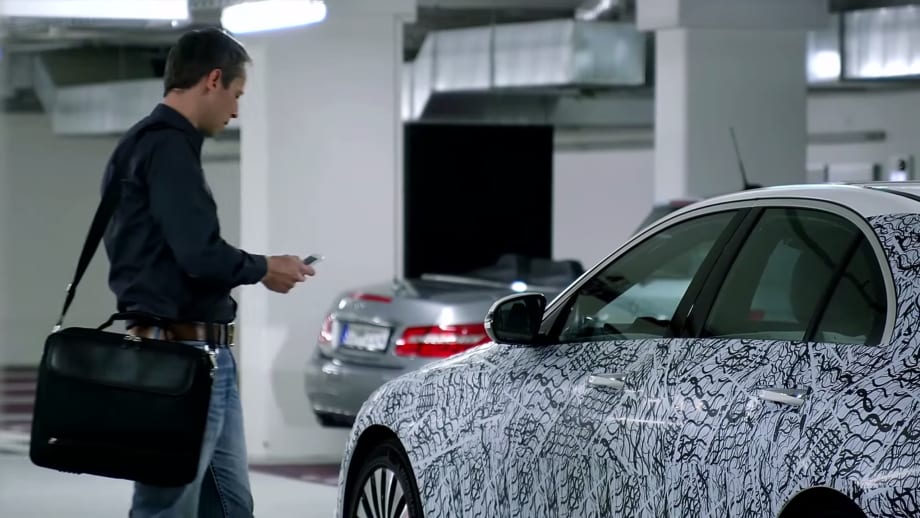
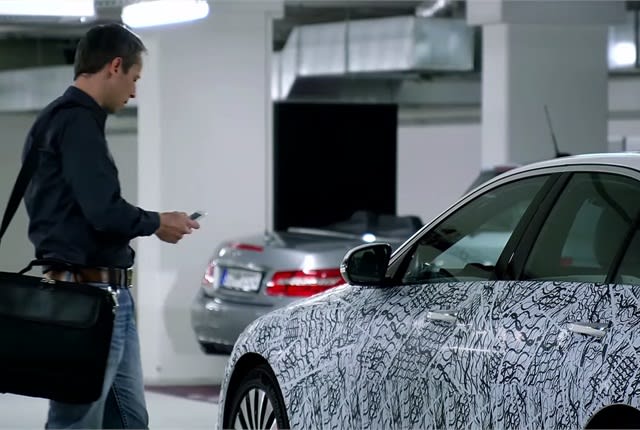
Drivers will also be able to use a smartphone app to guide the luxury sedan into and out of tight parking spaces – while they’re standing outside the car.
“We are taking a further major step along the road to autonomous and connected driving,” said Thomas Weber, a Daimler AG management board member who is responsible for group research and Mercedes-Benz cars development.
Autonomous braking will mitigate dangerous situations, and “car-to-X communication” will provide early warning of impending hazards, Mercedes-Benz said. Sophisticated radio technology will turn the driver’s smartphone into a vehicle key. Some components are even designed to protect occupants in a side collision and prepare their ears for the crash noise.
Here’s a rundown of E-Class driver assistance package highlights:
Intelligent Drive Next Level – This system can keep the car at the correct distance behind slower vehicles ahead automatically and can provide steering assistance. The system makes driving easier, particularly in traffic jams or heavy congestion. In combination with Comand Online, the optional Speed Limit Pilot subfunction can autonomously adjust the vehicle’s speed in response to camera-detected speed limits or speed limits logged in the navigation system.
Active Brake Assist – This system can warn the driver of imminent crash situations, provide assistance in the event of sudden braking and apply the brakes automatically in an emergency. In addition to detecting slower-moving, stopping or stationary vehicles, the system detects and reacts to crossing traffic at junctions, the tail ends of traffic jams and pedestrians in the danger zone ahead of the vehicle, for example.
Evasive Steering Assist – This system complements the pedestrian detection function of Active Brake Assist. When the driver deliberately or instinctively performs an evasive maneuver in a dangerous situation, this system can calculate steering torque to support the movement of the steering wheel. This helps the driver avoid the pedestrian in a controlled manner while later facilitating the vehicle's straightening.
Remote Parking Pilot – This system allows the vehicle to be moved into and out of a parking space while the driver is outside of the vehicle. The driver uses a smartphone app.
Car-to-X Communication – This system takes advantage of information about hazards or obstacles ahead.
Digital Car Key – This drive authorization system uses “near field communication” technology and allows the driver’s smartphone to function as a vehicle key.
Pre-Safe Impulse Side -- This system activates if an unavoidable side collision is detected. The air chambers in the backrest side bolsters inflate rapidly to move the occupant sideways, away from the danger area. This increases the distance between occupant and door.
Pre-Safe Sound – This system makes use of a natural reflex to protect the occupants’ ears from the expected noise in the event of a possible collision.
High-Resolution Multibeam LED Headlamps – These adaptive headlamps each have 84 individually activated high-performance LEDs. They automatically illuminate the road surface with precisely controlled bright light, without blinding other road users.
Mercedes-Benz has already begun providing glimpses of the 2017 prototype as a tease, including a new video demonstrating Remote Parking Pilot.
To view the video, click on the photo or link above. You’ll notice that the full look of the car is still being kept under wraps.
More Safety
IIHS Crash Avoidance Tests Reveal Safety Gaps in Cargo Vans and Work Trucks
New crash-avoidance ratings from the Insurance Institute for Highway Safety reveal inconsistent performance among commercial vehicles, with several popular cargo vans and heavy-duty pickups struggling to avoid collisions with other vehicles and pedestrians.
Read More →
What’s Next for Fleet? Safety, AI & Industry Recognition | AF News Recap
Could your company's culture be encouraging distracted driving? This week, we're exploring how workplace expectations affect driver safety, what AI, EVs, and autonomous vehicles could mean for the future of fleet management, and how fleet professionals can strengthen their award nominations.
Read More →
Does Your Fleet's Culture Encourage Distracted Driving?
What happens when the people responsible for enforcing safety rules are the ones setting the wrong example? The answer may reveal why some of the biggest risks to fleet drivers have little to do with what's written in the employee handbook.
Read More →
Fleet Manager’s Ultimate Playbook: Navigating the New Standard in OEM Connectivity
Rising operating costs, driver safety concerns, and unplanned downtime are putting unprecedented pressure on modern fleets. Discover how fleet managers use embedded OEM connectivity and real-time vehicle data to cut TCO, prevent downtime, and protect drivers without aftermarket telematics hardware.
Read More →
From Driver Well-Being to EV Charging | AF News Recap
Mental health belongs in the fleet safety conversation. This week, we’re looking at five ways fleets can support employee well-being before a crisis, plus Holman’s expansion in Mexico, new one-day Fleet Forward passes, and why EV charging demand is outpacing infrastructure growth.
Read More →
Nexar-Nauto Merger Aims to Give Fleets Better Safety Intelligence Through Larger Driving Dataset
Stefan Heck tells Automotive Fleet that combining more than 10 billion miles of driving history with Nexar's AI models will give fleets deeper insights into driver risk and roadway conditions than either company could provide independently.
Read More →
Don't Wait for a Crisis: 5 Ways to Build Mental Health Into Your Fleet Safety Program
For Suicide Prevention Month, fleet and safety leaders have an opportunity to put mental health where it belongs: at the center of workplace safety.
Read More →
How Camera Data Can Strengthen a Fleet’s Insurance Renewal
Insights from a commercial insurance carrier and a broker show how fleets can turn video telematic data, driver coaching, and improved claims results into a stronger case at insurance renewal.
Read More →
The Safest Fleets Aren’t the Ones with the Most Technology
You’ve made the telematics investment. Here’s how to capture the other half of its value and build the safest fleet on the road.
Read More →
Hidden in Plain Sight: Fleet Compliance Risks
Fleet compliance isn't just about having policies — it's about consistently enforcing them. This practical guide reveals six hidden compliance risks common in public sector and shared fleet operations and outlines proven strategies to improve visibility, accountability, and audit readiness
Read More →