




Video: Drivers Value Crash Protection Tech Over Infotainment
A new study from J.D. Power examines consumer preferences among future and emerging vehicle technologies.
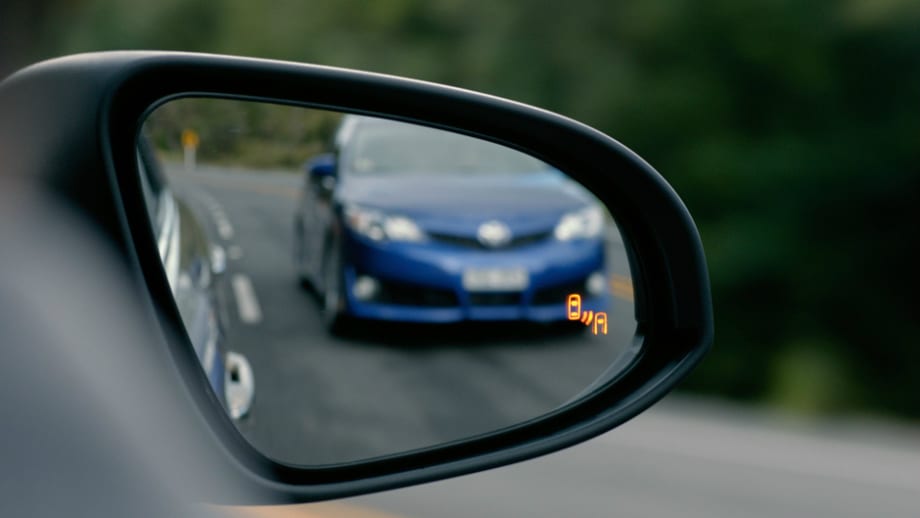
Photo of blind spot monitoring system courtesy of Toyota.
Three of the top five technologies that consumers would most prefer in their next vehicle are related to collision protection, according to a new study from J.D. Power.
Among the technologies consumers expressed the most interest in having in their next vehicle were blind spot detection and prevention systems, night vision, and enhanced collision mitigation systems, the J.D. Power 2015 U.S. Tech Choice Study found. Technologies that reduce the overall burden of driving and enhance vehicle safety attracted the most consumer attention.
These findings show growing acceptance for a relatively new concept for drivers — allowing the vehicle to assume critical functions, such as braking and steering. This driver willingness to relinquish such control is crucial to the future success of fully autonomous driving, researchers noted.
The only non-collision protection technologies to crack the top five were camera rearview mirror, which fell into the driving assistance category, and self-healing paint, a comfort and convenience category feature.
The new study used advanced statistical methodologies to measure preference for, and perceived value of, future and emerging technologies. A total of 59 advanced vehicle features were examined across six major categories: entertainment and connectivity, comfort and convenience, collision protection, driving assistance, navigation, and energy efficiency.
"There is a tremendous interest in collision protection technologies across all generations, which creates opportunities across the market," said Kristin Kolodge, executive director of driver interaction and HMI research at J.D. Power. "In contrast, there is very little interest in energy efficiency technologies such as active shutter grille vents and solar glass roofs. Owners aren’t as enthusiastic about having these technologies in their next vehicle because of other efforts automakers are taking to improve fuel economy, as well as relatively low fuel prices at the present time."
Smartphones play an increasingly vital role in everyday life, and vehicle technology is beginning to mirror what’s offered on those devices. However, Apple CarPlay and Google Android Auto technologies consistently drew among the lowest preference scores across all generations.
Consumer preferences for Apple CarPlay and Android Auto were uniquely dependent on which smartphone the survey participants owned. Those who owned a smartphone compatible with one of these technologies would choose the technology compatible with their phone at only a moderate rate, while those with the opposite brand of smartphone rarely, if ever, would choose that technology.
For example, Android owners indicated that Apple CarPlay is unacceptable nearly twice as often as they indicated that a solar glass roof is unacceptable. Similarly, Apple phone owners indicated that Android Auto is unacceptable nearly twice as often as a solar glass roof.
Kolodge noted that "lukewarm interest in these technologies that connect your phone to your vehicle, coupled with consumer loyalty to their phone, poses a unique challenge for automakers, which could be remedied by knowing their customers' phone preferences."
Owners of luxury vehicles tend to own iOS devices, research shows. As a result, for many luxury brands, Apple CarPlay may be the best option to offer – even though this may be leaving out a portion of the market.
"For non-luxury vehicle brands, the ownership of Apple and Android devices is much closer to an equal split. The solution for those brands may be to offer both operating systems and allow customers to select the option best suited for them," Kolodge said.
Photo of blind spot monitoring system courtesy of Toyota.
Other key findings of the study include:
Full self-driving automation technology, part of the collision protection category, is designed to perform all safety-critical driving functions and monitor roadway conditions. The younger generations (Gen Y and Gen X) had substantially higher preference for the technology than the older generations (Boomer and Pre-Boomer). The Pre-Boomer generation, in contrast, had a greater preference for lower levels of automation, such as traffic jam assist.
Blind spot detection and prevention drew high preference across the range of vehicle price segments. In contrast, reverse auto braking systems had low preference across the vehicle price segments and preference waned as vehicle prices increased.
Advanced sensor technologies, such as hand gesture controlled seats, biometric driver sensors or haptic touch screens, drew low preference.Technologies in the navigation category had low preference across all vehicle price segments.
The 2015 U.S. Tech Choice Study, fielded in January through March 2015, was based on an online survey of more than 5,300 consumers who purchased or leased a new vehicle in the past five years.
To view a video about the study's findings, click on the link or photo below the headline.
More Safety
IIHS Crash Avoidance Tests Reveal Safety Gaps in Cargo Vans and Work Trucks
New crash-avoidance ratings from the Insurance Institute for Highway Safety reveal inconsistent performance among commercial vehicles, with several popular cargo vans and heavy-duty pickups struggling to avoid collisions with other vehicles and pedestrians.
Read More →
What’s Next for Fleet? Safety, AI & Industry Recognition | AF News Recap
Could your company's culture be encouraging distracted driving? This week, we're exploring how workplace expectations affect driver safety, what AI, EVs, and autonomous vehicles could mean for the future of fleet management, and how fleet professionals can strengthen their award nominations.
Read More →
Does Your Fleet's Culture Encourage Distracted Driving?
What happens when the people responsible for enforcing safety rules are the ones setting the wrong example? The answer may reveal why some of the biggest risks to fleet drivers have little to do with what's written in the employee handbook.
Read More →
Fleet Manager’s Ultimate Playbook: Navigating the New Standard in OEM Connectivity
Rising operating costs, driver safety concerns, and unplanned downtime are putting unprecedented pressure on modern fleets. Discover how fleet managers use embedded OEM connectivity and real-time vehicle data to cut TCO, prevent downtime, and protect drivers without aftermarket telematics hardware.
Read More →
From Driver Well-Being to EV Charging | AF News Recap
Mental health belongs in the fleet safety conversation. This week, we’re looking at five ways fleets can support employee well-being before a crisis, plus Holman’s expansion in Mexico, new one-day Fleet Forward passes, and why EV charging demand is outpacing infrastructure growth.
Read More →
Nexar-Nauto Merger Aims to Give Fleets Better Safety Intelligence Through Larger Driving Dataset
Stefan Heck tells Automotive Fleet that combining more than 10 billion miles of driving history with Nexar's AI models will give fleets deeper insights into driver risk and roadway conditions than either company could provide independently.
Read More →
Don't Wait for a Crisis: 5 Ways to Build Mental Health Into Your Fleet Safety Program
For Suicide Prevention Month, fleet and safety leaders have an opportunity to put mental health where it belongs: at the center of workplace safety.
Read More →
How Camera Data Can Strengthen a Fleet’s Insurance Renewal
Insights from a commercial insurance carrier and a broker show how fleets can turn video telematic data, driver coaching, and improved claims results into a stronger case at insurance renewal.
Read More →
The Safest Fleets Aren’t the Ones with the Most Technology
You’ve made the telematics investment. Here’s how to capture the other half of its value and build the safest fleet on the road.
Read More →
Hidden in Plain Sight: Fleet Compliance Risks
Fleet compliance isn't just about having policies — it's about consistently enforcing them. This practical guide reveals six hidden compliance risks common in public sector and shared fleet operations and outlines proven strategies to improve visibility, accountability, and audit readiness
Read More →