




Tesla Model S Software Update Reduces Fire Risk
To address a potential fire risk, the automaker will provide a software update and replace certain NEMA adapters used during vehicle charging.

Tesla Model S Signature. Photo: Tesla Motors.
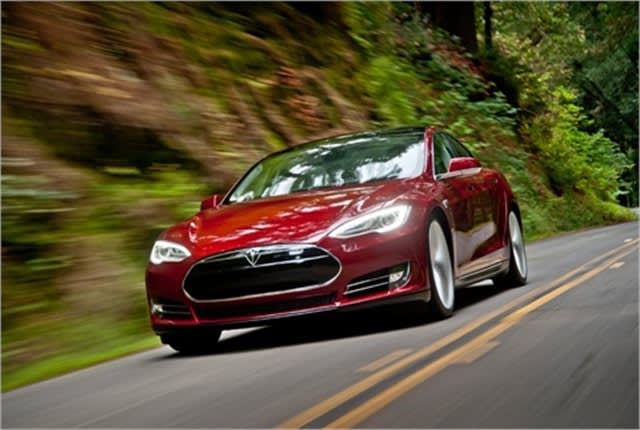
Tesla Model S Signature. Photo: Tesla Motors.
Tesla Motors Inc. is offering a software update for 29,222 2013 model-year Model S electric vehicles equipped with certain NEMA 14-50 (240 volt) Universal Mobile Connector (UMC) adapters.
During vehicle charging, the adapter, cord or wall outlet could overheat and pose a fire risk, the National Highway Traffic Safety Administration reported. Tesla will provide an over-the-air software update to remedy the problem. Additionally, Tesla will mail affected Model S owners a replacement NEMA 14-50 adapter that’s equipped with an internal thermal fuse.
Some vehicle owners have already received the software update, which allows the Model S onboard charging system to detect unexpected fluctuations in the input power or higher resistance connections to the vehicle. If these conditions are detected, the onboard charging system will automatically reduce the charging current by 25 percent.
“This fully addresses the issue by substantially reducing the heat generated in any high resistance connections outside the vehicle,” Tesla said in a released statement. “This update increases robustness and safety considerably in the unlikely event that a home wiring system, receptacle, adapter or cord is unable to meet its rated current capacity.”
To make sure they’ve received the updated software (version 5.8.4), Tesla Model S owners can check the vehicle’s center information screen.
Vehicle owners can reach Tesla at (877) 798-3752.
More Safety
Stellantis Recalls 1.3 Million Jeep Vehicles Worldwide Over Fire Risk
Stellantis is recalling more than 1.3 million Jeep Wrangler and Gladiator models worldwide over a fire risk linked to power steering pump wiring.
Read More →
Coaching Is Not Training, Even When AI Is Doing It
AI-powered safety platforms can detect risky behaviors and deliver immediate feedback. But effective driver development still requires a foundation of training followed by coaching that reinforces those skills.
Read More →
How Emotions Behind the Wheel Can Affect Fleet Safety
During National Safety Month, fleets are encouraged to look beyond distracted driving and recognize how stress, fatigue, and emotional well-being influence driver performance and crash risk.
Read More →
Nominations Open for 2026 Fleet Safety Award
Nominations have officially opened for the 2026 Fleet Safety Award Winner.
Read More →
Turning Connected Vehicle Data Into Decisions That Matter
Fleet leaders have more data than ever, but turning that data into clear, actionable decisions remains a challenge. This white paper shows how leading organizations are using connected vehicle data to improve safety, reduce costs, and optimize fleet performance. Learn how to turn insight into action across your fleet.
Read More →
Cameras, Safety and Insurance: From Reactive Claims to Real-time Prevention
Commercial auto remains one of the most challenging and costly lines of coverage for fleet operators and insurers alike. Learn more about how to effectively address these issues from Onur Aksan, Enterprise Business Development Executive, Geotab.
Read More →
NAFA Fleet Safety Symposium to Collocate With 2026 Fleet Forward Conference
The daylong certificate program will precede the Fleet Forward Conference at the Gaylord National Harbor in Maryland.
Read More →
The Distractions You Can’t Turn Off: What Drivers Face Outside the Vehicle
Fleet drivers face constant visual, cognitive, and environmental interruptions the moment they hit the road. From roadside chaos to mental fatigue and digital overload, today’s biggest driving risks often come from outside the vehicle itself.
Read More →
FLASH Weather AI Launches First Deep-Learning Hail Prediction Model With High-Resolution Forecasting
FLASH Weather AI has launched a first-of-its-kind hail prediction model capable of forecasting hail size and arrival time at 1-kilometer resolution up to 55 minutes ahead, giving fleets and insurers critical time to prepare for severe storms.
Read More →
How Coca-Cola United Protects Its Fleet from Growing Legal Risk
As litigation risk rises, vehicles are increasingly targeted. This Coca-Cola bottler shares how it’s reducing exposure through driver training, technology, and a proactive risk management approach.
Read More →