




Drowsy Driving on the Rise
A growing cause for concern, drowsy driving is a major safety threat. Fleet managers and drivers must recognize signs of fatigue or tiredness.


Fleet drivers are recommended to pull over, take a break or a power nap, if they have trouble focusing on the road. Photo via iStockphoto.com

Fleet drivers are recommended to pull over, take a break or a power nap, if they have trouble focusing on the road. Photo via iStockphoto.com
Drowsy driving is an increasing concern for today’s fleets, and can lead to drivers crashing and damaging a vehicle or worse, cause injuries to themselves and others. This safety concern now accounts for 100,000 automobile crashes per year, according to the National Highway Traffic Safety Administration (NHTSA).
In addition, drowsy drivers are involved in an estimated 21 percent of fatal crashes, according to a study by the AAA Foundation for Traffic Safety.
For that reason alone, it is important for fleet managers and drivers to know the signs, understand its cognitive effects, and apply safe driving habits to help eliminate driver drowsiness altogether.
Know the Signs
There are common signs of drowsiness that drivers should be taught to watch for: excessive yawning or rubbing of eyes, feeling restless, drifting from lane to lane or hitting a shoulder rumble strip, trouble focusing, and daydreaming.
But, there are also many signs that aren’t as apparent.
For instance, driving alone or on a long, rural road can make fleet drivers feel drowsy and lose their focus. And, driving for extended periods of time without a break can be just as hazardous.
Even the daylight saving time change can factor into drivers experiencing fatigue or drowsiness.
“Not planning properly for the end of daylight saving time can also contribute to drowsy drivers,” said Melissa Vega, manager of driver services at the Automobile Club of Southern California.
Moreover, those who work more than 60 hours a week need to be especially careful because they increase their risks of getting into an accident by 40 percent, according to research conducted by the National Sleep Foundation (NSF).
Fleet drivers, who are regulated under the Federal Motor Carrier Safety Administration (FMCSA)’s Hours of Service regulations, which are designed to combat drowsiness and fatigue, are limited to 11 hours of driving after having 10 consecutive hours off duty.
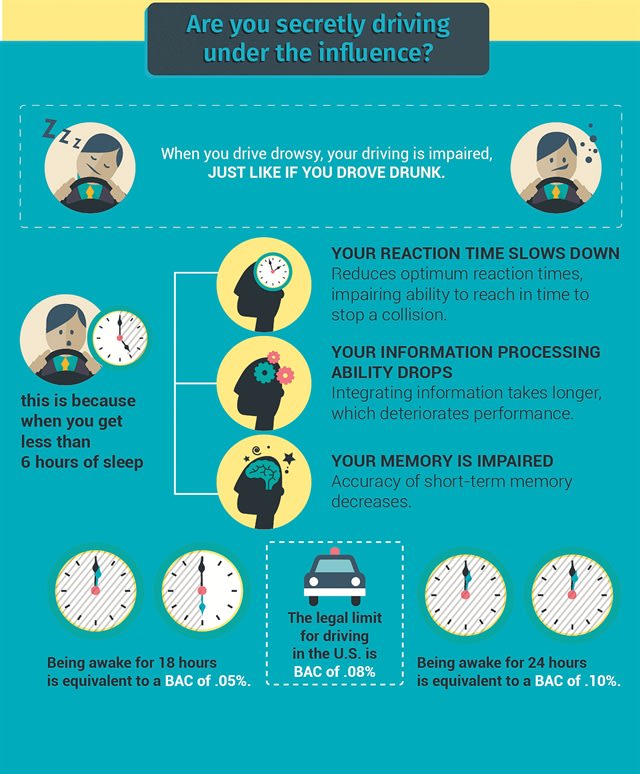
Drowsy driving is comparable to driving under the influence, the fleet driver’s reaction time and information processing ability is compromised. Photo via CJ Pony Parts
The Effects of Drowsiness
Not noticing distance traveled or daydreaming are prime examples of the cognitive impact drowsy driving has on a fleet driver.
A study by the Centers for Disease Control (CDC) found that driving while drowsy is comparable to driving under the influence. The effect of being awake for 18 hours straight is similar to that of someone with a blood alcohol content (BAC) of 0.05 percent.
As with driving while impaired by alcohol, drowsiness makes drivers less attentive, slows reaction time, and affects their ability to make decisions (see infographic).
“If a fleet driver begins to feel drowsy, they should take a break every two hours or about every 100 miles and that break should be about 20-30 minutes,” said Vega.
Fleet managers can help drivers get the right amount of sleep by providing educational materials and statistics on the dangers of drowsy driving.
Among the means they can do this is company newsletters, e-mails, and the fleet’s or company’s Facebook page.
More Safety
IIHS Crash Avoidance Tests Reveal Safety Gaps in Cargo Vans and Work Trucks
New crash-avoidance ratings from the Insurance Institute for Highway Safety reveal inconsistent performance among commercial vehicles, with several popular cargo vans and heavy-duty pickups struggling to avoid collisions with other vehicles and pedestrians.
Read More →
What’s Next for Fleet? Safety, AI & Industry Recognition | AF News Recap
Could your company's culture be encouraging distracted driving? This week, we're exploring how workplace expectations affect driver safety, what AI, EVs, and autonomous vehicles could mean for the future of fleet management, and how fleet professionals can strengthen their award nominations.
Read More →
Does Your Fleet's Culture Encourage Distracted Driving?
What happens when the people responsible for enforcing safety rules are the ones setting the wrong example? The answer may reveal why some of the biggest risks to fleet drivers have little to do with what's written in the employee handbook.
Read More →
Fleet Manager’s Ultimate Playbook: Navigating the New Standard in OEM Connectivity
Rising operating costs, driver safety concerns, and unplanned downtime are putting unprecedented pressure on modern fleets. Discover how fleet managers use embedded OEM connectivity and real-time vehicle data to cut TCO, prevent downtime, and protect drivers without aftermarket telematics hardware.
Read More →
From Driver Well-Being to EV Charging | AF News Recap
Mental health belongs in the fleet safety conversation. This week, we’re looking at five ways fleets can support employee well-being before a crisis, plus Holman’s expansion in Mexico, new one-day Fleet Forward passes, and why EV charging demand is outpacing infrastructure growth.
Read More →
Nexar-Nauto Merger Aims to Give Fleets Better Safety Intelligence Through Larger Driving Dataset
Stefan Heck tells Automotive Fleet that combining more than 10 billion miles of driving history with Nexar's AI models will give fleets deeper insights into driver risk and roadway conditions than either company could provide independently.
Read More →
Don't Wait for a Crisis: 5 Ways to Build Mental Health Into Your Fleet Safety Program
For Suicide Prevention Month, fleet and safety leaders have an opportunity to put mental health where it belongs: at the center of workplace safety.
Read More →
How Camera Data Can Strengthen a Fleet’s Insurance Renewal
Insights from a commercial insurance carrier and a broker show how fleets can turn video telematic data, driver coaching, and improved claims results into a stronger case at insurance renewal.
Read More →
The Safest Fleets Aren’t the Ones with the Most Technology
You’ve made the telematics investment. Here’s how to capture the other half of its value and build the safest fleet on the road.
Read More →
Hidden in Plain Sight: Fleet Compliance Risks
Fleet compliance isn't just about having policies — it's about consistently enforcing them. This practical guide reveals six hidden compliance risks common in public sector and shared fleet operations and outlines proven strategies to improve visibility, accountability, and audit readiness
Read More →