




Related: Vehicle Cost Analyzer Tool Launched
Fleet TCO Reaches 5-Year Low, Element Says
The total cost of ownership of fleet vehicles managed by Element Financial Corp. fell 14% in 2015 from the prior year and has reached a five-year low due to low fuel prices, the fleet management company has announced.
by Staff
May 17, 2016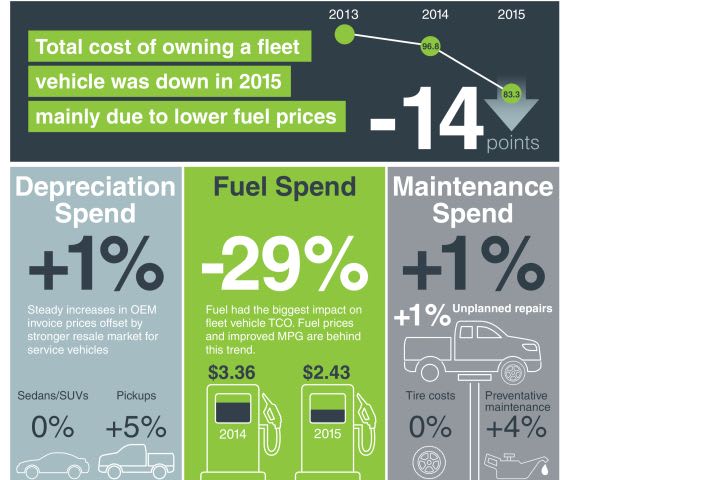
Infographic courtesy of Element.
2 min to read
Infographic courtesy of Element.
The total cost of ownership of fleet vehicles managed by Element Financial Corp. fell 14% in 2015 from the prior year and has reached a five-year low due to low fuel prices, the fleet management company has announced.
The findings came as part of Element's newly announced Element Total Cost of Ownership (TCO) Index, which will track TCO factors such as vehicle depreciation, fuel maintenance and interest expense. The annual index assigns 2013 a baseline score of 100 and rates future years. For 2015, the index was 83.3, according to Element.
"The Element Fleet TCO Index suggests that now may be a good time to replace vans and pickups while the resale market is still strong for those types of vehicles," said Bob Sandler, senior vice president of strategic consulting for Element Fleet Management. "Lower gas prices provide an opportunity for fleets to make replacement investments, increasing safety and fuel efficiency without a major year-over-year spike in expenses."
Element also noticed an increase in average fuel economy data from vehicles in the data, indicating that fleets have been adding higher-mpg vehicles.
Element noted three factors it considered in its TCO analysis, including average fuel costs, depreciation, and monthly maintenance expenses.
Average U.S. fuel costs fell 29%, because the price of fuel fell to $2.43 per gallon in 2015 compared to $3.36 the previous year and improvements in vehicle miles per gallon.
Depreciation costs rose 1% due to a higher average initial cost of vehicles and offset by continued strength in the resale market for vans and pickups.
And lastly, a 1% rise in average monthly maintenance costs resulted from a 1% increase in unscheduled repairs and 4% increase in preventative maintenance expenses. Tire costs remained static.
The index includes five vehicle categories including pickup trucks, cargo vans, sedans, SUVs, and minivans. Element sourced the data from all of its operations, including recent acquisitions.
More Operations

Moventum Fleet Management Names Mark Iorillo Head of Sales
Iorillo brings nearly 20 years of fleet management and sales experience to the role, including previous positions at Element Fleet Management, CEI, Donlen and Ryder.
Read More →
Fleet Has a Talent Pipeline Problem. What Comes Next? | AF News Recap
Where will fleet’s next generation of leaders come from? This week, we’re looking at the industry’s talent pipeline, what certification can add to a fleet career, how to build an award-worthy track record, and the return of Automotive Fleet’s Personal Use Survey.
Read More →
Smith System Launches Driver Risk Management Program
Fleets have more driver data than ever, but identifying risky behavior doesn't necessarily correct it. Smith System's new Driver Risk Management program combines monitoring, training, and follow-up coaching to help fleets connect risk signals with driver intervention.
Read More →
Automotive Fleet Opens 2026 Personal Use Survey for Commercial Fleet Managers
Less than two weeks left! Commercial and corporate fleet managers are invited to share how their organizations handle company vehicle personal-use policies, charges, and driver eligibility.
Read More →
From AI Prompts to AI-Generated Safety Songs | AF News Recap
Can better prompts make AI more useful for fleet managers? This week, we’re breaking down smarter fleet analysis, an AI-assisted experiment that turned safety training into music, and what happened to fuel prices in August.
Read More →
How to Write Better AI Prompts for Fleet Analysis
Include these six elements in your fleet prompts to generate more relevant analysis and accurate answers.
Read More →
Fleet Meets: Eric Kilgore
This edition of the Fleet Meets series features one of the industry's best leaders driving multi-market and national operations.
Read More →
Why Reactive Fleet Management Is Becoming Too Expensive to Sustain
Research highlights a growing need for proactive management strategies to address rising costs in fleet operations effectively.
Read More →
Sponsored•August 12, 2026
What Your Fleet KPIs Aren’t Telling You
Tracking fleet metrics is only useful when the data leads to better decisions. This guide helps fleet leaders assess cost, utilization, and downtime more accurately, identify performance gaps, and prioritize the actions that can improve operational results.
Read More →
Sponsored•August 7, 2026
Hidden in Plain Sight: Fleet Compliance Risks
Fleet compliance isn't just about having policies — it's about consistently enforcing them. This practical guide reveals six hidden compliance risks common in public sector and shared fleet operations and outlines proven strategies to improve visibility, accountability, and audit readiness
Read More →