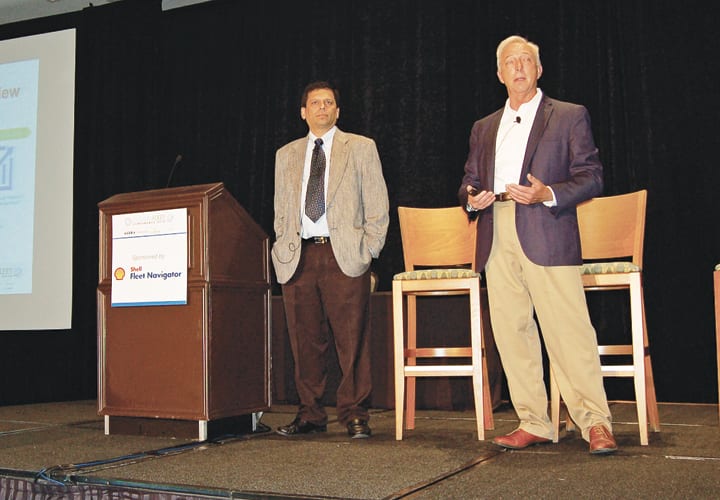
Ford’s Shounak Athavale (left), IT Manager/Experimental Lead for Fleet Insights, and Chris Miotke, practice principal in the Americas for HP, present the findings of the Fleet Insights experiment during the Global Fleet Conference in Miami. Photo courtesy of Ford.
6 min to read
Ford’s Shounak Athavale (left), IT Manager/Experimental Lead for Fleet Insights, and Chris Miotke, practice principal in the Americas for HP, present the findings of the Fleet Insights experiment during the Global Fleet Conference in Miami. Photo courtesy of Ford.
During the 2015 Global Fleet Conference held in Miami June 15-16, attendees were briefed on the preliminary results of an experiment conducted by Ford Motor Company and Hewlett Packard (HP) that could have wide-ranging and long-term implications for both fleets and consumers alike.
Ad Loading...
The experiment, Fleet Insights, is one of 25 studies the automaker has conducted or is currently conducting throughout the world to examine the future of mobility.
Ad Loading...
The purpose of the Fleet Insights project was to track the driving habits of 100 fleet vehicles used nationwide by HP employees for work and personal commuting. The goal of the project was to shed light on the purpose behind these trips and how drivers interacted with external factors, such as weather and traffic, and how to further personalize the drivers’ experience behind the wheel.
Getting the Timing Right
The experiment commenced at the end of 2014 and continued into 2015.
Ford’s Shounak Athavale, IT Manager/Experimental Lead for Fleet Insights, noted that Ford had already conducted a similar experiment with its own executive fleet, but the opportunity to partner with HP, which has a nationally dispersed fleet, provided the kind of diversity that would give better insights on vehicle use.
For its part, HP was eager to take part in leveraging some of its recently acquired data analytics platforms.
“The motivation for us getting involved came out of an executive briefing, during which my senior vice president said, ‘We have the ability to do experiments with this on our data discovery platform where we’ve got a cloud-based environment with all of the right analytic tools, got the data scientists, and we want to grow the use cases, so we can expand our experience,’ ” explained Chris Miotke, practice principal in the Americas for HP. “So, it became a, ‘let’s do it together, let’s make the agreement.’ ”
Ad Loading...
The companies shared the cost of the experiment with HP recruiting 100 of its fleet drivers. Ford paid for and installed the third-party plug-in device (PID) used to capture the data. Data from these PIDs were transmitted and analyzed to primarily discover if the fleet’s vehicles were being fully utilized, the ways in which fuel spend could be minimized, and any unexpected data/findings that were uncovered by tracking the vehicles.
Initially, data was collected once every minute and this was increased to once every second starting in January 2015, according to Athavale. It is this more frequently captured data that is being measured for the experiment, which was collected until late in the year. All of the vehicles used in the experiment were Ford products — Fusion, Focus, and Escape models in particular.
HP allows personal use, though only the employee is allowed to drive the vehicle. While all the drivers were fully aware that their data was being tracked, it was completely anonymized for the purposes of the experiment, which helped with getting volunteers and, could eventually be a key element in the global adoption of similar data analytics products for both fleet and consumer vehicles.
“For this experiment, we don’t know where someone lives; we don’t have their home address. We just know an area because of the GPS on the car and as we deal with other countries and look at the privacy issues, the issue becomes the accuracy in how you report the data,” Miotke said. “You can ‘cloud’ the accuracy of the information, so I’m not going to report where ‘Bob’s’ house is within feet, I can do it within five miles. Once we take something like this to the next step and it’s in production, we never see the data generally, we’re just letting the system run it and the customer’s looking at the data.”
While there were a few trepidations in the early phase of the experiment, the drivers generally “forgot” they were being monitored.
Ad Loading...
Drivers taking part in the experiment were able to monitor their individual driving data with a mobile app.
Measuring the Results
While the initial results have been instructive, Miotke noted that vehicles as part of the “Internet of Things” pose some challenges, particularly when analyzing data for significant trends.
Findings About HP Drivers
70% of trips on weekday; 75% of trips under 13 miles; 80% of trips between 7 a.m. and 5 p.m.
5% of trips have 100% engine idle time (engine warm up?).
300 trips are round trip routes (pickup/drop off trips?).
Most visited restaurants: McDonald's, Starbucks, and Burger King.
Most used gas station: Shell.
Breakdown of trip by classified type: 37% home and frequently visited location; 6% fuel; 5% shopping; 4% food; 14% others (excludes unclassified destination/purpose).
“The challenge we have with looking at a vehicle as an extension of the Internet of Things is that a lot of our data is going to be recurring or not changing or not what we want to see,” Miotke explained. “When you’re looking for anomalies, most sensor data is redundant, it’s going fine and fine and fine and then oops, and fine, oops and fine, oops. Now, I want to know that right away, so then it becomes not only the ability and connection to the vehicle itself, but how quickly can I get it and how quickly can I analyze it?”
One of the challenges of doing this effectively has to do with the nature of the automobile itself.
“I think the challenge we’re going to have as we go into more and more of this for a vehicle of any type is how quickly do we get the information? There’s an awful lot of people like Boeing and GE who can do it on aircraft engines, because they’ve got the ability and they’ve got the space to put those kinds of computers,” Miotke said. “Cars don’t have that kind of extra room or it may not be cost effective to put them on.”
Ad Loading...
While there may be some challenges in the future, the initial experiment did capture the kind of data that researchers set out to obtain, plus a few surprises.
Athavale and Miotke discovered that 70 percent of vehicle trips were made during weekdays, with 75 percent of those being under 13 miles, and 80 percent of those trips (perhaps not unsurprisingly) were made between 7 a.m. and 5 p.m. They also discovered that just 5 percent of the trips were responsible for 100 percent of engine idle time, which they hypothesized could have been due to drivers warming up their vehicles. Of the trips classified by destination type, home and frequently visited locations were the most common at 37 percent.
Looking Ahead
As with any experiment, Fleet Insights will likely not end when this first phase is completed.
“Moving forward, we have to figure out what’s in the best interest for both companies. Here, HP is both a customer and a partner so Ford would actually look at it and see what would help HP’s fleet, what would make sense, and that’s the process we’re in,” Athavale said. “So, if you use the design thinking process, you go with divergent thinking first and then converge, right, so it’s not that we don’t have an agreement because we disagree, we don’t have an agreement because we’re in that divergent phase right now.”
While the companies are still talking over the next phase of the experiment, Miotke has some clear directions he hopes it goes in.
Ad Loading...
“For me, the goal would be to demonstrate for our fleet manager and to Ford management, to say, we could do something as to take it further, right? So, as a practice principle, I have a goal of building business, so for me, this looks like an opportunity, maybe to expand our business,” he said.
Ultimately, Athavale sees larger implications for Fleet Insights.
“Whatever features and services that will come out of it, whatever learnings will be shared with the commercial part of the company,” Athavale said. “We didn’t start this experiment saying, ‘At the end of this experiment, we’re going to commercialize whatever comes out of it.’ We started this experiment with the notion, how can we make human progress, how can we make some things that customers want? And, so it was one way to look at how these employee fleets are actually used and they’re the proxy for how our customers in real life are going to be working.”
Where will fleet’s next generation of leaders come from? This week, we’re looking at the industry’s talent pipeline, what certification can add to a fleet career, how to build an award-worthy track record, and the return of Automotive Fleet’s Personal Use Survey.
Fleets have more driver data than ever, but identifying risky behavior doesn't necessarily correct it. Smith System's new Driver Risk Management program combines monitoring, training, and follow-up coaching to help fleets connect risk signals with driver intervention.
Less than two weeks left! Commercial and corporate fleet managers are invited to share how their organizations handle company vehicle personal-use policies, charges, and driver eligibility.
Can better prompts make AI more useful for fleet managers? This week, we’re breaking down smarter fleet analysis, an AI-assisted experiment that turned safety training into music, and what happened to fuel prices in August.
Tracking fleet metrics is only useful when the data leads to better decisions. This guide helps fleet leaders assess cost, utilization, and downtime more accurately, identify performance gaps, and prioritize the actions that can improve operational results.
Fleet compliance isn't just about having policies — it's about consistently enforcing them. This practical guide reveals six hidden compliance risks common in public sector and shared fleet operations and outlines proven strategies to improve visibility, accountability, and audit readiness