With the upswing in the economy, times are good for the car hauler industry. But, the 2008-2010 recession left the industry with significant challenges that need to be overcome.
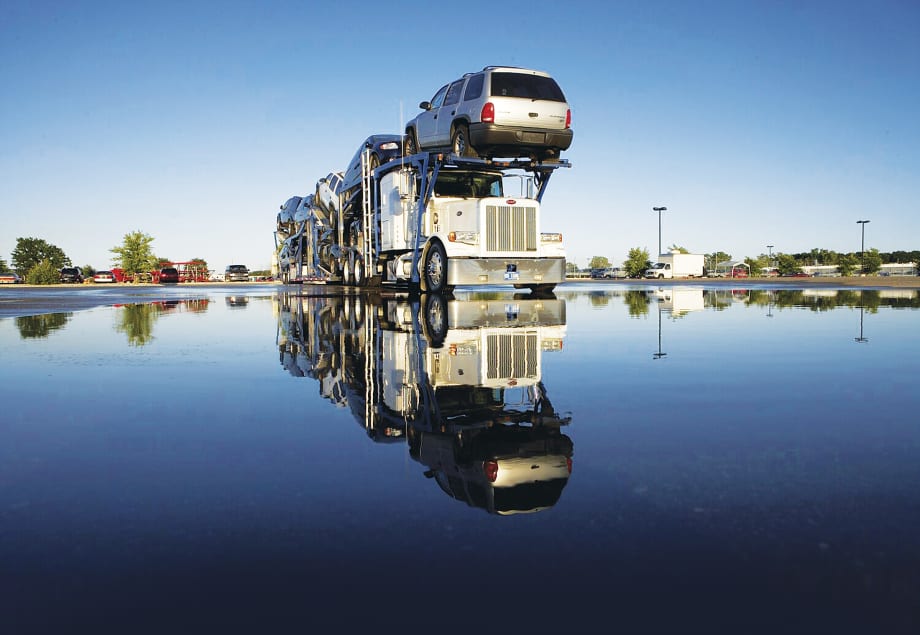
With the upswing in the economy, times are good for the car hauler industry. But, the 2008-2010 recession left the industry with significant challenges that need to be overcome. Photo courtesy of United Road.
7 min to read
With the upswing in the economy, times are good for the car hauler industry. But, the 2008-2010 recession left the industry with significant challenges that need to be overcome. Photo courtesy of United Road.
The automotive industry is on track for its fifth consecutive growth year. This comes as sort of a mixed blessing for the car hauler industry.
Ad Loading...
Business is booming, but the industry is still reeling from the aftereffects of the 2008-2010 recession, which has resulted in capacity issues. Other factors, such as increased federal regulations, have also added operational challenges for automotive transportation companies.
Ad Loading...
Recovering from the Recession
There were a number of challenges that came out of the recession, not least of which was a strong resurgence of the automotive industry.
At A Glance
The car hauler industry is solving the challenges created because of the 2008-2010 recession by:
Looking for ways to better recruit and retain drivers.
Finding creative ways to increase capacity.
Turning to technology, including telematics, to improve efficiencies.
“For only the second time in history, new-vehicle sales rose for the fifth straight year to 16.5 million units,” said Kathleen McCann, CEO of United Road. “The estimates for the next several years range from 17 million to 20 million units. Used vehicles sales approximated 42 million last year. Combined we were just short of the all-time high of 59 million units reached in 2000.”
This is at a time when the automotive industry is still dealing with the aftereffects of the recession, which includes less rail capacity, the elimination of numerous smaller players from the market — due in part to the recession’s capital crunch and new regulations — and the ongoing driver shortage.
“Some of the numbers I’ve heard quoted are that there’s a 30,000 driver shortage in the U.S. today and it’s going to go up to something like 150,000 CDL drivers in the next few years,” observed John Norris, president of AmeriFleet.
But, there are other challenges, such as increased demand for complex services, which require more expertise on the logistical and service sides of the business. Coupled with that is an increased demand for service.
Ad Loading...
A necessity to invest in technology to handle these increased customer demands has posed some challenges.
“Vehicle transport companies must invest in the newest technology and in a professional workforce,” said Lori Rasmussen, president of PARS. “The ability to provide greater access to — and control over —information about vehicle assets adds value in terms of both immediate decision-making and long-term analysis.”
Addressing the Driver Shortage
McCann noted that, unlike the rail industry, which has been constrained by the number of rail cars it can produce, there are more than enough trucks available to transport the millions of vehicles changing hands today.
Capacity is being constrained by the significant shortage of skilled, licensed car haulers.
“A big part of the shortage is because of onerous regulations, and because young people don’t look at driving as a significant opportunity,” said Norris of AmeriFleet.
Ad Loading...
McCann agreed that regulations have been a driving force, particularly in the “layering” effect they have had.
“No one is suggesting that drivers and equipment should be free of regulation. Many of our industry regulations are critical to safe operations on our roadways. We just need to be thoughtful about the amount and type of regulation and whether it is really improving safety,” she said. “The layering on of regulation upon regulation — often from uncoordinated and differing regulatory bodies — can cause drivers to leave the industry and make it difficult to attract new talent. This will likely exacerbate the already strained capacity situation.”
Rasmussen of PARS noted another challenge facing car hauler companies: finding drivers with a very particular set of skills.
“Vehicle transport companies rely on experienced drivers who reflect a high level of professionalism and know how to provide a degree of diplomacy in exceptional circumstances,” Rasmussen said. “PARS continues to explore new channels for finding and identifying the best drivers out there.”
McCann of United Road echoed Rasmussen’s comments. “Car haulers are skilled craftsman — they are agile climbers, car-lovers, comfortable with technology, customer service agents, have great geo-spatial skills, and can expertly navigate 80,000 pounds while caring for valuable cargo. They’re also some of the best salt of the earth human beings you would ever want to know,” she said. “As an industry, we need to do a better job of communicating that car hauling is an interesting and rewarding career, with excellent pay and benefits. You can provide well for your family while performing professional, exciting work.”
Ad Loading...
Norris of AmeriFleet noted the key is not only recruiting drivers, but holding onto them.
“We need to recruit and attract, but just as important, we need to retain,” he said. “And, one drives the other. If you retain well, you get more referrals into your system. Clearly, you have to pay commensurate to the market, and provide other opportunities. The reality is people leave not because of pay. People leave because they don’t feel engaged; they don’t feel supported. What we’re doing once a driver makes the decision to join us, is take time to identify and address their issues on the road and to make their job easier and engage them more efficiently and effectively.”
Finding Ways to Increase Capacity
McCann of United Road said that she and other industry leaders have been working with federal lawmakers to improve capacity at the vehicle level.
If successful, this would give car hauler companies a variance to increase the weight they could transport on a single car hauler by about 10 percent or one additional automobile.
“Over the last several years, diesel emission regulations and the shift in OEM vehicle securement requirements have combined to reduce the load factors,” McCann explained. In the first instance, adding the diesel emissions components have increased the length and weight of the tractors, essentially limiting space for the trailer.”
Ad Loading...
The way a vehicle is secured on the hauler can also effect capacity, according to McCann.
“When the OEM requires that a vehicle is strapped around the tires as opposed to chaining down the suspension, the vehicle is free to move on that suspension. This natural bounce has to be accommodated by leaving more room between the decks to avoid damage. When you’re looking at the configuration of a load of cars or light trucks on our car haulers, inches matter. So, essentially those two things have combined to create the loss of the portion of a vehicle on the average car hauler, and we all know that you can’t move half a car or three-quarters of a car,” she explained.
In addition to the added weight, McCann said that the vehicles loaded on car haulers would also be allowed to overhang on the front and back of the truck. Both the overall weight increase and overhangs would be eliminated with a driver’s first drop off, according to McCann.
The upshot would be to regain hauling capacity of about 10 percent.
Measuring the Effects of Technology
It may be unsurprising, but technology may be among the biggest silver linings for the automotive transportation industry.
Ad Loading...
Norris of AmeriFleet said his company is rolling out a new electronic condition report that will eliminate time-consuming paper forms and make the drivers more efficient and simplify their jobs. AmeriFleet is also adding a number of driver support positions to help drivers handle situations as they occur on the road.
Rasmussen of PARS sees GPS and telematics as an important part of solving some of the industry’s ongoing challenges.
“While the ability to provide real-time information is critical for achieving maximum savings and avoiding unpleasant surprises, technology has changed the industry in many other ways,” she said. “Secure and reliable cloud-based IT capabilities — accessible through any Web-connected device — make information instantly available to multiple parties virtually anywhere in the field.”
But, it continues on from there, according to Rasmussen.
“Expanded mobile access for initiating transactions and updating vehicle status in real time offers greater opportunities for your transport company to improve customer service and communication,” she said. “Finally, effective data collection and appropriate use of predictive analytics are keys to leveraging historical data, drawing meaningful conclusions, and turning that data into actionable information.”
Ad Loading...
McCann of United Road sees technology affecting the industry at every level.
“Technology is impacting every part of our business from how the trucks and trailers are built to how we interact with our customers and their customers to the visibility of where vehicles are in the supply chain at any point in time to communication with our drivers,” she said. “The entire process today from order to fulfillment can be done and is often done without any human intervention whatsoever. We should expect and drive toward more of that behavior because it will pull significant waste out.”
Where will fleet’s next generation of leaders come from? This week, we’re looking at the industry’s talent pipeline, what certification can add to a fleet career, how to build an award-worthy track record, and the return of Automotive Fleet’s Personal Use Survey.
Fleets have more driver data than ever, but identifying risky behavior doesn't necessarily correct it. Smith System's new Driver Risk Management program combines monitoring, training, and follow-up coaching to help fleets connect risk signals with driver intervention.
Less than two weeks left! Commercial and corporate fleet managers are invited to share how their organizations handle company vehicle personal-use policies, charges, and driver eligibility.
Can better prompts make AI more useful for fleet managers? This week, we’re breaking down smarter fleet analysis, an AI-assisted experiment that turned safety training into music, and what happened to fuel prices in August.
Tracking fleet metrics is only useful when the data leads to better decisions. This guide helps fleet leaders assess cost, utilization, and downtime more accurately, identify performance gaps, and prioritize the actions that can improve operational results.
Fleet compliance isn't just about having policies — it's about consistently enforcing them. This practical guide reveals six hidden compliance risks common in public sector and shared fleet operations and outlines proven strategies to improve visibility, accountability, and audit readiness