




Safety Goes Virtual at UPS
To create a simulated environment, UPS turned to Virtual Driver Interactive (VDI). The resulting portable system gives UPS drivers the ability to virtually learn how to handle highly volatile and dangerous driving situations.

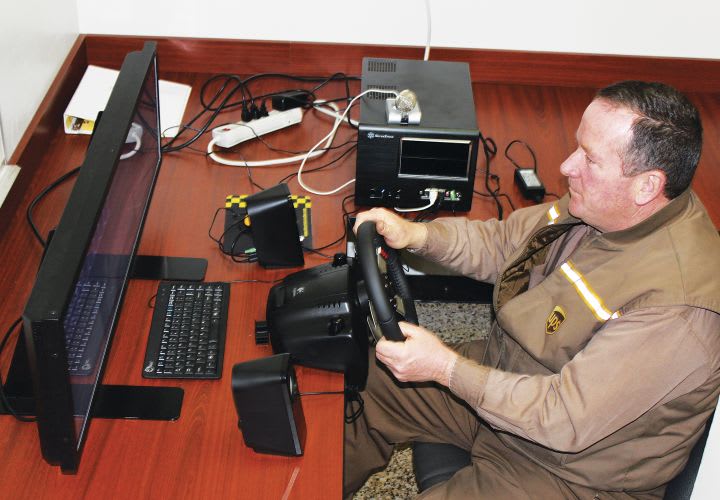
Photo courtesy of UPS.
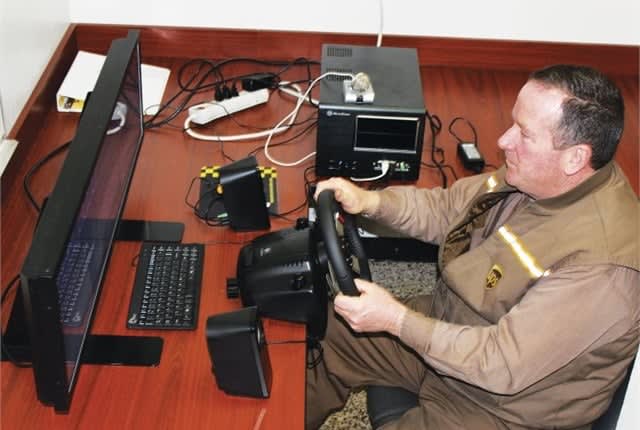
Photo courtesy of UPS.
With more than 7,200 employees honored in 2014 for having more than 25 years on the road without a crash, safety is at the core of UPS's fleet.
When hired, drivers are put through a rigorous training program of in-class instruction and behind-the-wheel coaching; however, some situations are difficult to cover using traditional training methods.
"We know inclement weather and other variables are hard to duplicate when you're out on the road, so we decided to replicate them in an off-road, non-business environment through a simulator," said Emilio Lopez, global fleet safety director for UPS.
To create this simulation environment, UPS turned to Virtual Driver Interactive (VDI), a company UPS has worked with since 2006. The resulting portable system gives UPS drivers the ability to virtually learn how to handle highly volatile and dangerous driving situations.
"UPS' first requirement was to develop something in which the driver didn't have to take their hands off the wheel to take the course," said Bob Davis CEO and president of Virtual Driver Interactive.
While the VDI simulator was built using a graphical gaming engine, that's where the similarity between it and a video game ends.
"When you first sit down at the system there's that video game allure, but you're quickly brought into the reality of why you're sitting in front of that virtual screen," said Jeff Watson, UPS's package division manager in Long Island City, N.Y.
Drivers are taking the training as seriously as if they were actually in the cab of one of the iconic brown UPS trucks, according to Kevin Gates, UPS North Atlantic District health and safety manager.
"I've personally seen an intensified concentration on someone when they're going through a module," he said.
The training is broken down into bite-sized chunks with each module focusing on a particular safety issue. Going through the entire virtual program takes about an hour, limiting driver downtime.
While ensuring drivers are able to handle a vehicle in dynamic conditions may be a key takeaway, Davis of VDI said there's something even more fundamental to the virtual learning experience.
"When teaching fleet drivers, it's all about the decisions you make. It's less about the car handling," he said. "No simulator is going to replace the driver's knowledge of being in the actual truck."
The simulators are currently being piloted primarily in two locations: metropolitan New York City and Texas.
As of press time, about 320 new and veteran drivers have used the simulator to supplement classroom and in-cab training and refreshers. The virtual training has been a big success.
"Since July 2013 when we implemented the simulator in our facility, we've seen a 38-percent reduction in crashes," said Rodney Ruff, division manager for UPS' Foster Avenue Building in Brooklyn, N.Y. "And, so far this year, we are trending well below last year's numbers."
More Safety

Does Your Fleet's Culture Encourage Distracted Driving?
What happens when the people responsible for enforcing safety rules are the ones setting the wrong example? The answer may reveal why some of the biggest risks to fleet drivers have little to do with what's written in the employee handbook.
Read More →
Fleet Manager’s Ultimate Playbook: Navigating the New Standard in OEM Connectivity
Rising operating costs, driver safety concerns, and unplanned downtime are putting unprecedented pressure on modern fleets. Discover how fleet managers use embedded OEM connectivity and real-time vehicle data to cut TCO, prevent downtime, and protect drivers without aftermarket telematics hardware.
Read More →
From Driver Well-Being to EV Charging | AF News Recap
Mental health belongs in the fleet safety conversation. This week, we’re looking at five ways fleets can support employee well-being before a crisis, plus Holman’s expansion in Mexico, new one-day Fleet Forward passes, and why EV charging demand is outpacing infrastructure growth.
Read More →
Nexar-Nauto Merger Aims to Give Fleets Better Safety Intelligence Through Larger Driving Dataset
Stefan Heck tells Automotive Fleet that combining more than 10 billion miles of driving history with Nexar's AI models will give fleets deeper insights into driver risk and roadway conditions than either company could provide independently.
Read More →
Don't Wait for a Crisis: 5 Ways to Build Mental Health Into Your Fleet Safety Program
For Suicide Prevention Month, fleet and safety leaders have an opportunity to put mental health where it belongs: at the center of workplace safety.
Read More →
How Camera Data Can Strengthen a Fleet’s Insurance Renewal
Insights from a commercial insurance carrier and a broker show how fleets can turn video telematic data, driver coaching, and improved claims results into a stronger case at insurance renewal.
Read More →
The Safest Fleets Aren’t the Ones with the Most Technology
You’ve made the telematics investment. Here’s how to capture the other half of its value and build the safest fleet on the road.
Read More →
Hidden in Plain Sight: Fleet Compliance Risks
Fleet compliance isn't just about having policies — it's about consistently enforcing them. This practical guide reveals six hidden compliance risks common in public sector and shared fleet operations and outlines proven strategies to improve visibility, accountability, and audit readiness
Read More →
NETS Sets 2026 Fleet Safety Benchmark Conference for Indianapolis
The Sept. 15–17 program will feature fleet benchmarking data, case studies, emerging technologies, and implementation strategies while running alongside the NSC Safety Congress & Expo.
Read More →
Off-the-Job Crashes Account for 43% of Employers’ $61.7 Billion Crash Burden
NETS quantifies costs dispersed across fleet, risk, HR, and other departments while providing new per-crash benchmarks for employers.
Read More →