




Volvo Targets Fuel Economy With Next-Gen Powertrains
The automaker's smaller, more intelligent Drive-E engines are designed to deliver lower emissions without compromising performance.

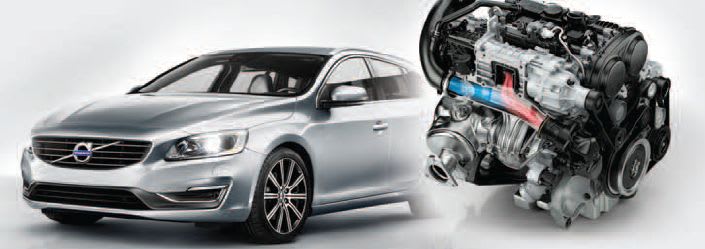
Volvo's new two-liter, four-cylinder engines in the Drive-E powertrain family will be launched in the U.S. in 2015-model year vehicles, including the S60 sedan (pictured), XC60 luxury SUV and V60 wagon.
Volvo is rolling out its four-cylinder Drive-E engines in 2015 model-year vehicles including the S60 sedan, XC60 luxury SUV and V60 wagon in a seismic shift away from five- and six-cylinder engines. The new Drive-E powertrains have been designed to maximize efficiency and provide drivability and performance, according to Volvo.
Developed in-house in Sweden, the new engines came out of an $11-billion multiple-year investment that sets up Volvo to offer hybrid and plug-in hybrid vehicles in future model years.
The Drive-E engines arrive as smaller and lighter weight while delivering considerably lower emissions and higher fuel economy savings ranging from 13 to 26 percent depending on the comparison, according to Volvo.
Though EPA fuel economy numbers will be available in early 2014, the automaker estimates preliminary combined fuel economy for the 2015 Volvo S60 to be 30 miles per gallon.
“Our new family of Drive-E engines optimizes power and efficiency in a no-compromise driving experience,” says North Holbrook, Volvo’s North American manager of commercial sales, “and we deliver these innovative engines in cars that continue to affirm Volvo’s safety leadership. What’s more, Drive-E engines offer the opportunity to be augmented with electrification for even greater benefit.”
The first Drive-E powertrains will arrive shortly after January’s 2014 Detroit Auto Show.
ENGINE SPECIFICS
Two Drive-E engines — a common-rail diesel and a direct-injected gasoline version — replace eight engine architectures on three platforms.
Volvo will offer two 2.0-liter, four-cylinder gasoline Drive-E engines in the U.S. — a 240-horsepower version and a 302-horsepower version. The 240-hp version offers 258 lbs.-ft. of torque, while the 302-hp version offers 295 lbs.-ft. of torque. The 240-hp engine is supercharged, while the 302-hp version is supercharged and turbo-charged.
The Drive-E powertrains arrive with features including friction reduction, start-stop brake regeneration and eight-speed gearbox.
Friction-reduction measures have been added throughout the engine, including ball bearings on the camshaft, high-speed continuous variable valve timing and heat management via a fully variable electric water pump.
All Drive-E engines feature Volvo’s stop-start and brake regeneration. This technology uses brake pressure measurement to trigger when to stop and start an engine.
The system is programmed to shut down the engine immediately when the car reaches a standstill. An electric pump keeps oil pressure up in the automatic gearbox while the engine is stopped. The system also includes an improved engine starter.
An eight-speed automatic gearbox has been designed to improve fuel economy and deliver a responsive drive from the vehicle. The gearbox has been tuned for smoother gearing.
“Think of it like having more gears on a bicycle,” said Derek Crabb, Volvo’s vice president of powertrain engineering. “You get more chance to operate it efficiently depending on the road conditions. With our new gearbox you get a bigger ratio spread. In essence, it gives you a better chance of getting good fuel economy from the engine.”
The Drive-E engines have also been engineered for future development of hybrid and plug-in hybrid vehicles by Volvo. Components such as an integrated starter generator can be easily connected, and the compact size of the engine allows an electric motor to be fitted in the front or rear of the vehicle. The battery pack would be located in the center of the car.
“A four-cylinder, transversely mounted engine is a way of building up for an electrified future,” said Crabb. “Hybrids are definitely going to be a dominant part of the top end of our range.”
Volvo is taking orders today for first quarter 2014 delivery of 2015 model-year vehicles.
Originally posted on Work Truck Online
More Operations

Fleet Has a Talent Pipeline Problem. What Comes Next? | AF News Recap
Where will fleet’s next generation of leaders come from? This week, we’re looking at the industry’s talent pipeline, what certification can add to a fleet career, how to build an award-worthy track record, and the return of Automotive Fleet’s Personal Use Survey.
Read More →
Smith System Launches Driver Risk Management Program
Fleets have more driver data than ever, but identifying risky behavior doesn't necessarily correct it. Smith System's new Driver Risk Management program combines monitoring, training, and follow-up coaching to help fleets connect risk signals with driver intervention.
Read More →
Automotive Fleet Opens 2026 Personal Use Survey for Commercial Fleet Managers
Less than two weeks left! Commercial and corporate fleet managers are invited to share how their organizations handle company vehicle personal-use policies, charges, and driver eligibility.
Read More →
From AI Prompts to AI-Generated Safety Songs | AF News Recap
Can better prompts make AI more useful for fleet managers? This week, we’re breaking down smarter fleet analysis, an AI-assisted experiment that turned safety training into music, and what happened to fuel prices in August.
Read More →
How to Write Better AI Prompts for Fleet Analysis
Include these six elements in your fleet prompts to generate more relevant analysis and accurate answers.
Read More →
Fleet Meets: Eric Kilgore
This edition of the Fleet Meets series features one of the industry's best leaders driving multi-market and national operations.
Read More →
Why Reactive Fleet Management Is Becoming Too Expensive to Sustain
Research highlights a growing need for proactive management strategies to address rising costs in fleet operations effectively.
Read More →
What Your Fleet KPIs Aren’t Telling You
Tracking fleet metrics is only useful when the data leads to better decisions. This guide helps fleet leaders assess cost, utilization, and downtime more accurately, identify performance gaps, and prioritize the actions that can improve operational results.
Read More →
Hidden in Plain Sight: Fleet Compliance Risks
Fleet compliance isn't just about having policies — it's about consistently enforcing them. This practical guide reveals six hidden compliance risks common in public sector and shared fleet operations and outlines proven strategies to improve visibility, accountability, and audit readiness
Read More →
Turning Fleet Payment Data into Executive Insights
Does data alone drive results in operations?
Read More →