




Distracted Driving Causes Nearly 40% of Accidents
Two studies show driver distraction due to technology is still a key factor in accidents, although most respondents claim use only in stopped traffic. Regulations and media attention have resulted in reduced technology use while driving.
Click here for a PDF of the full article, including charts.
As distracted driving laws rise in an increasing number of states, fleet managers should look to the habits of their own drivers. By studying statistics and information about driver tendencies, fleet managers can create stronger policies to reduce distracted driving liability.
In 2010, Nationwide Mutual Insurance Company conducted two studies on distracted driving. The data was collected via Computer Assisted Telephone Interviewing (CATI) from sample sizes of about 1,000 drivers. Interviewers adhered to quotas to ensure an accurate representation of male and female adult respondents in each regional sample.
The results were tabulated to replicate actual population distribution by age, gender, education, ethnicity, household size, number of telephone lines, and region, according to the March 2007 U.S. Current Population Survey.
Four in 10 Accidents a Result of Technological Distraction
According to the Nationwide study conducted in July, about four in 10 respondents (38 percent) claim to have been hit or nearly hit as a result of other drivers being distracted by cell phones or other technology. Of respondents claiming to have been hit or nearly hit, a larger percentage were 55 and older. In addition, higher numbers were reported in the South and West than in the East and Midwest.
Claimed Use Rates While Driving are Low
Claimed use rates of cell phone technologies for the majority of people who have access to them are rather low.
When asked about their usage of specific technologies on cell phones while driving, 32 percent of respondents said they used GPS, 21 percent sent text messages, 18 percent received e-mail, and 10 percent sent an e-mail.
An earlier study in May conducted for Nationwide Insurance found that while people have seen fellow drivers texting behind the wheel, eight in 10 drivers claim to have never texted while driving. In fact, less than a handful appear to be avid texters. Ninety-four percent of respondents said they rarely or never texted on a cell phone while driving. This number was characteristically highest among older drivers, with those age 55 and older at 97 percent. In contrast, 53 percent of those under 35 claimed they had never texted while driving.
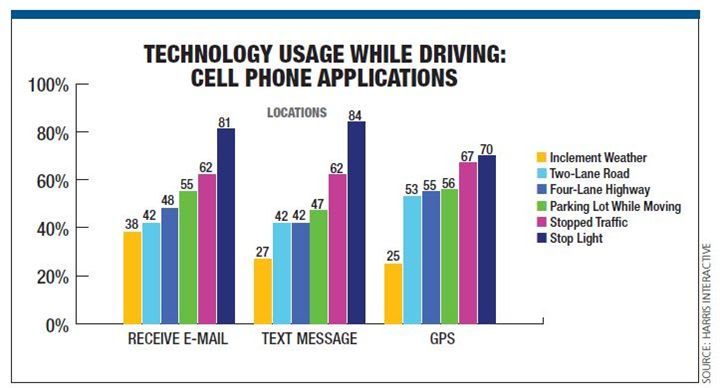
Of those respondents who have access to the top three most widely used cell phone technologies (e-mail, text, and GPS), most claim to use them while the vehicle was not moving, either at stop lights or in stopped traffic.
However, the percentage of respondents who used these cell phone technologies while moving was still disturbingly high. Overall, about half of respondents admitted to using these technologies on a four-lane highway, while a slightly smaller, although comparable, percentage admitted to using them on a two-lane road.
According to the survey, technology use was lowest while driving in inclement weather. Thirty-eight percent admitted to receiving e-mail, 27 percent to text messaging, and 25 percent to using a GPS device.
[PAGEBREAK]
Most Vehicles Have No Built-in Functionality
Six in 10 drivers said they do not have vehicles with any type of built-in technology. Of those who say they have some form of built-in technology, the majority claim these applications have a voice-activated functionality.
Of those drivers with the capability to make calls in their cars, 75 percent said this feature was voice-activated. Fifty-four percent of drivers with built-in GPS said it was voice-activated and 46 percent said it was not.
Respondents were asked how often they used these built-in technologies, the options being always, often, sometimes, rarely, or never. Most drivers admitted to using them while driving at least some of the time. Phone capability ranked highest in frequency of use (in comparison to music search, DVD/video monitor, and GPS), with 33 percent of respondents stating they used it "always."
Of those who talk on their cell phone while driving, 65 percent "rarely" or "never" used a hands-free device. Only 27 percent used it "all the time" or "often."
Regulations and Media Attention are a Strong Deterrent
Regulations and media attention have resulted in less cell phone use while driving. Thirty percent of respondents said they talked on a cell phone while driving less compared to the prior 12 months, while only 9 percent said they talked more. For the same time frame, 40 percent said they texted less, while 15 percent said they texted more.
Increased awareness of the dangers of driving while distracted is by far the leading reason why people are talking and texting less, as cited by 79 percent of respondents. Fear of consequences, such as tougher punishments and lawsuits, is also a strong deterrent. Company policy is another factor.
Of those who use cell phones while driving, more than half (59 percent) of respondents never use a hands-free device. The study also found the benefit of a hands-free device is not its effect on how much people talk, but drivers' feeling of security when they talk on their phones. Sixty-six percent of respondents felt safer using a hands-free device while 2 percent felt less safe.
In addition to electronic devices, other actions play a large role in taking away driver attention. Excluding cell phones, respondents to the study said drinking and eating behind the wheel was among the leading distractions while driving (29 percent), followed by looking for stations on the radio (19 percent).
More Safety
Tips for Driving Safely on Halloween Night
This video features a reminder from the Connecticut Department of Transportation (DOT) and the Connecticut Police Chiefs Association, urging drivers to prioritize safety this Halloween.
Read More →
IIHS Crash Avoidance Tests Reveal Safety Gaps in Cargo Vans and Work Trucks
New crash-avoidance ratings from the Insurance Institute for Highway Safety reveal inconsistent performance among commercial vehicles, with several popular cargo vans and heavy-duty pickups struggling to avoid collisions with other vehicles and pedestrians.
Read More →
What’s Next for Fleet? Safety, AI & Industry Recognition | AF News Recap
Could your company's culture be encouraging distracted driving? This week, we're exploring how workplace expectations affect driver safety, what AI, EVs, and autonomous vehicles could mean for the future of fleet management, and how fleet professionals can strengthen their award nominations.
Read More →
Does Your Fleet's Culture Encourage Distracted Driving?
What happens when the people responsible for enforcing safety rules are the ones setting the wrong example? The answer may reveal why some of the biggest risks to fleet drivers have little to do with what's written in the employee handbook.
Read More →
Fleet Manager’s Ultimate Playbook: Navigating the New Standard in OEM Connectivity
Rising operating costs, driver safety concerns, and unplanned downtime are putting unprecedented pressure on modern fleets. Discover how fleet managers use embedded OEM connectivity and real-time vehicle data to cut TCO, prevent downtime, and protect drivers without aftermarket telematics hardware.
Read More →
From Driver Well-Being to EV Charging | AF News Recap
Mental health belongs in the fleet safety conversation. This week, we’re looking at five ways fleets can support employee well-being before a crisis, plus Holman’s expansion in Mexico, new one-day Fleet Forward passes, and why EV charging demand is outpacing infrastructure growth.
Read More →
Nexar-Nauto Merger Aims to Give Fleets Better Safety Intelligence Through Larger Driving Dataset
Stefan Heck tells Automotive Fleet that combining more than 10 billion miles of driving history with Nexar's AI models will give fleets deeper insights into driver risk and roadway conditions than either company could provide independently.
Read More →
Don't Wait for a Crisis: 5 Ways to Build Mental Health Into Your Fleet Safety Program
For Suicide Prevention Month, fleet and safety leaders have an opportunity to put mental health where it belongs: at the center of workplace safety.
Read More →
How Camera Data Can Strengthen a Fleet’s Insurance Renewal
Insights from a commercial insurance carrier and a broker show how fleets can turn video telematic data, driver coaching, and improved claims results into a stronger case at insurance renewal.
Read More →
The Safest Fleets Aren’t the Ones with the Most Technology
You’ve made the telematics investment. Here’s how to capture the other half of its value and build the safest fleet on the road.
Read More →