




How to Develop a Fleet Safety Award Program
Companies understand the importance of driver safety. Rewarding drivers for safe driving records can help motivate and continue careful driving.


A well-designed and implemented driver safety recognition and award program is a significant component of effective fleet risk management efforts.
Safe driving recognition or incentive programs reward and reinforce good driving performance. These programs can be generated internally within the company, provided by a fleet management company or specialized safety program vendor, or developed through participation in a national safe driver award program such as the National Safety Council.
The following steps outline a basic fleet driver safety recognition program.
Step 1: Research
Explore the scope and options of safety award programs through industry publications and associations, peer research, fleet management companies, and safety program suppliers.
Step 2: Sell to Management
A critical element in a successful award program is visible management support and approval. To make the case for the expense of a safety recognition program, prepare a cost-benefit analysis. How much would the company save preventing accidents through proactively promoting safe driving behavior?
In 2000, the National Highway Traffic Safety Administration (NHTSA) estimated costs of traffic crash incidents were approximately $230.6 billion.
According to Dan Shive, vice president, risk management services at LeasePlan USA, a reward program can pay dividends beyond what most would expect. By rewarding drivers for their good behavior, a company fosters a culture of safety.
"Reward programs have proven to be a very effective way of saying thank you to drivers for maintaining a clear driving record, avoiding accidents and the associated costs, and thus mitigating a company's risk exposure," said Shive.
For the cost side of the presentation, develop a program budget, considering the following factors:
For an internally developed program, the cost of administration and implementation.
If outsourced, the supplier's program costs.
The cost of the incentives/awards themselves.
Internal marketing costs, i.e., announcements, recognition events, and newsletters.
Step 3: Determine Program Parameters
An effective safety recognition program is designed to each company's culture, fleet driver and vehicle profile, and budget. Questions to consider include:
What is the award criteria? Will minor violations be counted? How will drivers qualify for awards?
Who is eligible to participate?
What are the time parameters in which awards are earned: quarterly, semiannually, yearly?
Will there be tiered award recognition, i.e., awards increase in value for longer safe driving periods?
How will the program be coordinated with driving records tracking data?
"The key to safety awards is doing something good for drivers for following the rules," said Lou Mene, president of ITC Safety, a division of Industrial Training Consultations, Inc., a one-stop source for corporate driver training programs and safety equipment. ITC Safety also has behind-the-wheel training, customizable specialty gifts, and awards.
[PAGEBREAK]Step 4: Decide Type of Award/Incentives
Once program parameters are established, the next step is determining the actual awards, which vary widely according to company policies, culture, and budget.
Awards range from a monetary prize, gift certificate, upgraded fleet vehicle selection, plaques, and newsletter announcements to appreciation gear (shirt, jacket, mug, etc.). An informal survey of drivers can pinpoint which award type is most appreciated at the lowest cost.
Some fleets take advantage of turn-key safety programs, most of which provide customizable features. In the award program ITC Safety offers, for example, drivers who reach "good" behavior thresholds select a gift of differing value from a client's predetermined award category. In some cases, year-over-year "good" behavior rewards can accumulate, qualifying drivers for more desirable gifts.
"Some clients offer a catalog of gifts across a range of prices that drivers can choose from while others offer rewards tied to their company vehicle such as upgrades and options," explained Mene.
"Some clients handle recognition through subsidizing driver-paid options on vehicles; our technology allows us to automate the driver-paid subsidization, though typically clients handle the administration behind the program, for example, which drivers are eligible and for how much," said Vince Sommer, senior technical director of Safety and Trucks, Wheels Inc.
Rick Frazier, manager of leased assets for Kaman Industrial Technologies, an aerospace and industrial distribution company based in Bloomfield, Conn., operates a fleet of 600 vehicles. He uses PHH's Driver Safety Online Awards program.
"Safety is a big priority for us," said Frazier. "We collect MVRs and identify and work with our high-risk drivers. We wanted to recognize those drivers who consistently drive without incident over an extended period. [The PHH] program is customized specifically for us, totally automated so we don't even have to think about it once it's set up, and we only have to pay for the actual awards themselves. Most important, our drivers like it. They really appreciate receiving a reward of their choice valued at $100."
Frazier also said other drivers notice when a safe driver receives an award and wonder, "Why didn't I get one of those?"
Stephanie Rogers, sales & fleet administration for Allergan, an Irvine, Calif.-based pharmaceutical company, runs a fleet of approximately 14,000 vehicles and has implemented a safe driver recognition program based on awarding money toward driver-paid options on the driver's next vehicle order. Qualifying drivers:
Must be a company employee for a minimum of 12 months.
Have no preventable accidents within the last 24 months.
Score three points or less on their MVR for the previous 24 months.
At one year, qualifying drivers receive $250, the second year $500, for a maximum credit of $750.
Step 5: Marketing the Program
When the award program has been fully developed, the final step is putting it into action. Effective marketing and communication to drivers is key to motivating their participation.
Announce the program through as many internal media avenues as possible, including newsletters, flyers, special announcements at sales/operations meetings, e-mail notices, company Intranet page, etc.
Communicate the benefits of safe driving to the driver personally and the company overall.
Create a theme and logo to "brand" the program as an important company benefit.
Publicize award winners through internal communications media, special ceremonies, or notifications. Involve senior management.
More Safety

From Driver Well-Being to EV Charging | AF News Recap
Mental health belongs in the fleet safety conversation. This week, we’re looking at five ways fleets can support employee well-being before a crisis, plus Holman’s expansion in Mexico, new one-day Fleet Forward passes, and why EV charging demand is outpacing infrastructure growth.
Read More →
Nexar-Nauto Merger Aims to Give Fleets Better Safety Intelligence Through Larger Driving Dataset
Stefan Heck tells Automotive Fleet that combining more than 10 billion miles of driving history with Nexar's AI models will give fleets deeper insights into driver risk and roadway conditions than either company could provide independently.
Read More →
Don't Wait for a Crisis: 5 Ways to Build Mental Health Into Your Fleet Safety Program
For Suicide Prevention Month, fleet and safety leaders have an opportunity to put mental health where it belongs: at the center of workplace safety.
Read More →
How Camera Data Can Strengthen a Fleet’s Insurance Renewal
Insights from a commercial insurance carrier and a broker show how fleets can turn video telematic data, driver coaching, and improved claims results into a stronger case at insurance renewal.
Read More →
The Safest Fleets Aren’t the Ones with the Most Technology
You’ve made the telematics investment. Here’s how to capture the other half of its value and build the safest fleet on the road.
Read More →
Hidden in Plain Sight: Fleet Compliance Risks
Fleet compliance isn't just about having policies — it's about consistently enforcing them. This practical guide reveals six hidden compliance risks common in public sector and shared fleet operations and outlines proven strategies to improve visibility, accountability, and audit readiness
Read More →
NETS Sets 2026 Fleet Safety Benchmark Conference for Indianapolis
The Sept. 15–17 program will feature fleet benchmarking data, case studies, emerging technologies, and implementation strategies while running alongside the NSC Safety Congress & Expo.
Read More →
Off-the-Job Crashes Account for 43% of Employers’ $61.7 Billion Crash Burden
NETS quantifies costs dispersed across fleet, risk, HR, and other departments while providing new per-crash benchmarks for employers.
Read More →
Ram Recalls More Than 1.27 Million 1500 Pickups for Seat Belt Anchor Issue
The recall affects certain 2019-2026 Ram 1500 pickups that may have improperly attached second-row seat belt buckle anchors.
Read More →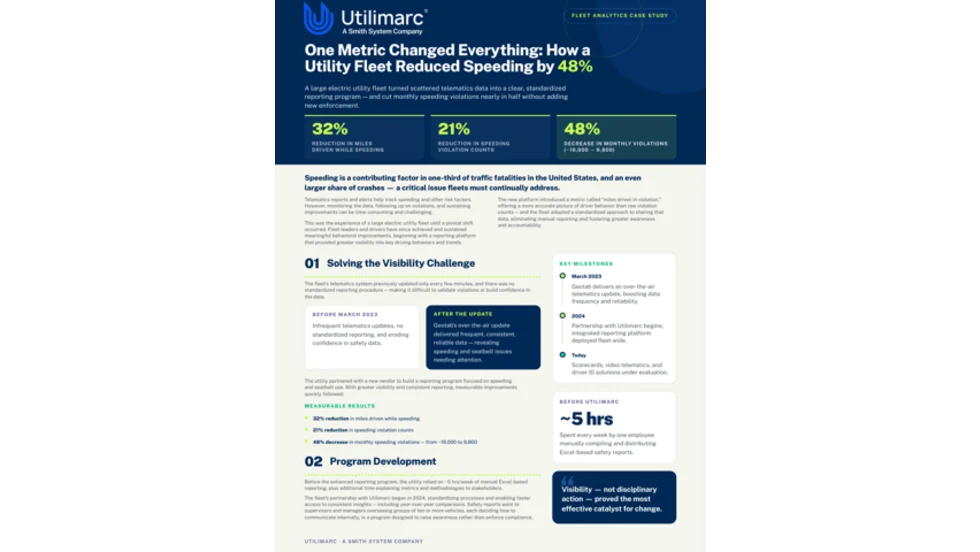
How Better Visibility Cut Speeding Violations by 48%
Fleet leaders don't need more data, they need clearer visibility into what the data is saying. This case study explores how one utility replaced speeding-event counts with a single metric — miles driven in violation — to strengthen safety and significantly reduce speeding violations.
Read More →