




GM to Offer New Cadillac CUE Infotainment System in 2012
SAN DIEGO – General Motors plans to debut its new Cadillac CUE infotainment system in the Cadillac XTS and ATS luxury sedans and SRX luxury crossover in 2012.
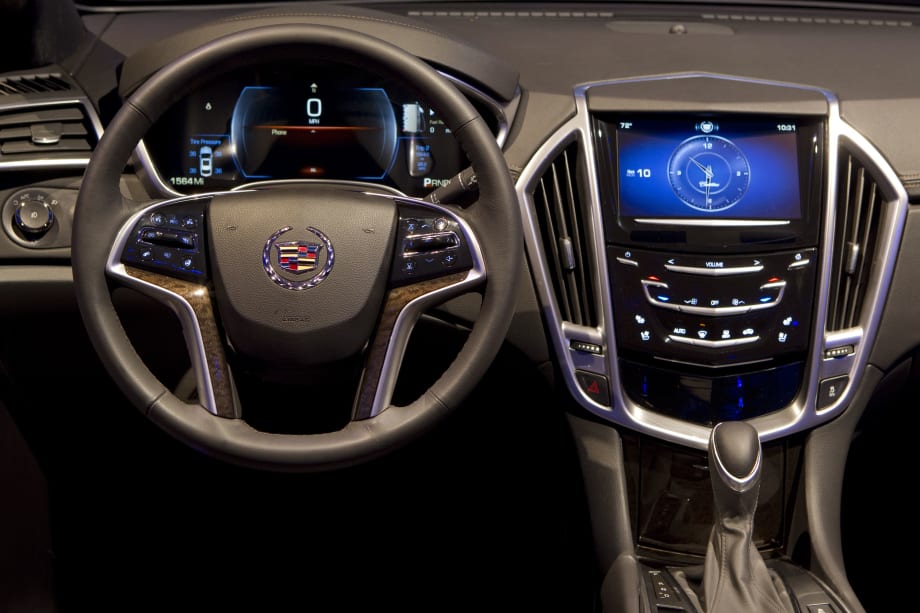
The CUE features an 8-inch LCD touch screen that’s integrated into the top of the central instrument panel as well as a motorized fully capacitive faceplate at the bottom concealing a 1.8L storage area.
The CUE features an 8-inch LCD touch screen that’s integrated into the top of the central instrument panel as well as a motorized fully capacitive faceplate at the bottom concealing a 1.8L storage area.
SAN DIEGO – General Motors plans to debut its new Cadillac CUE infotainment system in the Cadillac XTS and ATS luxury sedans and SRX luxury crossover in 2012.
CUE, which GM said stands for Cadillac User Experience, will allow users to pair entertainment and information data from up to 10 Bluetooth-enabled mobile devices, USBs, SD cards, and MP3 players. In addition, the automaker said the system reduces the complexity normally associated with infotainment system controls by cutting the number of buttons down to four. The system also features enhanced voice recognition, allowing vehicle occupants to use natural voice commands.
The CUE features an 8-inch LCD touch screen that’s integrated into the top of the central instrument panel as well as a motorized fully capacitive faceplate at the bottom concealing a 1.8L storage area. The LCD screen displays CUE’s home page, which GM said resembles a smart phone’s screen by using large icons to allow users to execute commands. Capacitive refers to using electrodes to sense the conductive properties of objects, such as a user’s finger.
The system will provide a range of features, GM stated.
Proximity Sensing: As the user’s hand approaches the LCD screen, command icons appear. The user can customize and arrange the icons.
Haptic Feedback: Buttons on the fully capacitive faceplate pulse when pressed to acknowledge the driver’s commands, which helps keep a driver’s eyes on the road.
Multi-Touch Hand Gestures: Interactive motions (tap, flick, swipe and spread) used on smartphones and tablets allow users to accomplish tasks on the LCD screen, such as scrolling lists, zooming maps, and searching favorites.
Natural Speech Recognition: This feature lets users speak logically with fewer specific commands to recall stored media or input navigation destinations. CUE’s text-to-speech feature will also allow users to receive text messages by system voice and to send recorded text messages in return.
Selectable Displays: 12.3 in. LCD reconfigurable gauge cluster (on select models) offers four selectable displays. They include Simple, Enhanced, Balanced and Performance and can mix traditional vehicle data such as a speedometer and fuel gauge with navigation, entertainment, and a 3D vehicle image.
New Operating System and Processor: The Linux operating system, “open” software platform, and ARM 11 3-core processor, each operating at 400 million of instructions (mips) per second. This hardware setup offers 3.5 times more processing power than current infotainment systems. GM said this will allow developers to write applications to CUE that be downloaded by consumers.
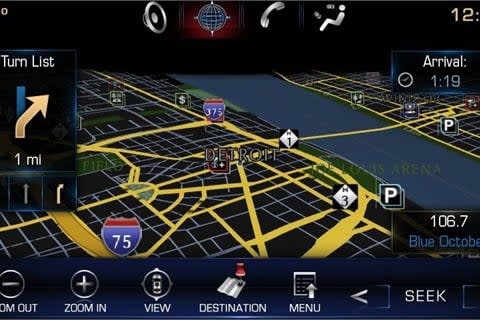
The CUE system's navigation feature.
The CUE system’s LCD screen will show the driver’s five most used functions along the top of the screen. Along the bottom of the screen, users can select up to 60 favorites from music to points of interest, addresses, maps for weather or directions, phone numbers or system commands. Users can re-order and name favorites.
The steering wheel contains a five-way controller on the right side to navigate the cluster display, a volume control, and buttons to cycle through favorites. The five-way controller on the left side manages cruise control functions, voice recognition, phone hang-up, and heated steering wheel.
GM said CUE’s customization and control features are further enhanced through OnStar’s suite of safety, security and connectivity services, such as Turn-by-Turn navigation, Automatic Crash Notification, hands-free calling, and the OnStar RemoteLink mobile application.
Key OnStar features are available through CUE’s LCD screen, gauge cluster and steering wheel controls.
More Operations

Moventum Fleet Management Names Mark Iorillo Head of Sales
Iorillo brings nearly 20 years of fleet management and sales experience to the role, including previous positions at Element Fleet Management, CEI, Donlen and Ryder.
Read More →
Fleet Has a Talent Pipeline Problem. What Comes Next? | AF News Recap
Where will fleet’s next generation of leaders come from? This week, we’re looking at the industry’s talent pipeline, what certification can add to a fleet career, how to build an award-worthy track record, and the return of Automotive Fleet’s Personal Use Survey.
Read More →
Smith System Launches Driver Risk Management Program
Fleets have more driver data than ever, but identifying risky behavior doesn't necessarily correct it. Smith System's new Driver Risk Management program combines monitoring, training, and follow-up coaching to help fleets connect risk signals with driver intervention.
Read More →
Automotive Fleet Opens 2026 Personal Use Survey for Commercial Fleet Managers
Less than two weeks left! Commercial and corporate fleet managers are invited to share how their organizations handle company vehicle personal-use policies, charges, and driver eligibility.
Read More →
From AI Prompts to AI-Generated Safety Songs | AF News Recap
Can better prompts make AI more useful for fleet managers? This week, we’re breaking down smarter fleet analysis, an AI-assisted experiment that turned safety training into music, and what happened to fuel prices in August.
Read More →
How to Write Better AI Prompts for Fleet Analysis
Include these six elements in your fleet prompts to generate more relevant analysis and accurate answers.
Read More →
Fleet Meets: Eric Kilgore
This edition of the Fleet Meets series features one of the industry's best leaders driving multi-market and national operations.
Read More →
Why Reactive Fleet Management Is Becoming Too Expensive to Sustain
Research highlights a growing need for proactive management strategies to address rising costs in fleet operations effectively.
Read More →
What Your Fleet KPIs Aren’t Telling You
Tracking fleet metrics is only useful when the data leads to better decisions. This guide helps fleet leaders assess cost, utilization, and downtime more accurately, identify performance gaps, and prioritize the actions that can improve operational results.
Read More →
Hidden in Plain Sight: Fleet Compliance Risks
Fleet compliance isn't just about having policies — it's about consistently enforcing them. This practical guide reveals six hidden compliance risks common in public sector and shared fleet operations and outlines proven strategies to improve visibility, accountability, and audit readiness
Read More →