




Toyota Unveils All-New 2013-MY Avalon at New York Auto Show
NEW YORK - The new Avalon features a redesigned exterior, new interior appointments, and improved ride quality and handling, according to Toyota.

The Avalon features a redesigned exterior, with a more compact overall design, a lower beltline, but more interior space.

The Avalon features a redesigned exterior, with a more compact overall design, a lower beltline, but more interior space.
NEW YORK – Toyota showed its all-new 2013-MY Toyota Avalon mid-size sedan at the New York International Auto Show. The new Avalon features a redesigned exterior, new interior appointments, and improved ride quality and handling.
Performance
Toyota announced few details about the powertrain or fuel economy of the new Avalon. The automaker’s Bob Carter, Group Vice President and General Manager, Toyota Division, only said the Avalon comes with a V-6 and that it has “excellent mileage” during the reveal. He added that Toyota will announce specifics on “powertrain advancements” later this spring.
Despite few details, the new Avalon offers three driver selectable driving modes, Normal, Eco, and Sport. Sport mode enhances the throttle response and weights the steering effort from center to a “sportier” feel. The Eco mode changes the throttle response and A/C system’s power use to boost fuel economy. Steering wheel paddle shifters give drivers more control over the vehicle’s performance characteristics in certain driving modes.
Exterior
One of the major focuses for Toyota’s design team was the Avalon’s exterior. The automaker describes it as “progressive and emotionally styled,” but the key design elements include a lower beltline, a more compact overall design, a longer, sloping roofline, flared front fenders, reduced front and rear overhangs, lower vehicle height, and a reduced body-to-tire gap. Wheel and tire combinations come in 17-inch and 18-inch choices.
Lighting features include the square Double-eye Projector Ellipsoid System headlamps with HID (High-Intensity Discharge)and Daytime Running Lights.
Interior
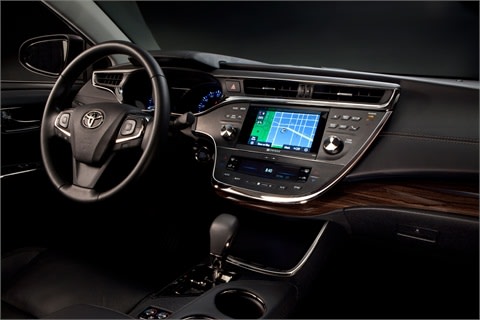
A Display Audio system with 6.1 inch touchscreen is standard on the new Avalon.
Toyota said its new Avalon will feature more interior room, for example plenty of rear seat legroom, and design elements that make the cabin feel more spacious. For example, the automaker said it lowered the front seat’s hip point by 10 mm to provide additional headroom. The structural design of the sunroof and headliner, and a concave dash panel design also help increase the cabin’s available space, according to Toyota. The luggage compartment has 16 cu. ft. of space, 1.6 more available cu. ft. compared to the previous model.
The new Avalon comes standard with a Display Audio system with 6.1 inch touchscreen. Toyota is offering Entune on the new Avalon, and other premium in-car technologies include three color display screens (to support the multi-information display), specifically the audio/navigation interface, and the climate control panel.
To reduce wind and other exterior noise, the design team used sound damping materials, an optimized exterior shape and features, and minimized exterior gaps and steps.
The vehicle’s interior seating offers leather trim on the seat upholstery, steering wheel, and shift knob, and smoked chrome accents are applied to instrument panel, center console, door panel, and steering wheel surfaces. The new Avalon’s console comes equipped with a USB port, aux input, and three-volt power outlet. It also features white ambient lighting, soft touch surfaces, and capacitive-touch switches
Interior options include a JBL Synthesis Premium Audio system, HDD Premium Navigation with 7-inch screen, dynamic radar cruise control, heated and cooled front seats, heated rear seats, and a three-zone air conditioning system.
Safety
The Avalon comes with 10 airbags and features Toyota’s Star Safety System as standard, which provides Vehicle Stability Control (VSC), Traction Control (TRAC), Anti-lock Braking System (ABS), Electronic Brake-force Distribution (EBD), Brake Assist, and Smart Stop Technology brake-override system.
Optional safety systems include a front collision detection system, a rear-view monitor, a blind spot monitoring system, and Rear Cross Traffic Alert, which is designed to alert drivers of cross traffic when backing.
More Operations

Fleet Has a Talent Pipeline Problem. What Comes Next? | AF News Recap
Where will fleet’s next generation of leaders come from? This week, we’re looking at the industry’s talent pipeline, what certification can add to a fleet career, how to build an award-worthy track record, and the return of Automotive Fleet’s Personal Use Survey.
Read More →
Smith System Launches Driver Risk Management Program
Fleets have more driver data than ever, but identifying risky behavior doesn't necessarily correct it. Smith System's new Driver Risk Management program combines monitoring, training, and follow-up coaching to help fleets connect risk signals with driver intervention.
Read More →
Automotive Fleet Opens 2026 Personal Use Survey for Commercial Fleet Managers
Less than two weeks left! Commercial and corporate fleet managers are invited to share how their organizations handle company vehicle personal-use policies, charges, and driver eligibility.
Read More →
From AI Prompts to AI-Generated Safety Songs | AF News Recap
Can better prompts make AI more useful for fleet managers? This week, we’re breaking down smarter fleet analysis, an AI-assisted experiment that turned safety training into music, and what happened to fuel prices in August.
Read More →
How to Write Better AI Prompts for Fleet Analysis
Include these six elements in your fleet prompts to generate more relevant analysis and accurate answers.
Read More →
Fleet Meets: Eric Kilgore
This edition of the Fleet Meets series features one of the industry's best leaders driving multi-market and national operations.
Read More →
Why Reactive Fleet Management Is Becoming Too Expensive to Sustain
Research highlights a growing need for proactive management strategies to address rising costs in fleet operations effectively.
Read More →
What Your Fleet KPIs Aren’t Telling You
Tracking fleet metrics is only useful when the data leads to better decisions. This guide helps fleet leaders assess cost, utilization, and downtime more accurately, identify performance gaps, and prioritize the actions that can improve operational results.
Read More →
Hidden in Plain Sight: Fleet Compliance Risks
Fleet compliance isn't just about having policies — it's about consistently enforcing them. This practical guide reveals six hidden compliance risks common in public sector and shared fleet operations and outlines proven strategies to improve visibility, accountability, and audit readiness
Read More →
Turning Fleet Payment Data into Executive Insights
Does data alone drive results in operations?
Read More →