




Cadillac Unveils 2013-MY XTS at LA Auto Show
LOS ANGELES - The company said the vehicle is positioned “directly above” the CTS family in the Cadillac brand lineup, and that the sedan features a range of advanced technologies designed to provide more efficient performance in a luxury vehicle.

The automaker said the vehicle is positioned directly above the CTS in the Cadillac lineup. Photo by Steve Fecht for Cadillac.

The automaker said the vehicle is positioned directly above the CTS in the Cadillac lineup. Photo by Steve Fecht for Cadillac.
LOS ANGELES – Cadillac showed its new 2013-MY XTS during one of the first press conferences of the day at the Los Angeles Auto Show on Nov. 16. The company said the vehicle is positioned “directly above” the CTS family in the Cadillac brand lineup, and that the sedan features a range of advanced technologies designed to provide more efficient performance in a luxury vehicle. The XTS is also the first Cadillac vehicle to launch with the company’s new CUE infotainment and connected vehicle system. The new vehicle will begin production in spring of 2012.
Performance
Under the hood, the XTS offers the direct-injection LFX 3.6L V-6. The engine is rated at up to 300 horsepower and 264 lb. ft. of torque. The all-wheel-drive model (which is standard) features fuel economy of 17 mpg city, 27 mpg highway. The front-wheel-drive model gets 17 city, 28 highway.
Cadillac stated that lightweight features help reduce the vehicle’s overall weight for greater efficiency and a more favorable front-to-rear weight balance. One example is a composite intake manifold that weighs 5.5 lbs. less than a comparable aluminum intake manifold. The LFX engine is mated to a Hydra-Matic 6T70 six-speed automatic transmission with tap-shift control.
The vehicle features a Haldex all-wheel-drive system with electronically controlled limited-slip differential, the automaker’s Magnetic Ride Control, rear air suspension, HiPer Strut front suspension and Brembo brakes as standard features. Magnetic ride control uses electronically controlled shocks that are filled with a magneto-rheological fluid that contains tiny iron particles, which align under a magnetic charge to provide resistance.
Exterior
GM’s Cadillac brand described the new vehicle as having “multidimensional exterior and interior elements, including the grille, headlamps, and new use of accent lighting.” The XTS comes with 19-inch wheels as standard and offers available 20-inch wheels.
Interior
Inside, the Cadillac provides 39 inches of headroom in the front and 37 in the back, 40 inches of rear legroom, seats five, and offers 18 cubic feet of storage space in the trunk. GM said the vehicle has a spacious interior in an efficient package.
The Cadillac CUE (Cadillac User Experience) system provides a configurable interface on an 8-inch screen in the center stack. Cadillac said CUE features capacitive-touch control with proximity sensing, gesture recognition, and natural voice recognition. An available option on the XTS is the 12.3-inch (312 mm) reconfigurable cluster. XTS also comes with OnStar as standard.
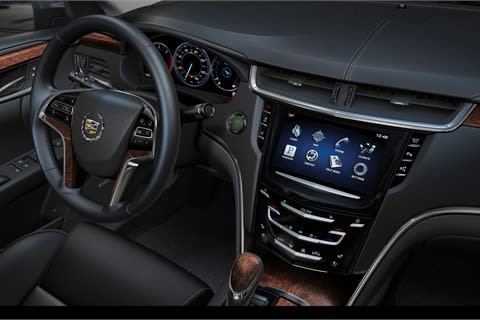
The XTS will launch with Cadillac's new CUE system.
Safety
The XTS’ new safety system uses what GM calls a “control and alert” strategy. The vehicle’s systems are designed to alert drivers to potential issues and will employ varying types of alerts, depending on the feature. The Safety Alert Seat feature, for example, will vibrate either the left or right side of the driver’s seat cushion, depending on where the potential safety concern is relative to the vehicle. The safety features that will automatically intervene, if necessary, includes Automatic Collision Preparation, which will take over if the driver does not react to previous alerts.
The XTS offers two safety packages, Enhanced Safety Strategy (ESS) I and ESS II.
ESS I includes the following:
Lane Departure Warning
Forward Collision Alert
Safety Alert Seat
Side Blind Zone Alert
Rear Cross Traffic Alert
Reflected LED display
ESS II includes all of ESS I’s content plus the following:
Head-up display (in color)
Front and Rear Automatic Brake
Adaptive Cruise Control
Automatic Collision Preparation
More Operations

Fleet Has a Talent Pipeline Problem. What Comes Next? | AF News Recap
Where will fleet’s next generation of leaders come from? This week, we’re looking at the industry’s talent pipeline, what certification can add to a fleet career, how to build an award-worthy track record, and the return of Automotive Fleet’s Personal Use Survey.
Read More →
Smith System Launches Driver Risk Management Program
Fleets have more driver data than ever, but identifying risky behavior doesn't necessarily correct it. Smith System's new Driver Risk Management program combines monitoring, training, and follow-up coaching to help fleets connect risk signals with driver intervention.
Read More →
Automotive Fleet Opens 2026 Personal Use Survey for Commercial Fleet Managers
Less than two weeks left! Commercial and corporate fleet managers are invited to share how their organizations handle company vehicle personal-use policies, charges, and driver eligibility.
Read More →
From AI Prompts to AI-Generated Safety Songs | AF News Recap
Can better prompts make AI more useful for fleet managers? This week, we’re breaking down smarter fleet analysis, an AI-assisted experiment that turned safety training into music, and what happened to fuel prices in August.
Read More →
How to Write Better AI Prompts for Fleet Analysis
Include these six elements in your fleet prompts to generate more relevant analysis and accurate answers.
Read More →
Fleet Meets: Eric Kilgore
This edition of the Fleet Meets series features one of the industry's best leaders driving multi-market and national operations.
Read More →
Why Reactive Fleet Management Is Becoming Too Expensive to Sustain
Research highlights a growing need for proactive management strategies to address rising costs in fleet operations effectively.
Read More →
What Your Fleet KPIs Aren’t Telling You
Tracking fleet metrics is only useful when the data leads to better decisions. This guide helps fleet leaders assess cost, utilization, and downtime more accurately, identify performance gaps, and prioritize the actions that can improve operational results.
Read More →
Hidden in Plain Sight: Fleet Compliance Risks
Fleet compliance isn't just about having policies — it's about consistently enforcing them. This practical guide reveals six hidden compliance risks common in public sector and shared fleet operations and outlines proven strategies to improve visibility, accountability, and audit readiness
Read More →
Turning Fleet Payment Data into Executive Insights
Does data alone drive results in operations?
Read More →