




GM Plans to Increase Rate of Volt Production
DETROIT – GM plans to close its Detroit-Hamtramck Assembly plant for four weeks in June to upgrade the facility’s capacity to produce Chevrolet Volt vehicles and prepare to assemble the 2013 Chevrolet Malibu sedan.
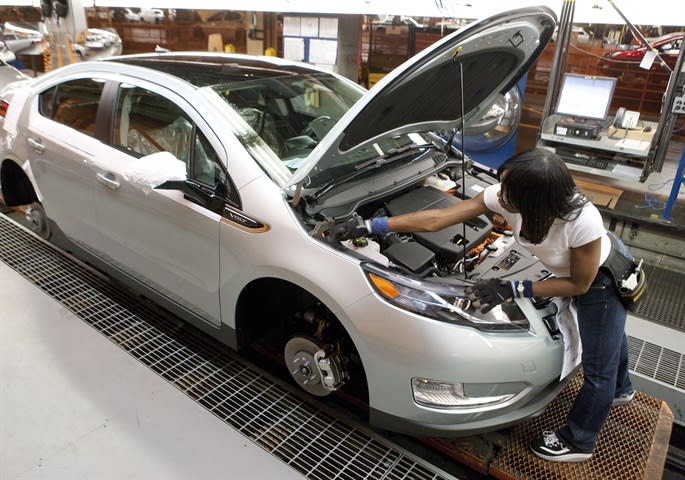
DETROIT – General Motors plans to close its Detroit-Hamtramck Assembly plant for four weeks in June to upgrade the facility’s capacity to produce Chevrolet Volt vehicles and prepare to assemble the 2013 Chevrolet Malibu sedan.
The automaker said the retail supply of Volts will be restricted during the next three months before the company resumes production. Coupled with already low dealer inventories and strong demand, the suspension of production, will result in limited availability and reduced sales in June and July.
As a result of the plant upgrades, planned Volt and Opel Ampera (the European version of the Volt) production capacity this year will increase to 16,000 units, including exports and a fleet of several hundred demonstration units sent to U.S. dealers. In 2012, global production capacity is expected to be 60,000 vehicles with an estimated 45,000 to be delivered in the United States. GM said it’s taking this action due to high customer demand for the vehicle.
“The Volt will be available to customers nationwide by the end of 2011,” said Cristi Landy, director of Chevrolet Volt Marketing. “By taking the time to reconfigure the plant, we will be better able to meet the tremendous consumer demand.”
The 2011 Volt was launched in California, New York, Connecticut, Maryland, Michigan, New Jersey, New York, Texas, Virginia and Washington, D.C. The Volt will be available nationwide and in Europe, China and Canada by the end of this year.
Production of the all-new 2013 Chevrolet Malibu will begin next year, according to the automaker.
More Operations

Fleet Has a Talent Pipeline Problem. What Comes Next? | AF News Recap
Where will fleet’s next generation of leaders come from? This week, we’re looking at the industry’s talent pipeline, what certification can add to a fleet career, how to build an award-worthy track record, and the return of Automotive Fleet’s Personal Use Survey.
Read More →
Smith System Launches Driver Risk Management Program
Fleets have more driver data than ever, but identifying risky behavior doesn't necessarily correct it. Smith System's new Driver Risk Management program combines monitoring, training, and follow-up coaching to help fleets connect risk signals with driver intervention.
Read More →
Automotive Fleet Opens 2026 Personal Use Survey for Commercial Fleet Managers
Less than two weeks left! Commercial and corporate fleet managers are invited to share how their organizations handle company vehicle personal-use policies, charges, and driver eligibility.
Read More →
From AI Prompts to AI-Generated Safety Songs | AF News Recap
Can better prompts make AI more useful for fleet managers? This week, we’re breaking down smarter fleet analysis, an AI-assisted experiment that turned safety training into music, and what happened to fuel prices in August.
Read More →
How to Write Better AI Prompts for Fleet Analysis
Include these six elements in your fleet prompts to generate more relevant analysis and accurate answers.
Read More →
Fleet Meets: Eric Kilgore
This edition of the Fleet Meets series features one of the industry's best leaders driving multi-market and national operations.
Read More →
Why Reactive Fleet Management Is Becoming Too Expensive to Sustain
Research highlights a growing need for proactive management strategies to address rising costs in fleet operations effectively.
Read More →
What Your Fleet KPIs Aren’t Telling You
Tracking fleet metrics is only useful when the data leads to better decisions. This guide helps fleet leaders assess cost, utilization, and downtime more accurately, identify performance gaps, and prioritize the actions that can improve operational results.
Read More →
Hidden in Plain Sight: Fleet Compliance Risks
Fleet compliance isn't just about having policies — it's about consistently enforcing them. This practical guide reveals six hidden compliance risks common in public sector and shared fleet operations and outlines proven strategies to improve visibility, accountability, and audit readiness
Read More →
Turning Fleet Payment Data into Executive Insights
Does data alone drive results in operations?
Read More →