




Chevrolet Debuts 2013 Malibu
DETROIT and SHANGHAI - Chevrolet debuted its 2013 Malibu in a live webcast and at the Shanghai Auto Show.
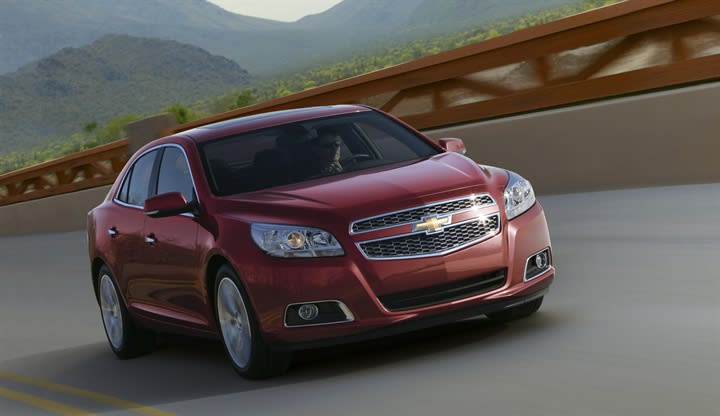
DETROIT and SHANGHAI - Chevrolet debuted its 2013 Malibu in China and the U.S. in a webcast on Tuesday, April 18 and live at the Shanghai Auto Show. The Malibu is Chevrolet’s first global mid-size sedan, which GM plans to sell in nearly 100 countries.
The new Malibu comes in three trim levels, LS, LT, and LTZ. The vehicle will come in 10 exterior colors and four interior color combination choices in North America, depending on the model. Malibu production in the United States begins in early 2012. It will be built in multiple locations around the globe, including the Fairfax, Kan. and Detroit-Hamtramck assembly plants in the United States. Pricing will be announced later this year.
So far, GM has not yet released any mpg numbers for this vehicle. We will provide an update on fuel economy figures when GM releases them.
“The current Malibu has left an award-winning impression and changed the way people think about Chevrolet. It redefined what an American midsize car could be,” said Rick Scheidt, vice president, Chevrolet Marketing. “This all-new Malibu delivers on the intangibles of today’s Malibu but gives customers even more: more style, fuel efficiency, content and features, craftsmanship, and dynamic capabilities rivaling high-end sedans.”
Product highlights for North American models include:
New 2.5L four-cylinder engine and next-generation six-speed automatic that lead Malibu’s powertrain lineup
Expressive exterior design with a wide, athletic stance
Aerodynamics that the company says is close to the Chevrolet Volt extended-range electric car, designed to enhance fuel efficiency and reduce wind noise, including active electronic shutters on select models
New Chevrolet-signature dual-cockpit with more interior room, features premium materials and is engineered to reduce noise
European-influenced ride and handling traits
New safety features and technologies including 10 air bags, ultra-high-strength steel, lane departure warning/forward collision warning, and rearview camera system
New Chevrolet MyLink connectivity integrates online services such as Pandora Internet radio and Stitcher SmartRadio
New 2.5L Powertrain Highlights
The 2013 Malibu models will feature a global lineup of powerful four-cylinder engines. In the North American market, the Malibu will offer the Ecotec 2.5L dual overhead cam four-cylinder engine with direct injection. New features include enhanced authority continuously variable valve timing, variable-displacement oil pump and electronic thermostat that save fuel while delivering V-6-like performance, GM stated. The company estimates the engine will be SAE-certified at more than 190 horsepower (141 kW) and 180 lb.-ft. of torque (245 Nm).
The 2.5L engine is mated to a Hydra-Matic 6T40 six-speed automatic. The new transmission offers features designed to enhance powertrain efficiency, such as changes to clutch controls and hardware that improves shift response and time. These changes enabled engineers to specify higher gearing to improve cruising efficiency while maintaining acceleration performance and driveability, according to GM.
Exterior Features
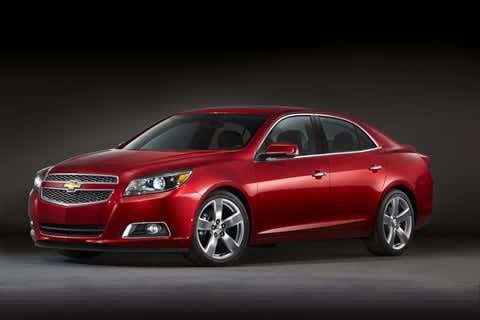
For the new version of the Malibu, GM gave its new model wider stance and an integrated rear spoiler. The new Malibu has a 4.5-inch (114 mm) shorter wheelbase and 62-inch (1,574 mm) front and rear tracks that are more than 2 inches (51 mm) wider than the model it replaces.
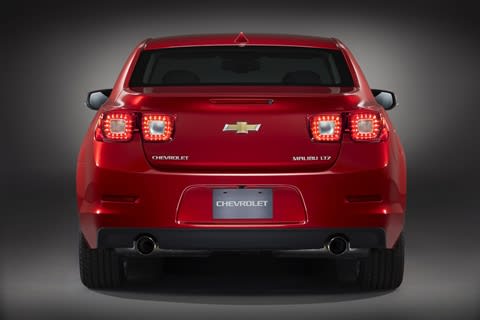
Other exterior design cues include Chevrolet’s dual-port grille, projector HID headlamps, larger Chevrolet bow-tie badges front and rear, and new Camaro-inspired LED dual-element taillamps. Wheel sizes come in 17-, 18-, and 19-inch sizes.
GM anticipates the new Malibu exterior will be SAE-certified as one of the most aerodynamically efficient cars in the segment, with a coefficient of drag (Cd) rating near Chevrolet Volt’s Cd of .280. The automaker said the Malibu’s new shape and design allowed engineers to remove 60 counts of wind drag compared with the model it replaces.
The new Malibu also has electronically controlled and integrated active aero shutters on select models in North American markets. The active shutter system automatically closes airflow through the lower intake opening when the vehicle needs the least amount of air intake. When the shutters are closed, the vehicle’s aerodynamics redirect airflow around the front of the vehicle and down its sides. Shutter open and close settings depend on engine coolant and vehicle speed. For example, the shutters open when the car is traveling up a hill, pulling a trailer, or in hot city driving; the shutters close at highway speeds when less engine cooling is required.
Interior Features
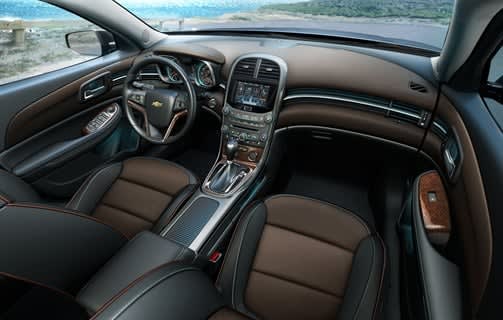
The new Malibu offers drivers a new dual cockpit design with nearly 4 cubic feet (113 L) of additional interior volume, along with more shoulder and hip room. The interior features metallic, chrome, or wood accents around the shifter, center stack, instrument cluster, and steering wheel.
One of the more interesting storage features in the vehicle is a six-inch-deep space behind the radio face, which articulates up and down. For infotainment, the Malibu will feature Chevrolet’s new MyLink system at launch. The radio face offers a 7-inch touchscreen display for controlling a range of features.
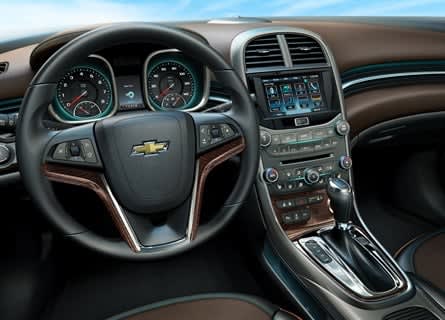
GM said the MyLink system builds on what OnStar offers and integrates online services such as Pandora Internet radio and Stitcher SmartRadio. MyLink features a high-resolution, full-color touch screen display. MyLink integrates wireless connectivity through Bluetooth to enable hands-free use of selected smart phone apps. Other Bluetooth features include stereo audio streaming and wireless control of smart phones.
Safety Features
GM stated the Malibu will be pedestrian protection-compliant in all markets where it is sold, and for the first time in North America. According to the company, pedestrian protection design in the front of the vehicle reduces the chance of secondary collision between the pedestrian and engine block in car-pedestrian accidents.
The Malibu will also offer these standard and available safety features:
Standard
Dual-stage driver and front passenger air bags
Driver and front passenger pelvic/thorax side-impact air bags
Driver and passenger knee air bags
Roof rail air bags with rollover protection
Optional
Available second-row head/thorax side-impact air bags
Available lane departure warning system with forward collision alert
Available rearview camera system
The automaker will include OnStar in Malibu’s safety features, which offers Automatic Crash Response, improved voice recognition technology, remote diagnostics, remote door unlock, Stolen Vehicle Slowdown, and six months of uplevel Directions and Connections service that includes Turn-By-Turn Navigation.
Ride and Handling Characteristics
GM referred to the European-inspired handling for the new Malibu, and listed a number of features designed to enhance the Malibu’s ride characteristics.
A solid body structure the company said is as stiff as any in the global midsize sedan market, which allow for precise tuning and dynamic vehicle control.
A premium steering gear for smooth, which the automaker said provides precise responsiveness and on-center feel.
MacPherson strut front and multi-link rear suspensions
Large, ventilated front disc and solid rear disc brakes, clamped on by dual-piston front and single-piston rear aluminum calipers
An isolated engine cradle for tuned, designed to provide refined feedback, without noise or vibration
A fuel-saving electric power rack-and-pinion variable-effort power steering, for improved handling during low-speed maneuvers and a higher degree of steering feel at higher speeds
Chassis control technologies include four-channel anti-lock brakes, full-function traction control, four-corner electronic stability control, electronic brake force distribution, brake assist system, corner brake control, hydraulic brake fade assist, and drag torque control.
More Operations

Fleet Has a Talent Pipeline Problem. What Comes Next? | AF News Recap
Where will fleet’s next generation of leaders come from? This week, we’re looking at the industry’s talent pipeline, what certification can add to a fleet career, how to build an award-worthy track record, and the return of Automotive Fleet’s Personal Use Survey.
Read More →
Smith System Launches Driver Risk Management Program
Fleets have more driver data than ever, but identifying risky behavior doesn't necessarily correct it. Smith System's new Driver Risk Management program combines monitoring, training, and follow-up coaching to help fleets connect risk signals with driver intervention.
Read More →
Automotive Fleet Opens 2026 Personal Use Survey for Commercial Fleet Managers
Less than two weeks left! Commercial and corporate fleet managers are invited to share how their organizations handle company vehicle personal-use policies, charges, and driver eligibility.
Read More →
From AI Prompts to AI-Generated Safety Songs | AF News Recap
Can better prompts make AI more useful for fleet managers? This week, we’re breaking down smarter fleet analysis, an AI-assisted experiment that turned safety training into music, and what happened to fuel prices in August.
Read More →
How to Write Better AI Prompts for Fleet Analysis
Include these six elements in your fleet prompts to generate more relevant analysis and accurate answers.
Read More →
Fleet Meets: Eric Kilgore
This edition of the Fleet Meets series features one of the industry's best leaders driving multi-market and national operations.
Read More →
Why Reactive Fleet Management Is Becoming Too Expensive to Sustain
Research highlights a growing need for proactive management strategies to address rising costs in fleet operations effectively.
Read More →
What Your Fleet KPIs Aren’t Telling You
Tracking fleet metrics is only useful when the data leads to better decisions. This guide helps fleet leaders assess cost, utilization, and downtime more accurately, identify performance gaps, and prioritize the actions that can improve operational results.
Read More →
Hidden in Plain Sight: Fleet Compliance Risks
Fleet compliance isn't just about having policies — it's about consistently enforcing them. This practical guide reveals six hidden compliance risks common in public sector and shared fleet operations and outlines proven strategies to improve visibility, accountability, and audit readiness
Read More →
Turning Fleet Payment Data into Executive Insights
Does data alone drive results in operations?
Read More →