




Toyota: Fix Developed for Sticking Accelerator Pedals
TORRANCE, CA - Toyota Motor Sales U.S.A. announced it will begin fixing accelerator pedals in recalled Toyota Division vehicles this week.
TORRANCE, CA - Toyota Motor Sales U.S.A. announced it will begin fixing accelerator pedals in recalled Toyota Division vehicles this week.
Toyota said its engineers have developed and tested a solution that involves reinforcing the pedal assembly in a manner that "eliminates the excess friction that has caused the pedals to stick in rare instances." In addition, Toyota said, it has developed an effective solution for vehicles in production.
Parts to reinforce the pedals are already being shipped for use by dealers, and dealer training is under way. Many Toyota dealers will work extended hours to complete the recall campaign as quickly as possible, the automaker said, with some even staying open 24 hours a day. The company has also halted production of the affected vehicles for the week of Feb.1.
Toyota said it has pinpointed the issue that could, on rare occasions, cause accelerator pedals in recalled vehicles to stick in a partially open position. The issue involves a friction device in the pedal designed to provide the proper "feel" by adding resistance and making the pedal steady and stable. The device includes a shoe that rubs against an adjoining surface during normal pedal operation. Due to the materials used, wear and environmental conditions, these surfaces may, over time, begin to stick and release instead of operating smoothly. In some cases, friction could increase to a point that the pedal is slow to return to the idle position or, in rare cases, the pedal sticks, leaving the throttle partially open, Toyota said.
To fix the problem, a precision-cut steel reinforcement bar will be installed into the assembly that will reduce the surface tension between the friction shoe and the adjoining surface. With this reinforcement in place, the excess friction that can cause the pedal to stick is eliminated. The company said it has confirmed the effectiveness of the newly reinforced pedals through rigorous testing on pedal assemblies that had previously shown a tendency to stick.
"Nothing is more important to us than the safety and reliability of the vehicles our customers drive," said Jim Lentz, president and CEO of Toyota Motor Sales. "We deeply regret the concern that our recalls have caused for our customers and we are doing everything we can -- as fast as we can -- to make things right."
On Jan. 21, Toyota announced its intention to recall approximately 2.3 million Toyota vehicles equipped with a specific pedal assembly. The company suspended sales of the eight models involved in the recall on Jan. 26.
[PAGEBREAK]
Toyota vehicles affected by the recall include:
Certain 2009-2010 RAV4
Certain 2009-2010 Corolla
2009-2010 Matrix
2005-2010 Avalon
Certain 2007-2010 Camry
Certain 2010 Highlander
2007-2010 Tundra
2008-2010 Sequoia
No Lexus Division or Scion vehicles are affected by these actions. Also not affected are the Toyota Prius, Tacoma, Sienna, Venza, Solara, Yaris, 4Runner, FJ Cruiser, Land Cruiser, Highlander hybrids and certain Camry models, including Camry hybrids, all of which remain for sale.
Further, Camry, RAV4, Corolla and Highlander vehicles with Vehicle Identification Numbers (VIN) that begin with "J" are not affected by the accelerator pedal recall.
If a driver experiences an accelerator pedal that sticks in a partial open throttle position or returns slowly to idle position, the vehicle can be controlled with firm and steady application of the brakes. The brakes should not be pumped repeatedly because it could deplete vacuum assist, requiring stronger brake pedal pressure. The vehicle should be driven to the nearest safe location, the engine shut off and a Toyota dealer contacted for assistance, Toyota advised.
Detailed information and answers to questions about issues related to this recall are available to customers at www.toyota.com/recall and at the Toyota Customer Experience Center at (800) 331-4331.
Separately from the recall for sticking accelerator pedals, Toyota is also in the process of recalling vehicles to address rare instances in which floor mats have trapped the accelerator pedal in certain Toyota and Lexus models (announced Nov. 25, 2009), and is already notifying customers about how it will fix this issue. In the case of vehicles covered by both recalls, Toyota intends to remedy both at the same time.
More Safety

Nexar-Nauto Merger Aims to Give Fleets Better Safety Intelligence Through Larger Driving Dataset
Stefan Heck tells Automotive Fleet that combining more than 10 billion miles of driving history with Nexar's AI models will give fleets deeper insights into driver risk and roadway conditions than either company could provide independently.
Read More →
Don't Wait for a Crisis: 5 Ways to Build Mental Health Into Your Fleet Safety Program
For Suicide Prevention Month, fleet and safety leaders have an opportunity to put mental health where it belongs: at the center of workplace safety.
Read More →
How Camera Data Can Strengthen a Fleet’s Insurance Renewal
Insights from a commercial insurance carrier and a broker show how fleets can turn video telematic data, driver coaching, and improved claims results into a stronger case at insurance renewal.
Read More →
The Safest Fleets Aren’t the Ones with the Most Technology
You’ve made the telematics investment. Here’s how to capture the other half of its value and build the safest fleet on the road.
Read More →
Hidden in Plain Sight: Fleet Compliance Risks
Fleet compliance isn't just about having policies — it's about consistently enforcing them. This practical guide reveals six hidden compliance risks common in public sector and shared fleet operations and outlines proven strategies to improve visibility, accountability, and audit readiness
Read More →
NETS Sets 2026 Fleet Safety Benchmark Conference for Indianapolis
The Sept. 15–17 program will feature fleet benchmarking data, case studies, emerging technologies, and implementation strategies while running alongside the NSC Safety Congress & Expo.
Read More →
Off-the-Job Crashes Account for 43% of Employers’ $61.7 Billion Crash Burden
NETS quantifies costs dispersed across fleet, risk, HR, and other departments while providing new per-crash benchmarks for employers.
Read More →
Ram Recalls More Than 1.27 Million 1500 Pickups for Seat Belt Anchor Issue
The recall affects certain 2019-2026 Ram 1500 pickups that may have improperly attached second-row seat belt buckle anchors.
Read More →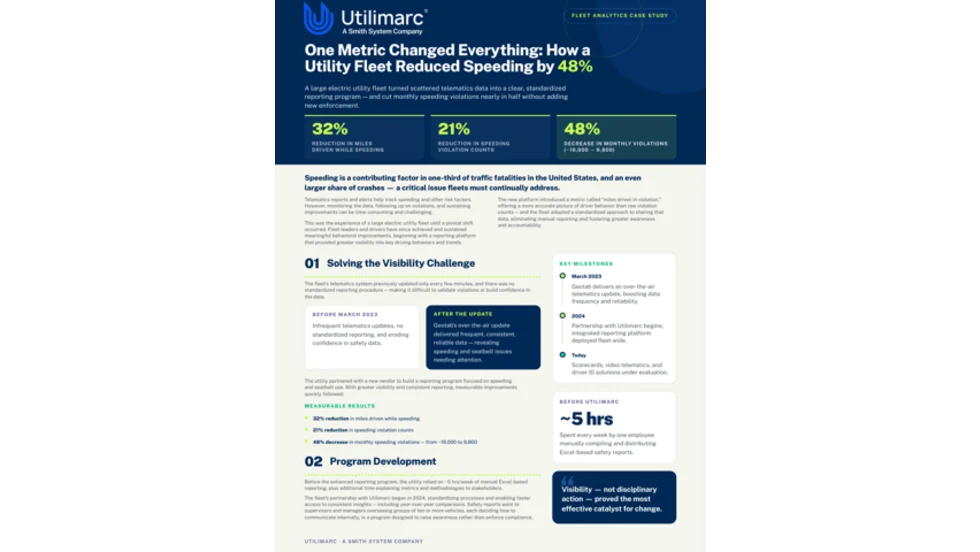
How Better Visibility Cut Speeding Violations by 48%
Fleet leaders don't need more data, they need clearer visibility into what the data is saying. This case study explores how one utility replaced speeding-event counts with a single metric — miles driven in violation — to strengthen safety and significantly reduce speeding violations.
Read More →
Operation Safe Driver Week: Why the Industry's Oldest Safety Campaign Still Matters to Fleets
A look at how a 2007 enforcement initiative became one of the most consequential weeks on the fleet safety calendar, and what it means for your drivers in 2026.
Read More →