




60 Ways to Reduce Your Fuel Spend
Fleets are adopting compensatory strategies to offset high fuel costs. These strategies include selector modification, revised vehicle specs, increased personal use charges, streamlined fleet operations, and driver behavior modification.

The cost of fuel is the No. 1 challenge facing fleet managers today. The breathtaking increase in gasoline and diesel prices over the past six years has given all of us a sobering reality check on how quickly the price of fuel can cause fleet budgets to hemorrhage, especially in the past year.
The new “fleet reality” is being defined by fuel. Ongoing high fuel costs are prompting fleets to establish minimum mpg requirements for vehicle inclusion on a selector list. However, the reality is that fleet applications restrict vehicle choices. Most fleets have limited options to change selectors and still get the right vehicle for the job.
Despite this obstacle, fleets are adopting compensatory strategies to offset higher fuel costs. Each month, I am in contact with hundreds of fleet managers around the country and I ask them what they are doing to reduce their fuel spend. During the course of these communications, I have collected 60 ways fleets are reducing their fuel spend.
The No. 1 approach to reduce fuel spend is spec’ing four-cylinder engines. An increasing number of companies are changing their 2009 specs to include a greater number of four-cylinder engines in their selector mix. For instance, Illinois Tool Works has shifted to four-cylinder engines. “We decided to change our vehicles from the typical V-6 to smaller four-cylinder models,” said Keith Scolan, manager global fleet for Illinois Tool Works in Glenview, Ill.
Endo Pharmaceuticals is also expanding its selector options with various four-cylinder models. “We have been given the flexibility to look at whatever manufacturers make sense for our selectors,” said Joe Niszczak, fleet manager for Endo Pharmaceuticals in Chadds Ford, Penn., “As a result, I am focusing on high-output four-cylinder models from Subaru, Toyota, and General Motors to potentially replace the full-size sedans we are using.”
E.A. Sween Company switched to a four-cylinder Chrysler Sebring from a six-cylinder. “The fuel savings are important to us, along with the lower capital cost and higher resale expected,” said Gregg Hodgdon, CAFM, director of fleet operations for E.A. Sween Company in Eden Prairie, Minn.
Another company planning to expand its four-cylinder engine offering is Regis Corp. “We are looking at four-cylinder vehicles for 2010 and will be testing four-cylinder Fusions this fall,” said Nancy Barlage, fleet administrator for Regis Corp. in Minneapolis.
Other examples of companies shifting more vehicles to four-cylinder engines are Bausch & Lomb, Owens Corning, Kraft Foods, Johnson & Johnson, Merck, Abbott, Infinity Insurance, etc.
[PAGEBREAK]
To add a vehicle to the fleet selector, some fleets require it must have minimum mpg rating. PPG is adopting a 30-mpg minimum for its fleet selector. “Our sedans for the 2009 model-year lineup will all have four-cylinder engines that get a minimum of 30 mpg,” said Charles Szymanski, manager global property casualty insurance & auto fleet, for PPG Industries in Pittsburgh, Penn.
Another company that bases selector decisions on EPA ratings is Labcorp. “We choose those vehicles with the best EPA fuel economy ratings,” said Lynda Dinwiddie, associate VP, fleet & travel for Labcorp in Burlington, N.C.
“We are attempting to downsize our fleet where it makes sense,” said Craig Howard, fleet manager for Verizon Business Fleet Operations.
Likewise, Toshiba America Medical Systems is investigating the feasibility of downsizing to smaller vehicles. “I am working with our service executive team to determine if we can possibly downsize from the Grand Caravan to a smaller more fuel-efficient vehicle,” said Jeff Berg, manager fleet & travel administration for Toshiba America Medical Systems in Tustin, Calif.
Honeywell has been “right-sizing” its cargo-type vehicles for the past few years. “We are continuing to right-size cargo-type vehicles by offering the Chevy HHR with a ladder rack for those that have a mini-cargo van, just to carry a ladder,” say Shelly Lofgren, fleet manager for Honeywell International.
More fleets are looking to add hybrids to their selectors, especially for urban applications. “We are looking to increase use of hybrids for inner-city vehicles and alternative fuels such as CNG,” said Howard of Verizon.
USG is also expanding its fleet of hybrids. “Toyota Prius remained on the selector for the second year with the addition of the Camry Hybrid at the sales manager level,” said Maria Williams, fleet operations supervisor for USG Corp. Another company increasing its investment in hybrid vehicles is Toshiba America Medical Systems. “We are in the process of converting our 150 Chrysler 300s over to Toyota Camry Hybrids,” said Berg of Toshiba America Medical Systems. “So far, we have replaced about 70 vehicles and should have the rest replaced in the next 18-24 months.”
Examples of other corporate fleets that have made substantial investments in hybrid vehicles are Hoffmann-LaRoche, Johnson & Johnson, PepsiCo, Consolidated Coca-Cola Bottling, Apple Inc., etc.
Another trend is to eliminate across-the-board 4x4 use. “We are making recommendations to management to go back to only offering four-wheel-drive vehicles for Snow Belt territories, taking larger SUVs and minivans off the selectors for sales groups that don’t really need them to do their jobs,” said Donna Bibbo, manager, fleet & employee services for Novo Nordisk Inc. in Princeton, N.J.
At a growing number of fleets, a driver must obtain management approval to get a 4x4 vehicle. “If a driver says 4WD is necessary, it is now the exception rather than a standard,” said Debbie Lakes, manager – corporate fleet for Flowserve Corp. in Dayton, Ohio.
There is a broad-based trend to increase personal use charges to drivers.
Many fleets are re-examining chargeback systems to determine whether personal use expenses are adequately recouped. Many fleets have increased personal use charges in reaction to higher fuel prices. The average personal use charge to employees in 2005 was $70-$90 per month. Today, it ranges from $80-$150 per month, with an average of $105 per month. The question is whether it needs to go even higher in today’s cost environment. Personal use of company vehicles accounts for approximately 15-18 percent of the overall miles accumulated during a vehicle’s service life.
Some companies are considering the outright elimination of personal use privileges to reduce fuel spend.
[PAGEBREAK]
In the era of lower fuel prices, companies often missed or ignored unauthorized use of company vehicles such as when an employee took a vacation. “I am running a monthly vacation report and will be checking it against fuel purchase dates as our employees are not allowed to use their fuel card for extended personal trips or vacations,” said one fleet manager who wished to remain anonymous.
The worst mileage a vehicle can get is 0 miles per gallon, which occurs when it idles. Idling for long periods of time, whether at a railroad crossing or pulling off the road to make a cell phone call, consumes gas that could be saved by simply turning off the engine. Restarting an engine uses about the same amount of gas as idling for 30 seconds. When idling for longer periods of time, shut off the engine.
Prolonged idling creates excess emissions and wastes fuel. However, as a caution, turning off the engine may disable safety features such as airbags. Drivers should be certain to utilize this strategy only in situations where there is no possibility of collision.
“We have communicated reminders to all our employees about our no-idle policy,” said Hodgdon of E.A. Sween Company. “On our Class 8 trucks, we are ordering Thermo King APU equipment to eliminate the need to idle to power A/C, heat, etc.”
If you are running a delivery fleet or have vehicles that follow a set daily pattern, efficient routing offers an effective way for fleets to manage fuel expenses. Not only does a routing plan make trips more fuel-efficient, but it also increases time efficiency as well. Plan and consolidate trips to bypass congested routes and avoid stop-and-go traffic.
Fleets are also reducing fuel spend by optimizing trip routing to avoid unnecessary travel and backtracking. “We are looking at ways to redesign our distribution system that will be more efficient,” said Hodgdon.
Other companies are evaluating routing software to optimize routing. “We are investigating a routing software package that would help us optimize our delivery routes to minimize miles driven,” said Jim Collins, CAFM, manager, support services for Royal Cup, Inc. in Birmingham, Ala.
Other fleets require strict adherence to routing plans. “We require strict adherence to the routing plan produced by our dynamic routing programs that minimize mileage, while maximizing customer service” said Steven LaPorte, business manager, North American transportation operations for Iron Mountain in Boston, Mass.
If you have several employees going to the same work location or job site, have them take one vehicle instead of driving separately.
Fleets are closely examining vehicle mileage records and eliminating marginal low-mileage vehicles that do not fully contribute to fulfilling the fleet application.
“We work under the premise that there are two ways to lower fleet costs: dispose of every vehicle you don’t need and modification of driver behavior,” said Ginny Liddle, corporate fleet administrator for Terracon in Olathe, Kan. “I provide a quarterly exception report to management listing the vehicles that have been driven less than 1,500 miles. With this and feedback from their own managers, they can make an informed decision whether to keep, dispose or transfer a vehicle. Modifying driver behavior is an ongoing process.”
Another strategy employed by some truck fleets is to realign truck assignments to be closer to the dealer repair network to minimize fuel expenditures in traveling to and fro. For instance, E.A. Sween Company is in the process of realigning its 250 Deli Express truck assignments. “We see the overall best repairs with fewer re-visits using a truck dealer repair network. Currently, the nearest dealer repair facility could be over a hundred miles away while we are parked at night near another brand of truck dealer. The fuel used for transportation to repair locations along with employee time to move a truck represents an opportunity for improvement,” said Hodgdon. “The extra transportation and repair time increases our need for spare trucks. Realignment will place more trucks with service locations that can provide quick and proper repairs allowing us to eliminate about 20 percent of our spare trucks.”
“We are taking a close look at all our pool vehicles to see if we can eliminate some underutilized vehicles,” said Brett Switzky, fleet services administrator for American Family Mutual Insurance Co. in Madison, Wis.
[PAGEBREAK]
Not only does overloading consume additional fuel, it poses a safety risk and unnecessary wear and tear on the vehicle. “In our business, our trucks are either fully loaded to the GVWR or on the road constantly or both. It is a challenge to lower our fuel costs based on our business requirements and the type of vehicle we need to do the job,” said Brenda Davis, fleet manager for Baker Hughes in Houston.
One way to reduce fuel expenditures is by modifying truck specs to increase mpg fuel economy. For example, fleets in certain industries are making changes to their truck, upfit, and tractor specifications to help improve fuel economy.
One cost reduction strategy is altering tire specifications, such as switching to low rolling resistance tires.
“We are examining the ROI on low rolling resistance (LRR) tires,” said J.J. Keig, CAFM, director of fleet maintenance for Brinks in Dallas, Texas. “The unfortunate issue is that often the tires are priced at a premium cost, which can eliminate or even offset the fuel savings on a cost basis.”
PHH Arval recently conducted a study that showed fuel costs can be reduced by slightly over-spec’ing a truck. Fuel economy was improved by as much as 0.3 mpg by slightly over-spec’ing an engine to run more consistently in the “sweet spot,” choosing a gear ratio low enough to suit a fleet’s application and location and enabling the correct fuel-efficient, engine-specific parameters.
[PAGEBREAK]
By gearing a truck so the engine is running at a slower RPM at a given speed, less fuel is burned. This must be balanced with meeting “startability and gradeability” requirements.
“We are optimizing drivetrains by careful spec’ing of vehicles, engines, transmission, and drive axles, which include synthetic lubricants in all drivetrain components and axle hubs” said Keig.
These engines run at a lower rating when the driver is operating the throttle. When the cruise control is engaged, the engine rating is increased to its higher rating. This encourages a driver to use cruise control, which can save fuel over a driver-controlled throttle.
“We have always used automatics in our trucks and vans, but last year began spec’ing the auto shifts for the tractors,” said LaPorte of Iron Mountain.
“We changed axle ratios on our trucks to take advantage of lower top speeds, while ensuring we will have the ability to leverage the 55 mph national limit, which may happen,” said Hodgdon.
22. Make Your Vehicle More Aerodynamic.
Wind drag is a key source of reduced fuel mileage, causing an engine to work harder, thereby reducing fuel economy. The faster you push a vehicle, the more air it must push out of the way. Even with all the talk about the aerodynamics of today’s vehicles, some trucks, vans, and SUVs have the aerodynamics of a brick.
Another way to minimize wind drag is to keep the windows rolled up. This allows air to flow over the body, rather than drawing it inside the cabin and slowing down the vehicle. Wide-open windows, especially at highway speeds, increase aerodynamic drag, and the result is up to a 10-percent decrease in fuel economy. If you want fresh air, run the climate system on “outside air” and “vent,” and crack the window for additional ventilation.
If you drive a pickup, lowering the tailgate creates turbulence, which makes for more wind drag, and that makes the truck less fuel-efficient at high-way speeds. By leaving the tailgate up, a smooth bubble of air in the bed is created. Air coming over the truck cab passes over it, thus improving fuel efficiency.
Other truck specifications to decrease fuel expenditures include specifying aerodynamic mirrors, moving air filters under the hood, and dropping fender-mounted mirrors.
23. Reduce Height of Cargo Boxes.
“We cut one foot off our roof box height several years ago to reduce drag. We didn’t need the space,” said LaPorte of Iron Mountain.
24. Remove Bug Deflector Shields.
More and more fleets are removing extraneous devices from vehicle exteriors, in particular trucks. “I am in the process of removing all bug deflector from our trucks,” said Theresa Anderson, corporate equipment manager for Parsons in Sumner, Wash. “It is a proven fact that this saves fuel.”
25. In-Cab Monitoring of Fuel Economy.
Some fleets are installing in-cab electronics for drivers to monitor fuel economy performance while driving.
[PAGEBREAK]
26. Changing Driving Habits.
An easy way to reduce fuel spend is to change drivers’ habits that unnecessarily consume fuel. “We have a driver awareness campaign to make them aware of how much excessive idling, aggressive driving behavior, improper tire pressure, etc., affect mpg and our carbon footprint,” said Howard of Verizon.
A similar approach has been adopted by Baker Hughes. “We are communicating to our drivers about the importance of maintenance, repairs, idling, tire inflation, etc.,” said Davis.
Changing driver attitude is easier said then done. “One challenge we face is changing our drivers’ driving habits,” said Scolan of Illinois Tool Works. “During this time of higher fuel cost, slower driving, more efficient routes, and less idling time will hopefully reduce costs.”
Fleet managers use e-mail newsletters to communicate these tips to drivers. “I put articles in our electronic newsletters to make the drivers more aware of how their actions can increase or decrease fleet costs,” said Liddle of Terracon. Similarly, other companies have developed a DVD on fuel economy tips to distribute to drivers.
Oftentimes, small increases in mpg can result in substantial savings when extrapolated across the entire fleet. “Recently, we calculated the annual savings in fuel cost we could gain if each of our drivers simply increased their individual fuel economy by one mile per gallon,” said Dinwiddie of Labcorp. “To facilitate this process, we’ve sent out various fuel savings tips. At the end of the year, we’ll compare our overall mpg for year-end 2008 versus year-end 2007. A one-mile-per-gallon fuel efficiency increase has the potential of saving us over $1 million annually versus 2007.”
PPG is also implementing a driver communication program. “We are conducting a rigorous communication campaign to outline how driver behavior can be a major influence in our fuel usage,” said Szymanski of PPG. “We have provided hard copy letters, e-mails, and Web links, which describe many of the ways drivers can save fuel. Our internal fleet Web site also provides this information as well as a Web-based locator for www.cheapgas.com.”
27. Have Drivers Ensure Tires are Inflated to the Correct Pressure.
This is the cheapest and easiest way to control fuel expenses and the one most often overlooked. It is worth the expense to buy tire gauges for drivers so they can ensure that tires are inflated to the manufacturer’s recommended level. One underinflated tire can cut fuel economy by 2 percent per pound of pressure below the proper inflation level. One out of four drivers, on average, drive vehicles with one or more underinflated tires. When a tire is underinflated, by 4 to 5 psi below the manufacturer’s recommended tire pressure, vehicle fuel consumption increases by 10 percent and, over time, causes a 15-percent reduction in tire tread life. Check the vehicle’s doorpost sticker for minimum cold tire inflation pressure.
28. Make Drivers Energy Conscious.
Similar to turning off the lights in unoccupied rooms at home, drivers should practice energy conservation habits in their vehicles as well. If a vehicle has a trip computer, encourage drivers to use the “instant fuel economy” display to refine driving habits.
Similarly, fleets are encouraging drivers to be “price sensitive” when refueling. “We encourage drivers and managers to look for the best net fuel pricing,” said LaPorte of Iron Mountain.
29. Institute Driver Training Course on How to Improve Fuel Economy.
Some fleets are evaluating the use of online training modules that teaches fuel conservation techniques for drivers.
30. Communicate Fuel Saving Tips to Drivers.
“I send fuel saving tips to all of our drivers,” said Berg of Toshiba America Medical Systems. Another company increasing communications to drivers is E.A. Sween Company. “We communicate to all of our employees the methods to conserve fuel with lower highway speeds and driver behavior changes,” said Hodgdon.
31. Incorporate Fuel Economy Suggestions in E-mail Communications.
At the bottom of every e-mail from Lofgren of Honeywell are six suggestion on how to reduce fuel spend. These include maintaining proper tire inflation, changing driving habits, such as not racing to a red light, maintaining posted highway speeds, and eliminating unnecessary idling engines.
32. Clean Out the Trunk and Eliminate Unnecessary Weight.
Cars, like cargo trucks, get much better mileage when they’re not loaded with unnecessary weight. According to AutoZone, every 200 lbs. of additional weight trims one mile off fuel efficiency. Most drivers accumulate material in their trunks, much of it unnecessary. Instruct drivers to remove all unnecessary items from the trunk, such as unneeded tools or materials.
33. Encourage Carpooling When Appropriate.
Encourage drivers to carpool when they know that they will be in the office all day for meetings or catching up with paperwork.
34. Drive the Posted Speed Limit.
Driving fast wastes gas. Traveling at 65 miles per hour uses 10-15 percent more fuel than driving at 55 mph. By adhering to speed limits, a driver will conserve fuel.
“We have limited our top speed to 68 mpg,” said Hodgdon. “We are unable to lower it further because it would increase our workday – making them too long.”
35. Use Cruise Control during Highway Driving.
Unnecessary changes in speed are wasteful, and the use of cruise control helps improve fuel economy.
[PAGEBREAK]
36. Avoid Jackrabbit Starts.
A car consumes extra fuel when accelerating. To maximize fuel economy, drivers need to examine their driving habits. Simply limiting acceleration and fast braking can increase fuel economy. When accelerating, suggest drivers pretend they have a fresh egg underneath their right foot. A light, steady pressure helps to minimize the amount of fuel consumed and maintain a more moderate and steady speed.
37. Anticipate Traffic Flow.
Anticipate traffic conditions, and accelerate and decelerate smoothly — it’s safer, uses less gas, and reduces brake wear. In commuter traffic, which usually involves stop-and-go movement, drivers should look two or more vehicles ahead rather than watching the driver directly in front of them. This enables more gradual acceleration and deceleration. By anticipating a traffic light change, an upcoming stop sign, or the need to slow down for a curve, drivers can avoid or reduce brake use and save gasoline in the process.
Like the “jack-rabbit start,” the “jackrabbit stop” is a major contributor to inefficient driving. When coming upon a “merge ahead” sign, drivers should automatically check their speed, traffic spacing, and length of the acceleration lane to merge smoothly without interrupting momentum any more than necessary.
38. Avoid Aggressive Driving.
The largest fuel waste occurs with aggressive driving. Time studies show that fast starts, weaving in and out of traffic, accelerating to and from a stop light doesn’t save much time, wastes fuel and wears out components such as brakes and tires faster. By not driving aggressively, drivers can save up to 20 percent in fuel economy, advises the EPA.
39. Use A/C Sparingly.
Use the air conditioner only when needed. An air conditioner is one of the biggest drains on engine power and fuel economy. It can reduce gas consumption by 5 to 20 percent, depending on the type of vehicle and the way it is driven. Don’t use it as a fan to simply circulate air. If it’s just too hot to bear without A/C, try to keep it set at around 72 degrees. Minimize use of air conditioning. Use the vent setting as much as possible.
40. Develop a Written Fuel Policy for Drivers to Adhere.
What are your fuel management policies? Are those policies understood by both drivers and management? Too often, fleets have no written fuel management policy in place. This policy would serve as a blueprint to reduce fuel spend and as an enforcement tool to ensure compliance with internal fueling policies.
41. Increase Overall Average Fleet MPG.
Companies such as Johnson & Johnson have established goals to increase the overall fleet average. In the case of Johnson & Johnson, the goal is to increase the overall average fleet mpg to 36.4 mpg by 2010.
42. Get a Fleet Fuel Card.
A fuel management program helps avoid unauthorized purchases by allowing fleet managers to control exactly what drivers’ purchase. Limiting the type of fuel purchased is an easy way to control costs. A fuel card can restrict driver purchases to only regular unleaded gasoline, not more expensive premium and super-unleaded grades of gasoline.
43. Eliminate SUVs, Shift to Crossovers, When Possible.
“We are reducing the number of mid-size SUVs in our fleet,” said Mary Pat Crabtree, relocation/fleet specialist for Brown-Forman. “Along with increasing the number of sedans, we will add crossover vehicles, such as the Edge, Equinox, Outlook, and Journey for those jobs that require a larger vehicle.”
44. Shift from Minivans to Sedans, When Possible.
“We previously purchased 60-percent minivans and 40-percent sedans in our sales and technical fleet,” said Szymanski of PPG Industries. “For this order cycle, we implemented gatekeepers at the VP level to review and approve an individual’s requirement of a minivan. We expect our minivans will drop to approximately 15 percent,” said Szymanski.
[PAGEBREAK]
45. Eliminate Pickups When Possible.
Some companies are eliminating trucks and shifting to crossovers, if able to fulfill the fleet application. One company shifting away from pickups is Advanced Stores Co. Inc.
“In the past, our fleet consisted of 100-percent light-duty pickup trucks,” said Carol Davies, CAFM, fleet manager, store support center for Advance Stores Co. Inc. in Roanoke, Va. “In 2008, we moved to the Pontiac Vibe for an increase in fuel economy. We have built the fleet up to 13 percent of our fleet and expect to grow that number in 2009. We have increased our fuel mpg by 9 gallons per mile.”
Another example is Flowserve Corp. “We are working with our drivers to reduce the number of F-150 Super Crews unless a truck is truly needed for the job,” said Lakes. “In the past, it was just one of our four choices that anyone could order. Our new process has helped us save money by only using trucks where essential.”
Another company decreasing the number of pickups in its fleet is USG. “We have eliminated the number of pickup trucks and are extending their replacement mileage,” said Williams of USG.
46. Tighten Driver Eligibility.
The rule of thumb is that an employee must drive a minimum 12,000 business miles a year to be eligible for a company-provided vehicle. Some companies are increasing this to a minimum of 15,000 business miles to eliminate marginal drivers and to reassign responsibilities to other drivers.
Sprint Nextel has eliminated nonessential drivers to reduce fuel spend. “We took over 500 nonessential vehicles out of the fleet,” said Bret Watson, CAFM, national fleet manager for Sprint Nextel Corp.
47. Police Exception Reports.
Fleet managers are paying increased attention to exception reporting provided by their fuel management providers. Identify drivers who purchase more gallons of fuel than the capacity of their fuel tank at a single refueling. This may indicate that a driver is fueling another vehicle or storing fuel in gasoline canisters for personal use. Also, monitor multiple refueling during the weekend and too-frequent refueling that doesn’t correspond to a vehicle’s mpg.
“We are keeping a close eye on exception reporting, such as the use of premium fuel, fuel purchases exceeding fuel tank capacity, etc., and raising awareness of drivers’ need to perform regular PMs, keep tire pressure monitored, and reduce cargo load,” said Barlage of Regis Corp.
Another fleet aggressively enforcing exception reports is Toshiba America Medical Systems. “I receive a premium fuel purchase report from our fleet management company, and I send an e-mail to those employees reminding them of our policy to not purchase premium fuel. For those who do not listen, I escalate it to their managers,” said Berg of Toshiba America Medical Systems.
Agreeing is Hodgdon of E.A. Sween Company. “We have tightened up our fuel usage monitoring program,” said Hodgdon. Likewise, H.J. Heinz Co. in Pittsburgh, Penn., has adopted a more in-depth “watchdog” approach to fuel expenses, said Fleet Manager Paula Bucklad. “We are working with those with company vehicles as opposed to working against them. We are alerting them to ways of conserving fuel, as well as the grade of fuel to purchase,” said Bucklad. “If you are straight-forwarded with the employees as to ‘what the flip side of the coin could be if the costs continue to escalate,’ they tend to work with you.”
48. Investigate Fuel Hedging.
“We will likely investigate fuel hedging for CY2009. Hedging doesn’t necessarily save you money, but it can smooth your expenses and avoid price spikes,” said LaPorte of Iron Mountain.
49. Use Tier 2 & 3 Fuel Suppliers.
“We began an initiative last year to increase fuel purchasing volume with Tier 2 and Tier 3 suppliers, who typically charge less. Already, we have increased our volume by 15 percent,” said Michael Bieger, senior director – shared services for Automatic Data Processing.
50. Don’t Buy Premium Fuel.
Use a high-quality fuel with the lowest appropriate octane rating. Check the owner’s manual for the manufacturer’s recommendation.
There is no benefit to using premium gas in a vehicle calibrated for regular unleaded. Resist the urge to buy higher-octane gas for “premium” performance, unless the vehicle requires it. Octane has nothing to do with gasoline performance. “Octane is a resistance to knock and does not influence the volatility factor of fuel,” said Keig. “Many people associate premium fuel to be better for an engine, which is simply not true.” Unless the vehicle’s owner’s manual specifically requires it, don’t use premium fuel. Most fleet vehicles are designed to run on unleaded regular and filling up with premium only increases cost, not performance.
Fuel costs could go down as much as 10 cents per gallon by buying regular fuel instead of premium.
51. Buy Fuel in the Morning.
To maximize fuel economy, Kelley Blue Book suggests buying gasoline when the temperature is cold and gasoline is at its densest. Consumers are charged based on volume, not density. Buy gasoline during the coolest time of the day or first thing in the morning. Conversely, heat causes fuel to expand and overflow. Don’t completely fill the gas tank in hot weather.
52. Maintain Constant Awareness of Market Prices for Fuel.
“Our managers are tied into every local fuel location in their geography and they check prices everyday. We move from one fuel stop to another to save a nickel a gallon,” said Paul Gossard, corporate director of safety, risk management, and quality assurance for Permasteelisa in Miami, Fla.
[PAGEBREAK]
53. Ensure Vehicles are in Peak Operating Condition.
“We have an active program to ensure vehicles are in peak operating condition from a maintenance and filter perspective,” said Keig of Brinks.
54. Monitor Preventive Maintenance Schedules.
Proper maintenance increases a vehicle’s fuel economy. For example, keep the wheels aligned. Wheels that “fight” each other waste fuel. Keep the air filter clean. “A dirty air filter can diminish the ability of the engine to realize optimum fuel/air ratios, thereby reducing the available power and operating efficiency,” said Keig of Brinks. “Filters should be inspected carefully and more often in hostile environments.” Replace the air filter as recommended — always consult the owner’s manual. Use good quality, energy conserving (EC) oils that have a viscosity grade consistent with the manual. Look for bottles marked with the symbol ECII, the American Society of Testing Materials logo for fuel-efficient oils. This will ensure the vehicle’s engine will operate at maximum efficiency, thus providing the best fuel economy.
55. Use Fuel with Detergent Additive.
Use a fuel with good detergent additives to keep the vehicle engine clean and performing efficiently. “These additives keep critical engine components clean and do not allow harmful deposits to enter the fuel and intake areas, which may diminish power and efficiency,” said Keig.
56. Implement Telematic Devices to Reduce Fuel Spend.
Some fleets are adopting a technology-based solution to reduce fuel spend. “We are looking to increase our telematic program, which is pending review,” said Howard of Verizon.
Honeywell also hopes to move forward on a telematics program to enhance fuel efficiency. “We conducted a pilot telematics program in our cargo-type vehicles,” said Lofgren. “The recommendation is being made to move forward and it is now under review by management.”
Other fleets are attempting to minimize idling. Recent telematic data acquired reveals that fleets tremendously underestimate the amount of idling that occurs.
57. Implement GPS Tracking Systems.
These systems have a dual purpose of tracking unauthorized travel and for route optimization. “We have started using GPS on some of our vehicles, and with proper controls and monitoring, we have reduced excess idle time and speeding in some of our branches,” said Kirk Herniman, manage, equipment & leasing for IES in Houston.
Other fleets are also adopting GPS systems to reduce fuel expenditures. ValleyCrest Companies in Calabasas, Calif., reports a 10-percent reduction in fuel costs since implementing a fleet-wide GPS system.
58. Develop an In-House Team to Reduce Fuel Costs.
According to Charles Bowen, director of fleet for Rollins Inc. in Atlanta, “We created a small team, utilizing internal resources that is looking more closely at fuel transactions and finding excess vehicles for turn-in.”
59. Benchmark Fuel Reduction Program.
Fleets are beginning to gauge the effectiveness of their fuel reduction programs by benchmarking against fleets to determine best practices.
60. Increasing MPG for Reimbursed Drivers.
Even if a company does not offer a company-provided vehicle, it is still
paying for the business-related fuel expenditures for employee-owned vehicles. “I am in the process of modifying our fleet policy to require that our reimbursed drivers obtain a minimum 20 mpg on their new personal vehicles,” said Berg of Toshiba America Medical Systems
More Fuel
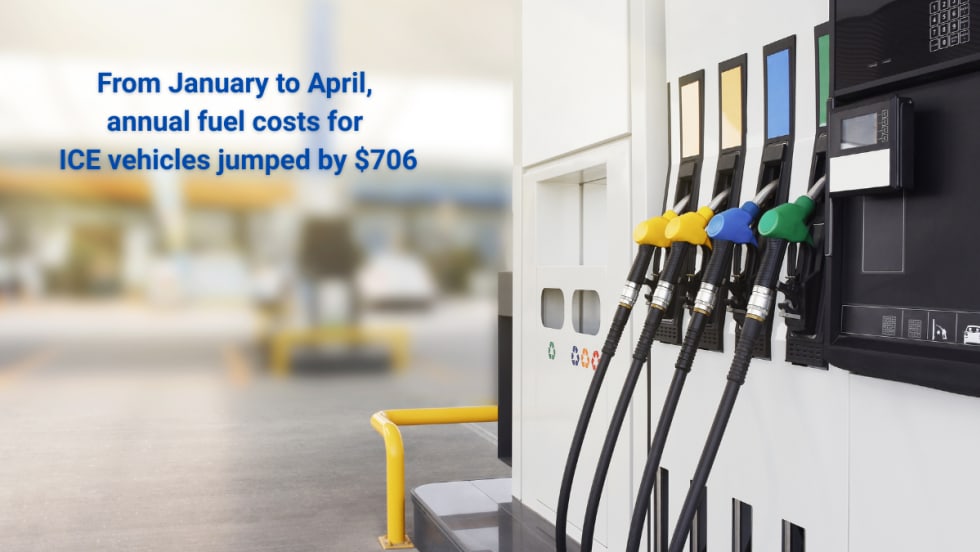
Study: How 2026's Gas Price Hikes Affect Different Vehicle Types
New data from iSeeCars reveals how rising fuel costs have affected different vehicle segments as gasoline prices climbed nearly 46% over the past four months.
Read More →
Are You Tracking Your Fleet's True Total Cost of Ownership?
Bobit Business Media surveyed 190 fleet professionals and found that while most fleets are tracking costs, fragmented systems and data gaps are keeping true TCO visibility out of reach. With rising pressure to control spend in an increasingly volatile environment, the gap between what fleets think they know and what the data actually shows is wider than you might expect. See how your peers are managing costs today and where the industry still has room to improve.
Read More →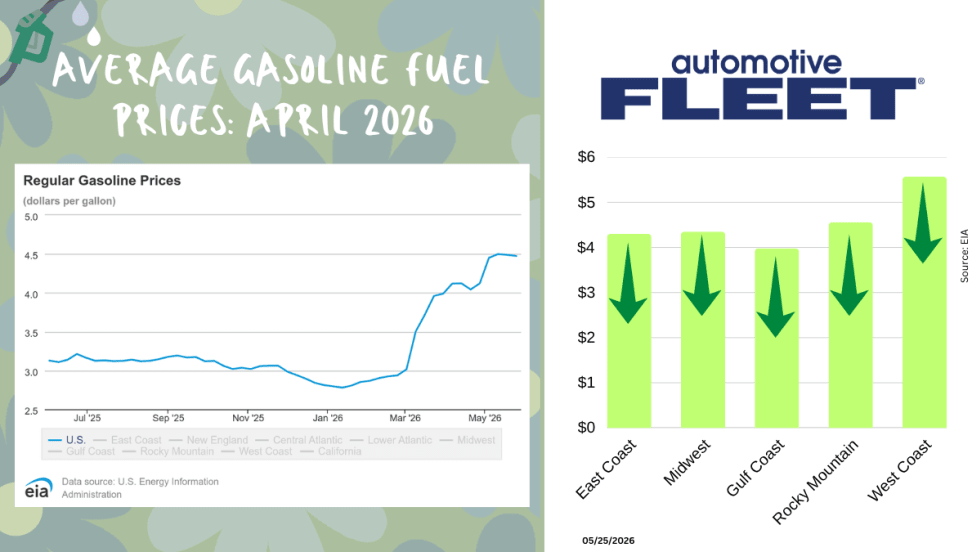
May Fuel Update: All Regions Experience Declines
Gas prices are finally easing in much of the country, but experts warn global tensions could quickly reverse the trend as the national average remains well above last month’s levels.
Read More →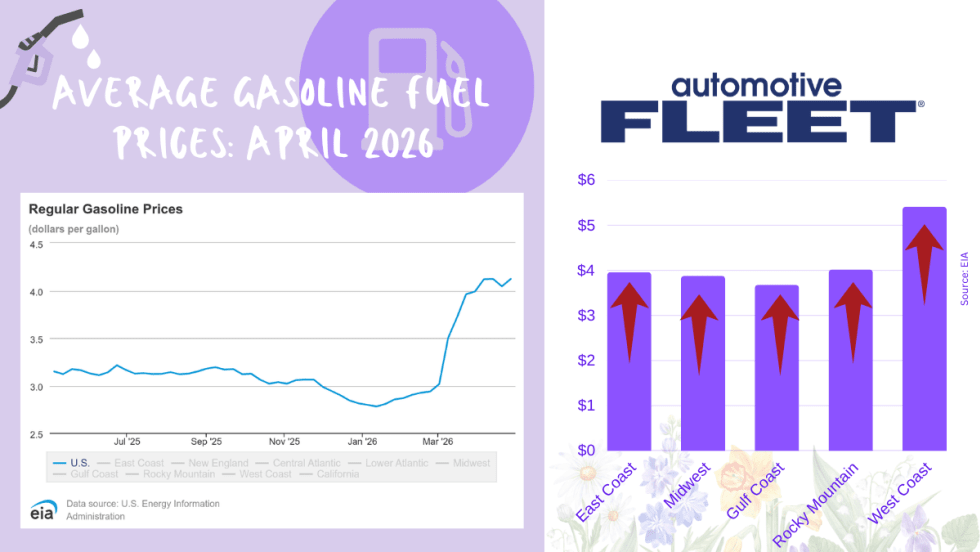
April Fuel Update: Prices Climb Above $4 as Spring Surge Accelerates
National average jumps to $4.04 per gallon, up sharply from last year, with West Coast prices topping $5 and further increases expected amid rising oil tensions.
Read More →
Tips from Fleet Managers on Saving Fuel Costs
Fleet leaders share practical strategies to reduce fuel spend through smarter policy, routing, and driver guidance.
Read More →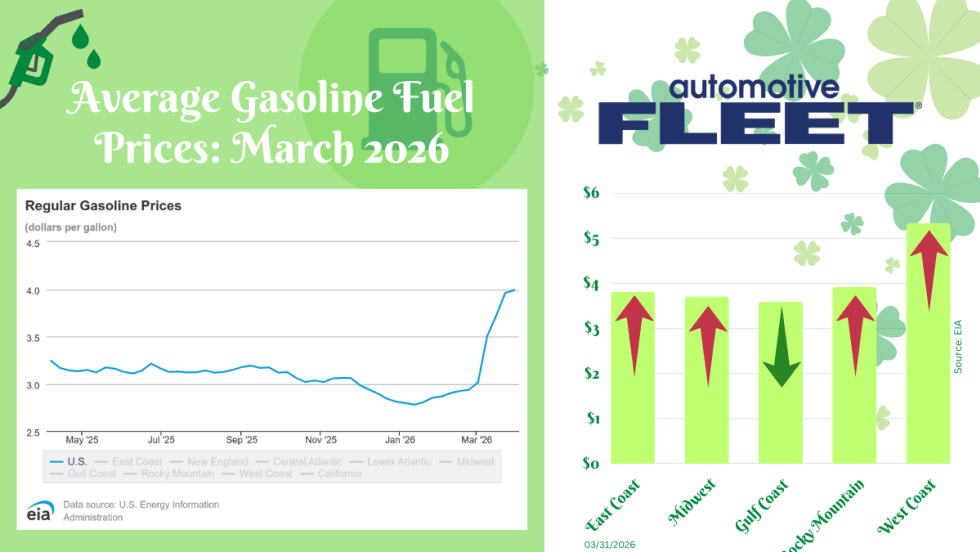
March Fuel Update: Prices Settle With a $4 Average
Fuel prices significantly slowed this week, but a $4 national average is still expected.
Read More →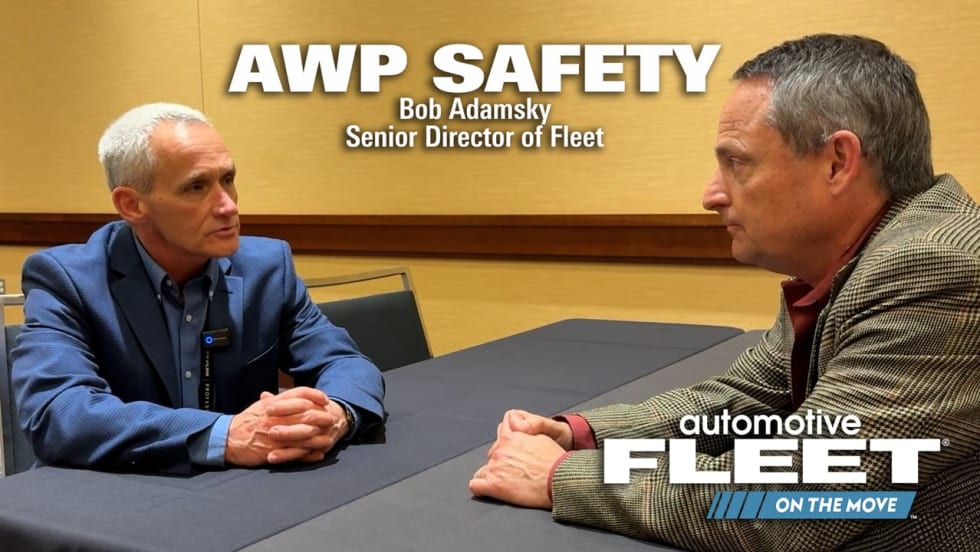
Bob Adamsky on Fuel Volatility: “Don’t Panic — Have a Plan”
With oil prices rising again, AWP Safety’s fleet manager shares how to respond to rising fuel costs and how the right strategy can turn fuel spikes into cost-saving opportunities.
Read More →
Oil Market Turbulence Is Complicating Fleet Cost Planning
Rapid swings in crude oil prices driven by the conflict in the Middle East could create longer-term cost pressures for fleets, affecting fuel prices, supply chains, and vehicle strategy, says NTEA’s Andrew Wrobel.
Read More →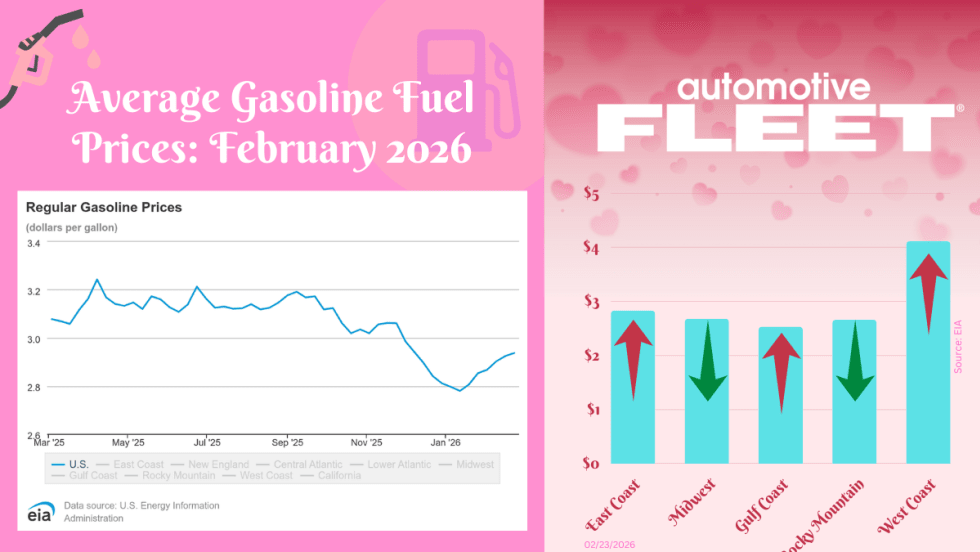
February Fuel Update: Prices Inch Higher for Third Week in a Row
The final February fuel update reveals prices continuing to inch higher for the third week in a row.
Read More →
The 2026 Fuel Economy Guide: Updated Cost and Efficiency Benchmarks for Fleets
Fleet managers can use the DOE’s 2026 Fuel Economy Guide to benchmark MPG across powertrain types using side-by-side vehicle ratings and compare new model-year options.
Read More →