



Data Box
Capital: Brasília
Population: 209,567,920
GDP: US$1.9 trillion
Total Vehicles (incl. private fleet): 80 million
 MENU
MENU SEARCH
Automotive sales declined 28.6% year-over-year during 1Q 2016. In the fleet market, all major OEMs are using various financial incentives to defend their market shares. The 2016 forecast is that there will be 123,000 fleet sales.

Graphic courtesy of istockphoto.com

Graphic courtesy of istockphoto.com
While South America is comprised of 13 countries, about 60% of the people living on the continent reside in Brazil. Today, Brazil is in turmoil, experiencing both a political crisis and economic instability.
On the political front, the country’s Brazilian Senate voted 61 to 20 on August 31, 2016, to impeach suspended President Dilma Rousseff, and removed her from office for the rest of her term. The Brazilian Senate convicted Rousseff on charges of manipulating the federal budget in an effort to conceal the nation’s mounting economic problems.
Of the four Brazilian presidents elected to office since democracy was reestablished in the 1980s, Rouseff is the second to face impeachment. In 1992, Fernando Collor de Mello resigned before the Senate could convict him on corruption charges.
Brazil is not the only South American country coping with a political and economic crisis, neighboring Venezuela is also in midst of a downward spiral of widespread social turmoil.
While the continent has tremendous economic potential and a wealth of natural resources, all of the national economies in South America are currently slowing down, with the most noteworthy being Brazil, since it is the continent’s largest economy.
The three pillars of the Brazilian economy are agribusiness, petroleum exports, and commodities.
“Although Brazil is ranked as the largest economy in Latin America, based on its gross domestic product (GDP), its economy is in contraction,” said Marcelo Tezoto, manager, South America fleet sales development manager for GM Brazil. “The consumer confidence index remained close to its historic minimum, due to the continuing economic recession and political instability.”
From 2000 to 2012, Brazil was one of the fastest-growing economies in the world, but Brazil’s economic growth started to decelerate in 2013, and the country’s economy is expected to shrink by 3.8% in 2015, more than forecast, as demand for its commodities slows. The forecast is for Brazil’s economy to contract another 4% in calendar-year 2016.
“Brazil’s political and economic crisis is creating instability, which is shrinking its domestic markets, not only for automobiles, but for all business segments in Brazil,” said Tezoto. “GDP is expected to be around negative 3%.”
Another reason for the economic slowdown is the fall in crude oil prices. Brazil is the world’s 12th largest oil producer.
“There is also a high dependency on international funds and the volatility of exchange rate fluctuations,” said Tezoto.
Brazil’s economy is affected by the continued contraction of jobs and high inflation rate of 8%, in 2016.
“The unemployment rate stood at 10.9% in the quarter ended in March, which is 3 percentage points above the level observed a year earlier,” said Tezoto. “However, the average real income dropped 3.2% year-over-year in the first month of the year.”
Auto sales are expected to decline again in 2016, for the fourth consecutive year, due to increasing unemployment, high interest rates, tight credit, and economic uncertainty.
The forecast in 2016 is that there will be 123,000 fleet sales in Brazil. Another dark cloud is that government fleet sales are slowing, as government revenues decline, and are not acquiring the same volume of vehicles as it has in prior years.
The automotive industry is a critical sector in the Brazilian economy. With a population of more than 200 million people, Brazil is the largest fleet market in South America. “Currently, the fleet market in Brazil is tough and all automotive manufacturers are using a variety of financial incentives to defend their market shares,” said Tezoto.
Idle factory capacity for the Brazilian auto industry is around 40%.
“When you include vans, buses, and trucks, there are more than 100 nameplates sold in South America. Some markets sell identical vehicles, but have different market strategies and positioning for these vehicles,” said Tezoto.
In 2010, just over 3 million cars were sold in Brazil, making it the world’s fourth largest car market, ahead of Germany, but since then automotive sales have declined.
In 2015, the automotive industry sold around 2.6 million units. This is down 27% compared to 2014. Of the 2.6 million sold in 2015, approximately 28% were sold as fleet units.
Currently, there are 40 brands that are operating in Brazil. “The forecast for 2016 is for annual automotive sales to be around 2.2 million units. The forecast is that the fleet market share will increase to 30%,” said Tezoto.
As of August 2016, automotive sales of Brazilian-made cars decreased 28.6% year-on-year during the first quarter of 2016, according to Anfavea, the country’s national association of motor manufacturers.
Over the past three years, Brazil’s steady decline in domestic sales has been mitigated by rising exports — mostly to Mexico and Argentina under regional trade pacts. In March 2016, 38,559 cars and light trucks were exported, up 19.7% year on year, according to Anfavea.
Out of the approximately 4 million corporate vehicles in Brazil, more than half are located in the southeast region of the country, which contains the major population centers, including Rio de Janiero and Sao Paulo.
The strongest vocational segments acquiring commercial fleets are pharmaceutical, agribusiness, and food companies. There is also a big demand for fleet vehicles by rental companies.
Examples of companies operating major fleets in Brazil are Proctor & Gamble, Johnson and Johnson, Merck, Honeywell, Bayer, and Nestle.
But the majority of fleets are smaller with the average fleet size around 100 units.
One challenge facing fleet managers in Brazil is the geographic dispersion of fleets due to the country’s massive size. This geographic dispersion is compounded by poor road conditions and poor driver education.
“The fleet sales focus we have in Brazil is big companies, while small companies are serviced by the dealers,” said Tezoto.
The Chevrolet subsidiary in Brazil is the largest subsidiary outside of North America. Its dealer network is comprised of 578 points.
GM is looking to further expand its service offerings to Brazilian fleets and retail buyers. For instance, in 2015, General Motors launched OnStar in Brazil, with it debuting as standard equipment in the 2016 Chevrolet Cruze, Cobalt, S10, Trailblazer, Onix, and Prisma. In addition, GM is introducing MyLink2 with connection for Apple CarPlay and Android Auto to its carline in Brazil.
Brazil is a significant automotive manufacturing footprint, with GM itself having three assembly plants and a proving ground in the country.
Brazil imposes 35% import duties to “incentivize” commercial companies to buy vehicles that are produced locally. Not only does the 35% import duty apply to vehicles, but also to imported replacement parts that will be needed during the course of a vehicle’s service life.
In terms of fleet acquisition trends, the compact SUV is one of the fastest growing vehicle segments in the Brazilian market.
Brazil is the 10th largest energy consumer in the world and the largest in South America.
Brazil has a national initiative to reduce dependence on imported petroleum. Historically, imported oil accounted for more than 70% of the country’s oil needs, but Brazil succeeded in becoming self-sufficient in oil in the 2006-2007 time frame.
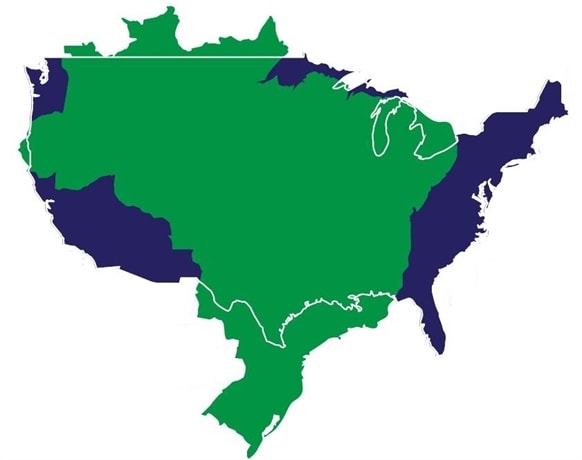
Illustration of geographic outline of Brazil superimposed on geographic outline of the U.S. courtesy of istockphoto.com
Despite this, current fuel prices in Brazil are increasing. Contributing to the increased cost of fuel are taxes on gasoline and diesel, which were increased Feb. 1, 2015.
“Because of the economic and political crises, fuel prices are going up. Companies are looking for flex-fuel vehicles, such as ethanol/gasoline possibilities. Another popular fuel choice is pickup trucks with diesel engines,” said Tezoto.
The used-vehicle market is very strong in Brazil, especially when compared to the new-vehicle market.
In terms of new-vehicle sales, Brazil’s auto industry is having one of its worst years in 2016, due to the nation’s economic crisis. While new-vehicle sales have declined, the used-vehicle sales activity is very robust, as Brazilian consumers seek lower-cost transportation.
“The used-vehicle market is much better than the new-vehicle market. Even though there has been a decrease in volume in the used-vehicle market versus last year, it is lower than the decrease in sales in the new-vehicle market. Vehicle depreciation rates vary and are influenced by engine displacement, size of the vehicle, brand, and other variables. A small vehicle has, on average, 10% depreciation after the first year. A large vehicle, such as an SUV, has around 26% depreciation after the first year of usage,” said Tezoto.
The government has raised taxes and introduced new taxes in an effort to balance Brazil’s budgetary deficit caused by the steep recession in the country’s economy.
There are a number of sales taxes specifically based on the type of vehicle and its powertrain. “Taxation depends on the engine size, type of vehicle, and the segment to which it belongs. For instance, a vehicle with 1.0L engine has a lower taxation rate than a 2.0L engine. Pickup trucks have fewer taxes than passenger cars,” said Tezoto.
In June 2016, the Brazilian Central Bank raised its forecast for Brazil’s consumer-price index for 2016 to 6.9%, from 6.6% in March’s report, but cut its 2017 inflation forecast to 4.7% from 4.9%.
As of July 2016, inflation in Brazil was at 8.4%, continuing a steady decline from the 10.71% inflation rate the country experienced in January 2016.
When coupled with inflationary pressures present in the Brazilian economy, higher interest rates will increase fleet vehicle acquisition costs and the expense of other fleet-related services. But the Brazilian Central Bank is now forecasting a moderation in inflation in 2017, which is welcomed news by both commercial and consumer buyers.
The third-party vehicle maintenance/service provider network in Brazil is not reliable in some parts of the country. But OEM-franchised dealers do a good job in servicing fleets.
While parts availability has been an issue for some Brazilian OEMs, it is not so with General Motors.
“In Brazil, parts availability is not an issue for General Motors. The supply of spare parts for fleet owners and customers in general is good,” said Tezoto.
“Our forecast for 2016 total market sales in Brazil, including fleet and retail, is around 2.5 million to 2.6 million units. In 2016, fleet sales are forecast to be around 700,000 to 800,000 units,” said Tezoto.
Editor's note: This article first appeared online in the Q3 Global Fleet Market Conditions supplement published in October of 2016.

Holman is bringing its Mexican fleet management operation fully under its own brand after more than 30 years as a joint venture. The change gives multinational fleet customers a single Holman operation across the U.S., Canada, and Mexico.
Read More →
The age-old problem of downtime will always be a reality, but with new strategies at hand, fleets have more ways to keep trucks on the road longer.
Read More →
The Top 300 Commercial Fleets: See the List
Read More →

Part Two: Commercial auto remains one of the most challenging and costly lines of coverage for fleet operators and insurers alike. Continue learning more about how to effectively address these issues from Onur Aksan, Enterprise Business Development Executive, Geotab
Read More →
Commercial auto remains one of the most challenging and costly lines of coverage for fleet operators and insurers alike. Learn more about how to effectively address these issues from Onur Aksan, Enterprise Business Development Executive, Geotab.
Read More →
Fleet leaders are under pressure to reduce costs, adapt to economic uncertainty, and make smarter decisions. See how peers across North America are responding with real data, proven strategies, and forward-looking insights. Download the 2026 Market Pulse Report to benchmark your strategy and uncover where you can gain an edge.
Read More →
Enterprise Mobility connects with mobility solutions around the globe
Read More →
Unlock the secrets to a successful transition to electric fleets with Automotive Fleet's comprehensive Fleet Electrification Guide!
Read More →
Viaduct will join Sumitomo as an independent subsidiary. Partnership strengthens global reach and accelerates AI-driven innovation for fleets and manufacturing.
Read More →