




GM’s Lutz Extols ‘Electric Evolution’ at LA Auto Show
LOS ANGELES - Bob Lutz filled in as keynote speaker on day one of the Los Angeles Auto Show press days, outlining GM's electric vehicle research and product development, including the Chevrolet Volt.
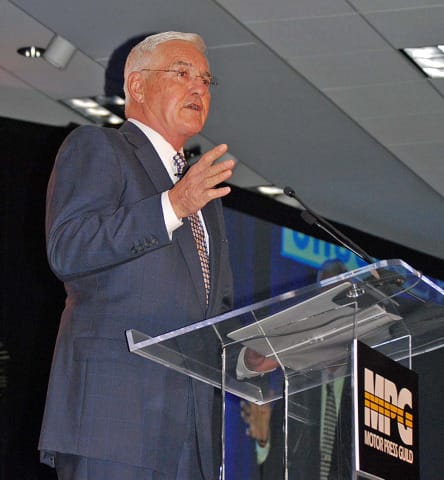
Bob Lutz, General Motors vice chair of marketing and communications, outlined the automaker's electric vehicle research and product development, including the Chevrolet Volt, an electric vehicle with extended-range.
LOS ANGELES - Announcing new partnerships to further develop electric vehicles, Bob Lutz, General Motors vice chair of marketing and communications, told members of the Motor Press Guild (MPG) in a keynote address Dec. 2 at the Los Angeles Auto Show , "Going forward, the auto industry can no longer rely on oil to supply 98 percent of world's automotive energy requirements."
Considering global energy and environmental issues and the automobile's future, that "one fact stands out above all others," said Lutz, who outlined GM's electric vehicle research and product development, including the Chevrolet Volt, an electric vehicle with extended-range.
Lutz was a last-minute substitution for planned speaker GM's CEO Fritz Henderson, who abruptly resigned his post the day before the MPG event. Praising Henderson as an "intelligent" and highly capable leader, Lutz declined to comment further on the GM management development.
Lutz' presentation focused on the "Electric Evolution," and he announced the 2011 Volt will be available first to the California market "by the end of next year," followed by launches in other "lead markets" to be made public in the coming weeks.
He also announced new partnerships with three California utilities - Pacific Gas & Electric, Southern California Edison, and the Sacramento Municipal Utility District - and the Electric Power Research Institute (EPRI), an independent non-profit research organization based in Palo Alto, Calif. With the help of a matching $30 million U.S. Department of Energy (DOE) grant, the partnerships "will advance the electrification of the automobile," Lutz explained.
As part of the program, GM will deliver more than 100 Chevrolet Volts to participants to use in their fleets for two years, starting in early 2011. Findings based on performance data collected though the Volt's OnStar system and driver feedback will be reported to the DOE. The "extended, real-world study will help us make electric vehicles as good as they can be for our EV [electric vehicle] customers," said Lutz.
Advanced lithium-ion battery technology is "key" to marketing and public acceptance of the Volt and other electrically driven vehicles, Lutz said. He described GM's research and development efforts this area, including a joint engineering development contract with LG Chem and Compact Power, and a partnership with the University of Michigan to create a new advanced battery lab and specialized battery engineering curriculum. In August, GM also opened a high-volume lithium-ion battery pack plant in Brownstown, Mich.
Lutz also cited GM's multipronged alternatively powered vehicle strategy, which includes internal combustion engine improvements, broad-scale application of hybrid technology, advanced biofuels, such as cellulosic and non-food-based ethanol development, and hydrogen fuel-cell vehicles, including the Chevrolet Equinox Fuel Cell now undergoing testing with selected GM customers.
In addition to noting the company's technology and research partnerships with business and agencies in China, India, and Brazil, the GM vice chairman pointed out the single "tough, but fair," national standard to control greenhouse gas emissions and fuel economy U.S. automakers endorsed last summer. "A single standard helps OEMs improve our planning and manufacturing efficiency, and develop future product plans with greater consistency and certainty," said Lutz.
More Operations

90% Use Telematics. Are Fleets Getting Safer? | AF News Recap
This week, we're breaking down which industries have the highest rates, how Jamie McKay manages 2,400 vehicles, what's happening with the 2027 fleet awards, and why software-defined vehicles could introduce new costs.
Read More →
What's Best Handled by an FMC, and What's Better Done Directly?
Fleet managers continue to rely on FMCs for essential services but are taking a closer look at where working directly with suppliers can improve efficiency and responsiveness.
Read More →
Fleet Meets: Erin Gilchrist
Meet Erin Gilchrist, the inaugural Mike Antich Spirit of Fleet Award winner, as she shares insights on leadership, mentorship, the power of industry connections, and why people remain at the heart of fleet's future.
Read More →

How 2026 Fleet Visionary Jamie McKay Manages 2,400 Vehicles Across 37 States
How do you keep 2,400 vehicles running across 37 states? Fleet Visionary Award winner Jamie McKay shares how collaboration, flexibility, and a few simple strategies help her tackle fleet management challenges at Aptive Pest Control.
Read More →
Managing Fleet Costs in an Era of Permanent Volatility
Fleet operating costs have risen more than 20% since 2020, raising a key question: When does extending a vehicle's service life stop making financial sense?
Read More →
The Next Evolution of Fleet Management: Autonomous Operations
This opening keynote session at the Fleet Forward Conference highlights the future of autonomous driving for fleets.
Read More →
How to Reduce the Total Cost of Risk From Catalytic Converter Theft
A stolen catalytic converter can cost fleets far more in downtime and lost productivity than in repairs. A total-cost-of-risk approach can help fleet managers quantify their exposure and prioritize theft prevention.
Read More →
Personal-Use Charges Rise as Vehicle Values Fall | AF News Recap
Personal-use charges are climbing, wholesale used-vehicle values are declining, and commercial fleet sales growth is slowing. This week, we're breaking down the latest fleet data, plus how Element Fleet Management is helping Waymo prepare for its first Canadian robotaxi market.
Read More →
Here's When You Should Make an Exception to Fleet Policy
Fleet policies are designed to create consistency, but not every driver or situation fits neatly within standard rules.
Read More →
AI-Native or AI-Acquired: What Should Fleet Managers Look for in an AI Platform?
Six questions can help fleet managers look beyond AI marketing claims to evaluate integration, data access, and real-world operational performance.
Read More →