




Future of Renting Is Bright
While no one expects a nation rolling entirely on rented wheels, the rent-a-car industry has a virtually limitless growth potential.


Consider the growth that the industry has experienced since the close of World War II. Best available estimates place the number of vehicles in operation in 1947 at about 12,000 and the revenues they produced at about $20,000,000. Last year there were more than 70,000 cars in domestic rental operations producing revenues of more than $200,000,000. And the outlook for 1962 is even brighter. AUTOMOTIVE FLEET estimates that 1962 rent-a-car revenues will top $250,000,000. This means that the industry has experienced a 600 per cent increase in fleet size and a 1,200 per cent increase in revenues in less than a decade.
Since the industry has grown so rapidly, it might appear to the casual observer that a leveling-off period is ahead. To the contrary, experienced observers look for a continued healthy growth in the immediate years ahead.
R. A. Petersen, executive vice president of Hertz Corp. said the future growth of the car rental industry will reflect the "continuing change in our society and the expanding need of the average American for increased mobility."
"Since potential is rarely, if ever, achieved through passivity, perhaps the most pertinent factor in the situation is our industry's consistently active efforts to reach out for new customers-by the process of tailoring rent-a-car services to the growing needs of a mobile population," Petersen told AUTOMOTIVE FLEET.
BUILT-IN MARKET
One reason for the almost unlimited growth potential of the car rental industry is readily evidenced in the fact that there are more than 90,000,000 licensed drivers in the United States, one third of whom do not own a personal car. This is a built-in-and virtually untapped market. By a steady series of innovations and promotion campaigns-including special rates and tin use of credit-the car rental industry is getting-and will continue to get these drivers into rented cars.
"Unquestionably, the industry's growth has been, and is being, greatly stimulated by increased convenience and accessibility of rent-a-car service and by the growing number of special car rental services and rates," Petersen said.
Some of these services, according to Petersen, include "rent it here . . . leave it there"-which makes one-way motoring possible. Free delivery of rented cars to home or office is also provided in some cities. Arrangements with carriers and hotel-motel chains make it possible to offer "package" vacations featuring use of a rented car.
To get its message across to the public, the rental industry will spend an estimated $20,000,000 on national and local advertising in 1962. This is a substantial sum when compared with the first rent-a-car advertisement-a 50 cent classified ad in 1904.
"In the years ahead, business and travel will increase still more and society's general need for mobility will further expand," Petersen said. "These years will bring an era characterized by more cars, more rental locations and continuing healthy growth for the already burgeoning rent-a-car industry."
AIR TRAVEL AIDS INDUSTRY
The spectacular post-war increase in air travel is another factor favorable to the growth of the rent-a-car industry.
Since jet planes now can carry travelers virtually anywhere in the world in a matter of hours, vacationers are able to enjoy more of their valuable vacation time by renting a car when they reach their destination rather than spending several days or even a week driving. By tin's same "fly-drive" method, business travelers get the mobility they need to cover destination areas more thoroughly. There isn't much sense, for example, in having a salesman take a full day to drive from Detroit to Chicago or New York to Boston, and another full day out of his work week to drive back home. He can fly to his destination in less than an hour, rent a car and take care of his business, using a full five days, and then fly back home. The "fly-drive" method results in a return to a five day sales week, rather than a three day week.
Competition Grows
Competition in the rent-a-car field is continuing to become fierce as the newcomers grow and the old-line firms expand.
Both Avis and National Car recently completed reorganization and expansion programs aimed at giving them an increased share of the market. And Hertz, the giant of the field, shows no signs of letting up. Hertz expenditures for equipment this year will be at a record high.
The newcomers are beginning to flex their muscles. Kinney Corp., headquartered in New York, plans to expand to the Miami market. Kinney now operates more than 3,000 cars, double the number it had a year ago. Econo-Car, which began operations 14 months ago, now has outlets in 16 states and plans to expand to all 50 states within the year.
Budget-Rent-A-Car, according to President Jules Lederer, will have a 1963 volume of $9,000,000 to $12,000,000 as the result of "aggressive advertising and lower rates." Budget, based in Chicago anticipates 1962 volume to hit $4,500,000.
Olin's Rent-A-Car System Inc., which has operated exclusively in Florida for the past 28 years, has now branched out and now operates in such cities as New York, Boston and Atlanta. President L. R. Smith told AUTOMOTIVE FLEET that Olin's should increase its fleet size "by tenfold by 1966." Plans call for offices or licensees in the top 20 major population cities by the end of 1963.
Cars Rental System Inc., an association of new car dealers who are in the rental and leasing field, has also expanded operations. As part of its program to help new car dealers increase their share of market, the association conducts special educational seminars on renting and leasing.
More Operations
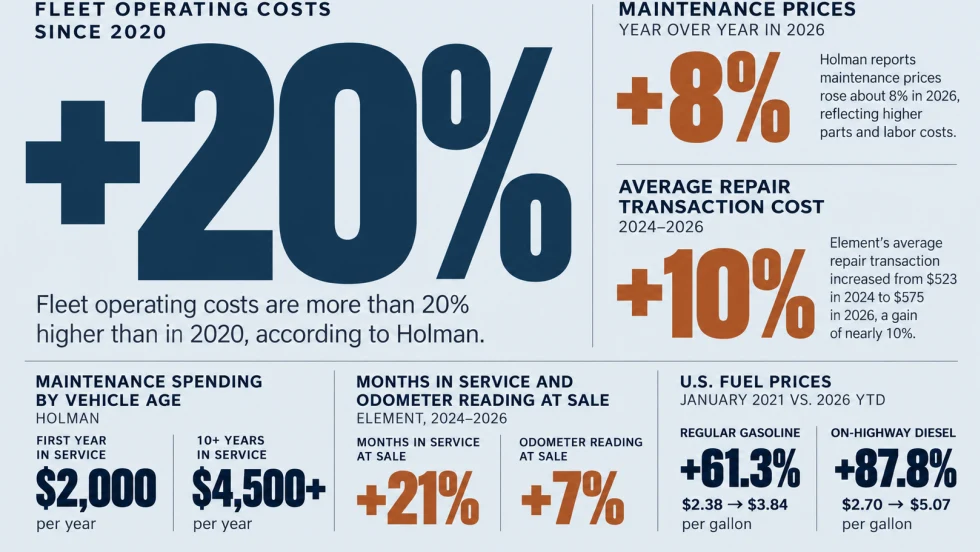
Managing Fleet Costs in an Era of Permanent Volatility
Fleet operating costs have risen more than 20% since 2020, raising a key question: When does extending a vehicle's service life stop making financial sense?
Read More →
The Next Evolution of Fleet Management: Autonomous Operations
This opening keynote session at the Fleet Forward Conference highlights the future of autonomous driving for fleets.
Read More →
How to Reduce the Total Cost of Risk From Catalytic Converter Theft
A stolen catalytic converter can cost fleets far more in downtime and lost productivity than in repairs. A total-cost-of-risk approach can help fleet managers quantify their exposure and prioritize theft prevention.
Read More →

Personal-Use Charges Rise as Vehicle Values Fall | AF News Recap
Personal-use charges are climbing, wholesale used-vehicle values are declining, and commercial fleet sales growth is slowing. This week, we're breaking down the latest fleet data, plus how Element Fleet Management is helping Waymo prepare for its first Canadian robotaxi market.
Read More →
Here's When You Should Make an Exception to Fleet Policy
Fleet policies are designed to create consistency, but not every driver or situation fits neatly within standard rules.
Read More →
AI-Native or AI-Acquired: What Should Fleet Managers Look for in an AI Platform?
Six questions can help fleet managers look beyond AI marketing claims to evaluate integration, data access, and real-world operational performance.
Read More →
A buyer's guide to fleet management software in 2027
Buying fleet management software in 2027 means looking beyond features and price. As fleet operations, technology and expectations evolve, this guide explores what today’s fleet professionals should consider when choosing a system that can deliver value now and adapt to what comes next.
Read More →
What Will Shape the Next Era of Fleet Management?
EVs, AI, and autonomous vehicles are reshaping fleet management. Discover what’s ahead—and how fleet leaders can prepare for the next era.
Read More →
How Fleets Can Recruit and Train Veterans for Technician Roles
Here's how the technician shortage has affected uptime for fleets, and what to do about it.
Read More →
Avis Budget Group Deploys Neology Toll Management Technology Across Major Brands
Neology’s neoFleet platform will manage toll transactions and toll-authority operations for vehicles across Avis, Budget, Payless, Budget Truck and Zipcar.
Read More →