




Why NAFA Wants to Change its Name
NAFA says changing its name is much more than just a new moniker; it is a philosophical change for how the association will approach its customers and position itself to attract potential new members and affiliates.


Gayle Pratt, director of fleet and indirect purchasing, Global Operations, for Ecolab Inc., and current NAFA president.
The National Association of Fleet Administrators (NAFA) announced at its 2007 Fleet Management Institute in Houston that as part of NAFA’s year-long branding initiative, it’s preparing to change the association name to Fleet Management Association. The chairperson of the Branding Oversight Committee (BOC) is Patsy Brownson, CAFM, fleet director at Cox Enterprises, Inc., Atlanta. Brownson is also a past president of NAFA. The BOC co-chair is Oleg Cytowicz, automotive fleet coordinator with Unilever in Englewood Cliffs, N.J.
The reason for the proposed name is to better define NAFA and clearly differentiate it from similar organizations. The name change will also serve to resolve two inconsistencies in its current name. To learn more about NAFA’s proposed name change, Automotive Fleet recently interviewed Gayle Pratt, NAFA’s new president.
AF:Why does NAFA feel it is necessary to change the association’s name after 50 years of use?
Pratt:The organization’s name and logo are just part of our re-branding initiative. Branding is much more than attaching a name to an offering. Branding means making a promise to customers about delivering a fulfilling experience and a high level of performance. As part of our branding effort, we are now making that promise and putting things in place to enable the association to deliver a fulfilling experience to every customer — every member, affiliate, supplier, and prospective stakeholder — every time they come in contact with us. So, this change is much more than just a name change; it is a philosophical change for how the association will approach its customers and how it will position itself to be attractive to potential customers.
We intend to retain our history and the value of NAFA’s legacy to members and the industry; they make up the foundation of who and what we are today. Now we will build on that foundation and strength.
The recommendation to change the association’s name to the Fleet Management Association solves several issues. From a tactical standpoint, it resolves inconsistencies in the current name: we are not a “national” association and we are more than “administrators” in our profession. We have long had members and affiliates in Canada, and for several years, we have had a handful of overseas members. The title ‘“Administrator” no longer accurately reflects many of the job titles in leadership and management of today’s fleet professionals. Also, the new name takes the emphasis away from who the association represents and puts it on what we represent. We are not just an association for fleet managers, we are an association for the entire fleet management profession. This opens the door for any and all who are involved in any type of fleet management, and provides for broader membership growth.
AF:What was the process that NAFA employed in selecting a new name for the organization?
Pratt: Every member and affiliate has been asked to participate in surveys and other forms of feedback over the past three years.
In 2004, the Board of Governors developed a strategic plan based on a broad and comprehensive survey of both members and affiliates. As those strategic plan initiatives took form and implementation stages began to develop, we realized in 2005 we needed a review of the association’s name, its brand, brand promise, and commitment to members and affiliates.
We engaged a consulting firm to assist us with the branding effort early in 2006. The consulting firm conducted surveys of members and affiliates to understand their levels of satisfaction with and commitment to the NAFA brand. In addition to online surveys, the consultants and staff conducted telephone surveys seeking feedback from a variety of member segments. Armed with that new information, throughout the year, we held branding workshops at the Board of Governors meetings, which include all 34 local chapter chairs, the national committee chairs, and the Board of Trustees.
At the February 2007 Board of Governors meeting, the Branding Oversight Committee was established to move this initiative to final development and implementation. This committee, staff, and the incoming and outgoing Boards of Trustees then met in March 2007 to make final recommendations, based on the eight months of extensive study, research, and feedback from our consultants, volunteers, and membership.
AF: How will the name change benefit NAFA members and affiliates?
Pratt: Members and affiliates will benefit by having a better association, one that delivers on its promises. As I said, this is more than just a name change; this is a philosophical change for how the association will approach its customers and how it will position itself to be attractive to potential customers.
Members and affiliates will also benefit because we will be more inclusive, which will expand our resources, our expertise, and our abilities.
More than 150 members and affiliates spent time with the Branding Oversight Committee and the branding consultant at the annual conference in May in Houston, to provide feedback on the proposed name change, the branding effort, and membership services in general. They overwhelmingly supported everything being proposed. They felt the proposed name accurately reflects who we are as professionals and where the association should be positioned. They also noted the name does not have limits, as does our current name. Rightfully so, they do have expectations of the association and how things will improve. We are confident our plans and strategies will deliver a new association that exceeds their expectations.
We are also confident that the proposed name will unify our profession and clarify that we are all professionals in fleet management. The new name gives us the opportunity to grow and engage the fleet community at large — not restricted by boundaries.
AF: What were some of the other proposed names that were contenders as the association’s new name?
Pratt: There were many names, combinations of names, and adverbs and adjectives tested and tried at the two-day board meeting in March. But we kept coming back to focusing on simplicity and accuracy. For instance, the terms “international,” “global,” or “worldwide” are often changed as the popularity of those phrases swings. We felt that by being silent on that issue, we were accomplishing the same goal and allowing ourselves the freedom to be international or global without saying so.
The Fleet Management Association provides for growth and the opportunity to offer education and services as our membership grows. All along, we wanted the name to complement the education competencies for which we are so widely recognized — those core fleet management skills that are needed by all fleet professionals. We are careful not to segment our membership by type of fleet, or create education that deviates from the core fleet competencies, so neither should our name.
AF: Why did NAFA decide to change the name of its annual conference and eliminate the Law Enforcement Group reference?
Pratt: We adopted the typical branding protocol, recommended by the Branding Oversight Committee and board leaders. This protocol calls for the association’s name or acronym to always be first and most prominent, followed by the name of the product, service, or event. They want to retain the word Institute as it confers a higher education event and garners more support for travel and education development. So the Fleet Management Association Institute and Expo would be descriptive of the annual conference while ensuring the association’s name is always first.
That being said, the Institute is and will still be geared for diverse fleets. Our annual event will still be the event for all of fleet management and will still have law enforcement fleet topics. The Public Safety Group (formerly LEG) will develop public safety fleet education for the event, while the Curriculum Committee will create education appealing to all segments of fleet management, and the Affiliates Committee will support these events with diverse business solutions for the fleet industry.
AF: What is the communication strategy to transition to the new name?
Pratt: We will be communicating to members, affiliates, and the entire fleet and automotive communities through press releases, articles, interviews, newsletters, Web sites, and any and all means. This interview is part of that communication plan, where we are answering the FAQs that people have and letting them know how we arrived at this point.
From June through August, we will be testing a new logo design and tag line, by asking members and affiliates to give us their feedback online. In August, we will ask all eligible members to vote on the new name to officially make the change, as required in our bylaws.
If the new name is approved, we will begin a transition from “NAFA” to “FMA.” The name, logo, and “NAFA” will not immediately disappear, as we are cognizant that we want to retain our history and provide a link from the former name and acronym to the new association name and brand. Over the course of several months, into 2008, we will be phasing out the “NAFA” name and brand. We are following a concept similar to that followed by AT&T and Cingular, where first it was introduced that the two will merge, then they announced that Cingular was becoming AT&T, and now the Cingular brand and logo are slowly disappearing.
AF:Re-branding strategies are expensive propositions. Do you anticipate the gains to offset the expense?
Pratt: Our strategic plan recognized that changes we’d be researching, analyzing, proposing, and implementing for the association would require funds to successfully implement. As such, we earmarked funds to ensure our strategic initiatives would be implemented professionally. Re-branding is a most important step for the association; our efforts have been developed with great thought and within means, and are being implemented with concise strategy and clarity.
We believe the gains will be realized in the short-term, as well as in the longterm. There are literally thousands of companies, organizations, and entities that we plan to reach out to as a result of our efforts.
Thank you for allowing us this opportunity to present this important message to your readers. If anyone should have any additional questions or require more information, they may contact Phil Russo, our executive director, at prusso@nafa.org, or visit the association’s Web site at www.nafa.org.
NAFA’s New President
Gayle Pratt, director of fleet and indirect purchasing, Global Operations, for Ecolab Inc., was named president of NAFA during the association’s conference in Houston in May. A NAFA member since 1991, her fleet career spans more than 28 years in the private and public sectors. Pratt held her first national committee chair position in 1995 and first served on the Board of Trustees as treasurer in 1997.
More Operations

How to Manage Conflict for Your Fleet Operations
Conflict management is becoming a core leadership skill. Here are five strategies fleet leaders should know.
Read More →
Turning Connected Vehicle Data Into Decisions That Matter
Fleet leaders have more data than ever, but turning that data into clear, actionable decisions remains a challenge. This white paper shows how leading organizations are using connected vehicle data to improve safety, reduce costs, and optimize fleet performance. Learn how to turn insight into action across your fleet.
Read More →
Cameras, Safety and Insurance: From Reactive Claims to Real-time Prevention
Commercial auto remains one of the most challenging and costly lines of coverage for fleet operators and insurers alike. Learn more about how to effectively address these issues from Onur Aksan, Enterprise Business Development Executive, Geotab.
Read More →

Are You Tracking Your Fleet's True Total Cost of Ownership?
Bobit Business Media surveyed 190 fleet professionals and found that while most fleets are tracking costs, fragmented systems and data gaps are keeping true TCO visibility out of reach. With rising pressure to control spend in an increasingly volatile environment, the gap between what fleets think they know and what the data actually shows is wider than you might expect. See how your peers are managing costs today and where the industry still has room to improve.
Read More →
Turn Fleet Data Into Smarter Decisions
Fleet leaders have access to more operational data than ever, but disconnected systems and unclear metrics often slow decision-making instead of improving it. This article outlines five practical steps fleets can take to transform fragmented data into actionable insights that improve planning, safety, utilization, and long-term performance.
Read More →
Hybrids: Electrification Without the Challenges
For fleet managers, fuel is one of the biggest line items in the budget — and it's one hybrids can shrink without changing how your people work. Download the eBook to see the numbers, understand the technology, and get a step-by-step guide to making the switch.
Read More →
How NOV Uses Telematics to Improve Fleet Safety Across 160 Locations
James Victory of NOV discusses how the company manages fleet safety, maintenance, and telematics across more than 150 locations supporting oilfield operations throughout the U.S.
Read More →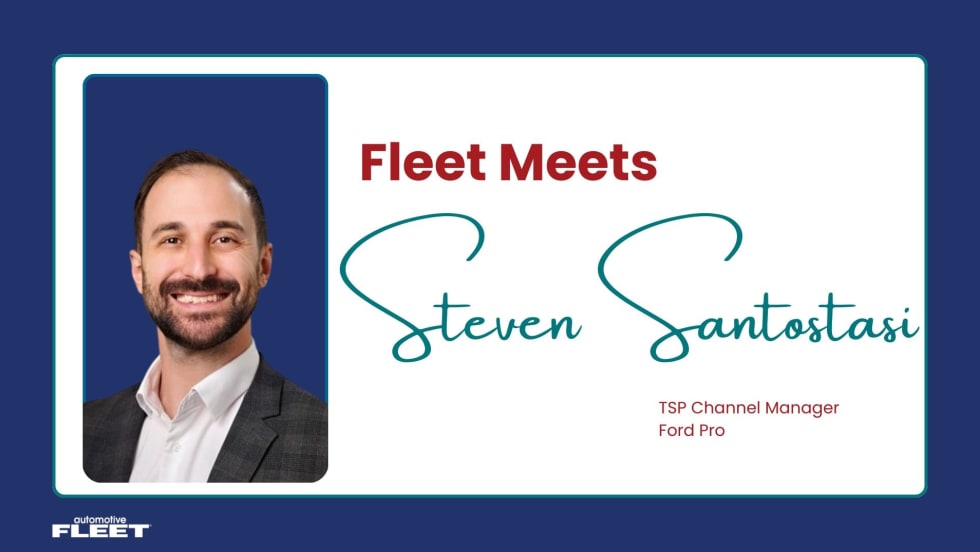
Fleet Meets: Steven Santostasi
This edition of the Fleet Meets series features Steven Santostasi, the current TSP channel manager for Ford Pro.
Read More →
Why Fleet Managers Are Replacing Departmental Vehicles with Shared Motor Pools
Departmentally assigned vehicles often create hidden costs through underutilization, poor visibility, and increased administrative burden. This white paper explores how shared motor pool strategies help fleets reduce costs, improve accountability, and optimize vehicle utilization.
Read More →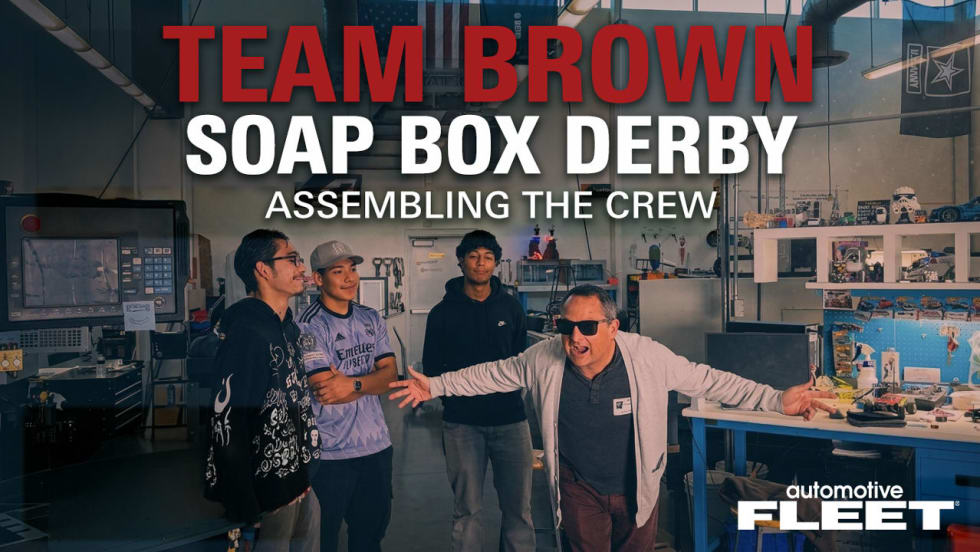
Soap Box Derby Challenge: Assembling the Crew
Meet Gabriel, Matthew, and Angel — the team helping bring this soap box derby build to life.
Read More →