




2013 Cadillac XTS to Feature Active Safety & Driver Assistance System
DETROIT – The all-new 2013 Cadillac XTS introduces an advanced active safety and driver assistance system. According to General Motors, the system represents a significant milestone toward the development of self-driving vehicles.
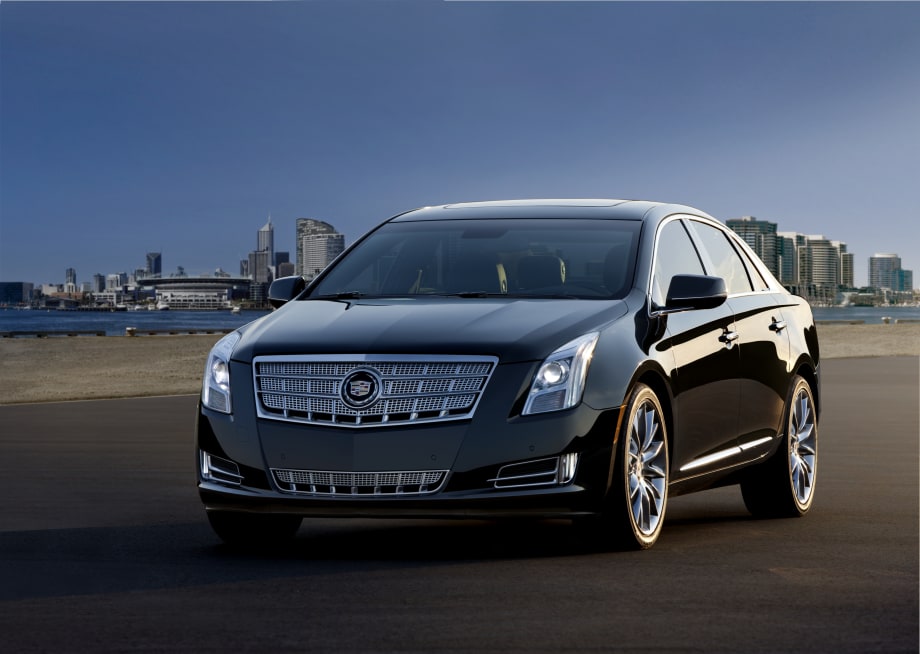
2013 Cadillac XTS
DETROIT – The all-new 2013 Cadillac XTS introduces an advanced active safety and driver assistance system. According to General Motors, the system represents a significant milestone toward the development of self-driving vehicles.
2013 Cadillac XTS
Coming this fall to XTS, the available Driver Assistance Package is the first General Motors system of its kind to use sensor fusion, which enables integration of a broad range of sensing and positioning technologies that can alert drivers of road hazards and help them avoid crashes.
The system’s use of radar, cameras and ultrasonic sensors enables advanced safety features, including:
Rear Automatic Braking
Full-Speed Range Adaptive Cruise Control
Intelligent Brake Assist
Forward Collision Alert
Safety Alert Seat
Automatic Collision Preparation
Lane Departure Warning
Side Blind Zone Alert
Rear Cross Traffic Alert
Adaptive Forward Lighting
Rear Vision Camera With Dynamic Guidelines
Head Up Display
“We believe sensor fusion will enable future active safety systems to handle a greater number of inputs to provide 360 degrees of crash risk detection and enhanced driver assist features,” said Bakhtiar Litkouhi, GM research and development lab group manager for perception and vehicle control systems.
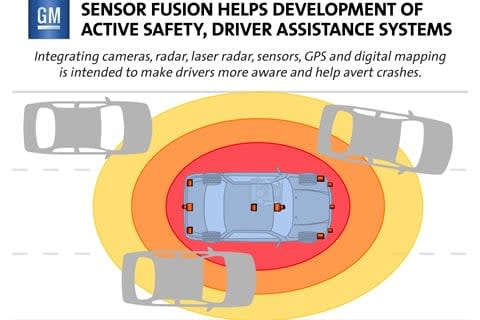
GM Sensor Fusion
“A system that combines the strengths of multiple sensing technologies and expertly manages those inputs can provide advisory, warning and control interventions to help drivers avoid collisions and save lives,” Litkouhi said.
Sensor fusion also is a building block in the development of semi-autonomous and fully autonomous vehicles, which are designed to maintain lane position and adapt to traffic environments. More sophisticated self-driving technology, which could enable semi-autonomous and fully autonomous driving, is expected by the end of the decade.
GM’s work on sensor fusion draws on its experience with The Boss, a fully autonomous Chevrolet Tahoe developed by GM, Carnegie Mellon University and other partner companies, and named for GM R&D founder Charles F. “Boss” Kettering. In 2007, The Boss navigated 60 miles of urban traffic, busy intersections and stop signs in less than six hours to win the Defense Advanced Research Projects Agency (DARPA) Urban Challenge competition.
Sensor fusion development also is bolstered by GM’s work on the EN-V, three semi-autonomous electric concept vehicles unveiled at the 2010 Shanghai World Expo. By combining GPS with vehicle-to-vehicle communications, distance-sensing and object detection technologies, EN-V can be driven both manually and autonomously -- the latter allowing it to automatically select the fastest route based on real-time traffic information.
Among the technologies that GM is considering to develop for future active safety systems is LIDAR, a light detecting and ranging technology that can measure the distance to a vehicle or object by illuminating it, often using pulses from a laser. Although LIDAR is no replacement for driver vision, it can become another set of eyes when visibility has deteriorated due to inclement weather or darkness. When combined with radar, cameras and ultrasonic sensors, LIDAR has potential crash avoidance capability.
A more advanced positioning system, using more accurate GPS and digital mapping, also is expected to play an important role on future active safety systems because it helps locate vehicles in relation to one another. While GPS effectiveness can be limited in urban canyon environments where high-rise buildings can interfere with satellite signals, the technology is still considered an asset when “fused” with other sensing and positioning technologies.
“No sensor working alone provides all the needed information. That’s why multiple sensors and positioning technologies need to work together synergistically and seamlessly,” Litkouhi said. “Sensor fusion will help facilitate that.”
More Safety

Nominations Open for 2026 Fleet Safety Award
Nominations have officially opened for the 2026 Fleet Safety Award Winner.
Read More →
Turning Connected Vehicle Data Into Decisions That Matter
Fleet leaders have more data than ever, but turning that data into clear, actionable decisions remains a challenge. This white paper shows how leading organizations are using connected vehicle data to improve safety, reduce costs, and optimize fleet performance. Learn how to turn insight into action across your fleet.
Read More →
Cameras, Safety and Insurance: From Reactive Claims to Real-time Prevention
Commercial auto remains one of the most challenging and costly lines of coverage for fleet operators and insurers alike. Learn more about how to effectively address these issues from Onur Aksan, Enterprise Business Development Executive, Geotab.
Read More →

NAFA Fleet Safety Symposium to Collocate With 2026 Fleet Forward Conference
The daylong certificate program will precede the Fleet Forward Conference at the Gaylord National Harbor in Maryland.
Read More →
The Distractions You Can’t Turn Off: What Drivers Face Outside the Vehicle
Fleet drivers face constant visual, cognitive, and environmental interruptions the moment they hit the road. From roadside chaos to mental fatigue and digital overload, today’s biggest driving risks often come from outside the vehicle itself.
Read More →
FLASH Weather AI Launches First Deep-Learning Hail Prediction Model With High-Resolution Forecasting
FLASH Weather AI has launched a first-of-its-kind hail prediction model capable of forecasting hail size and arrival time at 1-kilometer resolution up to 55 minutes ahead, giving fleets and insurers critical time to prepare for severe storms.
Read More →
How Coca-Cola United Protects Its Fleet from Growing Legal Risk
As litigation risk rises, vehicles are increasingly targeted. This Coca-Cola bottler shares how it’s reducing exposure through driver training, technology, and a proactive risk management approach.
Read More →
How to Speak the Same Language on Fleet Safety
Drivers, supervisors, and data often speak different safety “languages.” Getting on the same page will drive better results.
Read More →
Fleet Cybersecurity 101: What You Need from Your Technology Vendors
From identity management to third-party certifications, the right technology partner should make security easier to manage. Here are the three building blocks that fleet managers need to stay in control as connected systems scale.
Read More →
Reducing Risk by Eliminating Phone Use Behind the Wheel
Distracted driving remains one of the most persistent risks in fleet operations. New approaches focus on removing mobile device use entirely while adding real-time safety support.
Read More →