




GM Says Self-Driving Vehicle Technology to be Available by Decade’s End
DETROIT - General Motors’ Vice President of Global Research and Development Alan Taub commented on autonomous vehicle development during the Intelligent Transport Systems World Congress in Orlando.
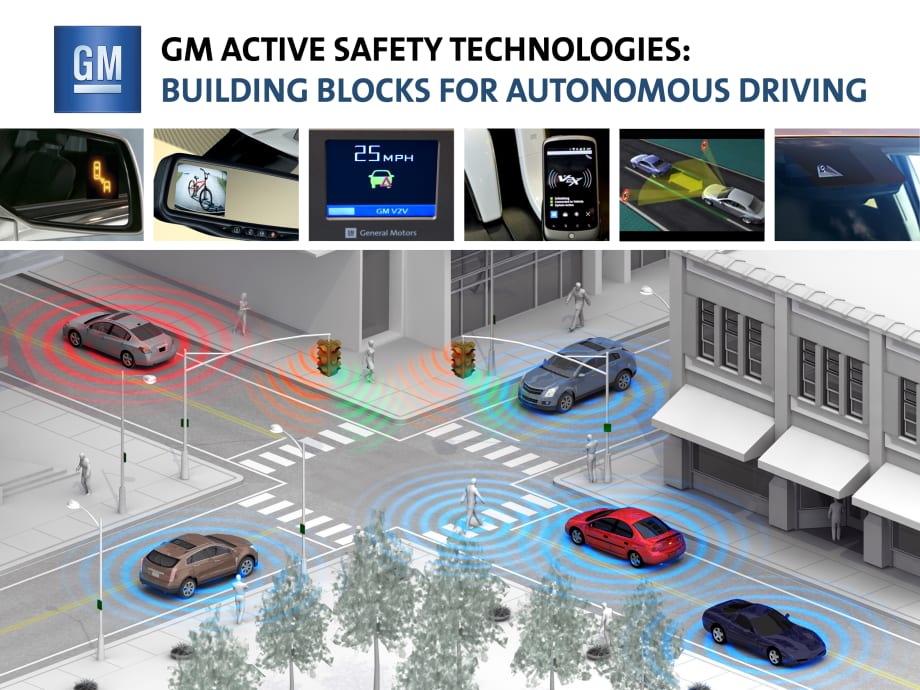
This diagram from GM shows how a range of technologies will work together to enable autonomous driving.
This diagram from GM shows how a range of technologies will work together to enable autonomous driving.
DETROIT – General Motors’ Vice President of Global Research and Development Alan Taub said technologies that enable vehicles to drive themselves will be available by the end of the decade. He added that vehicles that partially drive themselves will be available by the middle of the decade.
Taub made these comments to the Intelligent Transport Systems World Congress in Orlando on Sunday, Oct. 16. He said that these new technologies are being built on leading-edge active safety systems. Technologies such as sensors, radar, portable communication devices, GPS, and cameras provide information about the vehicle and its surroundings to a vehicle’s computer system and the driver.
“The technologies we’re developing will provide an added convenience by partially or even completely taking over the driving duties,” Taub said. “The primary goal, though, is safety. Future generation safety systems will eliminate the crash altogether by interceding on behalf of drivers before they’re even aware of a hazardous situation.”
GM said it’s already including a number of these safety systems in its vehicles. A lane departure warning system is available on the Chevrolet Equinox and GMC Terrain; the Cadillac Escalade, GMC Yukon, Chevrolet Tahoe, and Suburban all offer an available side blind-zone alert. A number of GM vehicles, including the Equinox and Terrain, offer back-up cameras.
The automaker said additional advanced safety systems in development that will provide the foundation for autonomous driving including the following:
Crash Avoidance: A crash avoidance system available on the 2012 GMC Terrain uses a camera to help drivers avoid front-end and lane departure crashes. The system uses a high-resolution digital camera mounted on the windshield ahead of the rearview mirror to look for shapes of vehicles and lane markings, alerting the driver to possible collisions and lane departures.
V2V and V2I Systems: Vehicle-to-vehicle and vehicle-to-infrastructure communication systems gather information from other vehicles, roadways, and traffic signals to warn drivers about possible hazards ahead. For example, slowed or stalled vehicles, hard-braking drivers, slippery roads, sharp curves, and upcoming stop signs and intersections. These systems, on display this week at the ITS World Congress, can be embedded in the vehicle or be added as applications to portable devices/smartphones that connect wirelessly to the vehicle.
The EN-V urban mobility concept combines GPS with vehicle-to-vehicle communications and distance-sensing technologies to enable autonomous driving. The EN-V’s capabilities, which GM said are being demonstrated at the ITS World Congress, includes pedestrian detection, collision avoidance, platooning, and automated parking and retrieval, where the EN-V drops off its driver, parks itself and then returns to pick up the driver via commands from a smartphone.
With regard to autonomous vehicle system development, GM worked with Carnegie Mellon University to develop the “The Boss” Chevrolet Tahoe that brought autonomous vehicle operation to life in 2007 and won the DARPA Urban Challenge.
The event required teams to build a driverless vehicle capable of driving in traffic and performing complex maneuvers such as merging, passing, parking, and negotiating intersections over a 60-mile course.
More Safety

Nominations Open for 2026 Fleet Safety Award
Nominations have officially opened for the 2026 Fleet Safety Award Winner.
Read More →
Turning Connected Vehicle Data Into Decisions That Matter
Fleet leaders have more data than ever, but turning that data into clear, actionable decisions remains a challenge. This white paper shows how leading organizations are using connected vehicle data to improve safety, reduce costs, and optimize fleet performance. Learn how to turn insight into action across your fleet.
Read More →
Cameras, Safety and Insurance: From Reactive Claims to Real-time Prevention
Commercial auto remains one of the most challenging and costly lines of coverage for fleet operators and insurers alike. Learn more about how to effectively address these issues from Onur Aksan, Enterprise Business Development Executive, Geotab.
Read More →
NAFA Fleet Safety Symposium to Collocate With 2026 Fleet Forward Conference
The daylong certificate program will precede the Fleet Forward Conference at the Gaylord National Harbor in Maryland.
Read More →
The Distractions You Can’t Turn Off: What Drivers Face Outside the Vehicle
Fleet drivers face constant visual, cognitive, and environmental interruptions the moment they hit the road. From roadside chaos to mental fatigue and digital overload, today’s biggest driving risks often come from outside the vehicle itself.
Read More →
FLASH Weather AI Launches First Deep-Learning Hail Prediction Model With High-Resolution Forecasting
FLASH Weather AI has launched a first-of-its-kind hail prediction model capable of forecasting hail size and arrival time at 1-kilometer resolution up to 55 minutes ahead, giving fleets and insurers critical time to prepare for severe storms.
Read More →
How Coca-Cola United Protects Its Fleet from Growing Legal Risk
As litigation risk rises, vehicles are increasingly targeted. This Coca-Cola bottler shares how it’s reducing exposure through driver training, technology, and a proactive risk management approach.
Read More →
How to Speak the Same Language on Fleet Safety
Drivers, supervisors, and data often speak different safety “languages.” Getting on the same page will drive better results.
Read More →
Fleet Cybersecurity 101: What You Need from Your Technology Vendors
From identity management to third-party certifications, the right technology partner should make security easier to manage. Here are the three building blocks that fleet managers need to stay in control as connected systems scale.
Read More →
Reducing Risk by Eliminating Phone Use Behind the Wheel
Distracted driving remains one of the most persistent risks in fleet operations. New approaches focus on removing mobile device use entirely while adding real-time safety support.
Read More →