





Dive Deeper: More Than Half of U.S. Trucks Use Advanced Diesel Technology
RFID Technology Can Help Manage Fleet Loads
Adding tiny RFID tags to incoming and outgoing cargo in trucks can help the driver and the distribution office keep track of items.
March 1, 2008
Active devices transmit a short range radio signal, while passive devices respond to reception of a short range radio signal.
6 min to read
[EMPTY CREDIT]
Radio frequency identification (RFID) may be an unfamiliar term to many. Turnpike drivers who pass through an automatic toll pass experience one type of RFID device. A pet implanted with a microchip for identification is another type. RFIDs are becoming a growing technology in today’s fleet.
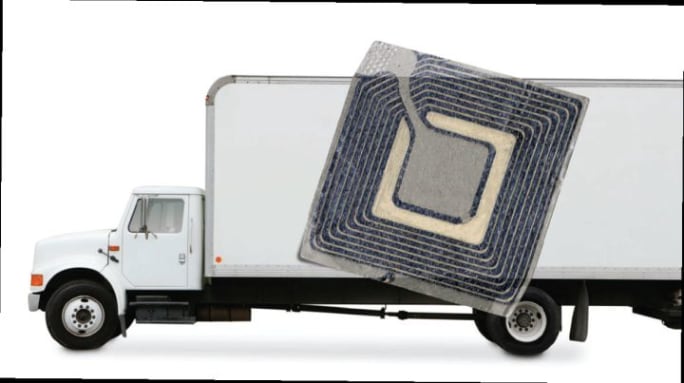
Radio frequency and other forms of wireless product identification devices and systems are increasingly used worldwide in a variety of ways to serve assorted purposes and functions. RFID devices come in two basic types: active and passive. Active devices transmit a short range radio signal, while passive devices respond to reception of a short range radio signal. The content of those signals can be used to identify, monitor, and speed delivery of items to which the RFID device has been applied.
RFID tags can be set up to incorporate identification data before they are applied, often by self-adhesive means, to products or packages. RFID tags can be wirelessly interrogated by suitable radio frequency transceivers. Depending upon the nature of the tags, the transceivers can be at varying distances from each other, as close as a few feet and as far apart as several yards. Applications for RFID tags include inventory control, anti-theft purposes, and product location, among many others.
Using RFID to Manage Cargo
An important use for RFID tags in truck fleets is monitoring cargo location and condition. Opening and closing the cargo door on a truck can send a signal to a receiver that the units of cargo in the truck have been added to or subtracted from, and a computer can keep track of the changes.
In addition, since the computer is aware of the cargo units in the truck, the driver can be notified if the wrong piece of cargo was delivered at a given stop.
Today, cargo management processes tend to be labor-intensive and expensive. Shipment verification is often done manually, and information is then re-keyed into information systems. These manual systems impede the efficiency of freight sequencing and dispatching. Companies cannot easily track where their freight is at any given time, and trucks often sit idle, nonproductive and vulnerable to theft and tampering.
Finding an RFID Solution
An ideal solution to this problem, and one being worked on by several companies, would combine RFID devices with sensors and computers. Both truck and driver would be made aware of each stop location on the day’s route. An RFID reader in the truck would confirm that each stop was made.
When RFID technology is combined with computerized databases, a wide range of management functions can be tracked, for example,
Contents of the truck.
Delivery route information.
Storage requirements of the products.
Data about temperatures and other environmental conditions affecting cargo.
All this information and more can be transmitted to a small computer in the truck. Cell phone or radio technology can then be used to transmit the data back to the dispatcher.
The RFID tags "know" their position thanks to zone identifiers placed in shipping yards and at points along truck routes. The tags report real-time information to RFID readers connected to the central enterprise system.
The result: A freight company can monitor its assets and products in real time. It knows the movement and location of freight shipments throughout their journeys and can compare current location to the original route plan. Think of it as giving inventory management responsibilities to the shipments themselves; they can report their contents and exact location, as well as how they are being treated.
Here are just some of the possibilities allowed by the latest RFID technology:
Sensor-equipped active RFID tags can be used to monitor and report on conditions experienced by the tag. An accelerometer can measure the vibration or shock levels experienced by the tag and, by extension, the cargo unit to which it is attached. The tag’s memory capability can capture the peak acceleration or shock level experienced by the tag. If the cargo unit arrives at its intended location in a damaged condition, an examination of this peak shock level can determine if the damage was the fault of the shipping agent, the shipper, or the receiver.
Temperature sensors are particularly useful on climate-sensitive cargo, such as frozen foods. An RFID tag equipped with a temperature sensor knows whether a shipment of frozen food thawed during shipment or after delivery.
Sensors can signal when the shipper laid a box on its side, despite the box’s clearly marked "This End Up" label. Information obtained by sensors associated with active RFID tags can be transmitted to a receiver each time the receiver is turned on, and then supplied by the receiver to the memory of an attached computer.
This type of information can be downloaded from the computer memory by command of the dispatcher at any time during the course of a delivery sequence or upon completion of a delivery route to create an event report. The report allows the dispatcher to determine when, where, and under what circumstances troublesome events may have occurred to cargo units present in the vehicle cargo space during a specific delivery trip.
Controlling Inventory
The RFID system provides detailed and accurate inventory control, without much of the possibility for error that occurs with manual control.
Assume that a vehicle is operated by a delivery service from a base location. Cargo to be delivered is loaded into it. Different cargo units are to be delivered from the vehicle at a number of stops.
At the base, a delivery schedule can be created. The schedule includes a list of the cargo to be removed from the truck at each delivery location.
The information in the delivery schedule can be recorded by the dispatcher on passive data storage media, such as a CD-ROM, a computer diskette, or flash drive, and given to the driver. Using a data entry device in the cab of the vehicle, the driver can load the delivery schedule into an onboard computer. The driver may also be given a hard copy of the delivery schedule. The driver then closes the door to the cargo space and departs.
When the cargo space door is closed, the transceiver receives cargo unit identifying information from the RFID tags carried by each cargo unit. An initial inventory of units in the cargo space is created in the computer’s memory. On arrival at the first delivery location, the driver stops, opens the cargo access door, and removes those units designated by the delivery schedule at that location.
The driver may, at the same time, receive from the customer additional packages or cargo units, each bearing an RFID tag for delivery elsewhere. The vehicle operator places the incoming cargo units in the cargo space and closes the access door. The door closure registers the new cargo inventory in the memory of the onboard computer. The computer then compares the new inventory with the initial inventory and identifies the differences between them.
A difference report reviews the delivery schedule for that location. If there is an inconsistency between the two, an alarm alerts the driver of the misdelivery so the error can be corrected before the vehicle leaves.
Originally posted on Work Truck Online
Subscribe to Our Newsletter
More Telematics

Building Smarter Cybersecurity Policies for Fleet Operations
As fleet operations become increasingly connected, cybersecurity can no longer be treated as an IT issue alone. Building effective policies requires a proactive approach that protects vehicles, data, and operational systems while ensuring employees, vendors, and technology partners follow consistent security standards.
Read More →
Sponsored•June 1, 2026
Turning Connected Vehicle Data Into Decisions That Matter
Fleet leaders have more data than ever, but turning that data into clear, actionable decisions remains a challenge. This white paper shows how leading organizations are using connected vehicle data to improve safety, reduce costs, and optimize fleet performance. Learn how to turn insight into action across your fleet.
Read More →
Sponsored•June 1, 2026
Cameras, Safety and Insurance: From Reactive Claims to Real-time Prevention
Commercial auto remains one of the most challenging and costly lines of coverage for fleet operators and insurers alike. Learn more about how to effectively address these issues from Onur Aksan, Enterprise Business Development Executive, Geotab.
Read More →

The Predictive Pivot: How AI and Data Are Redefining Auto Logistics in 2026
AI is no longer a luxury but the baseline for profitability in 2026. Auto haulers that adopt these tools now will quickly outpace those that use manual workflows or take a wait-and-see approach.
Read More →
How 5-Second Telematics Data Is Changing Fleet Safety
More detailed telematics data is giving fleets a clearer picture of what happens before a crash. Here’s why 5-second data matters.
Read More →
Mobilisights Rebrands as Mobilisights Connect
Stellantis is rebranding and expanding its B2B offerings, now offering software solutions for fleets through Mobilisights Connect.
Read More →
Can AI Really Make Fleet Drivers Safer?
Wheels’ David Glines explains how AI-powered coaching, connected vehicle data, and video telematics are helping fleets improve driver behavior.
Read More →
Ford Pro Telematics Introduces Asset Tracking
Ford Pro Telematics new software update allows fleet managers more control over their vehicle data and assets with customizable dashboards and data-driven search capabilities.
Read More →
Lytx Announced LytxOne, a Unified Fleet Management Platform
Lytx recently announced the launch of LytxOne, a unified fleet management platform engineered to combine video safety, telematics, and maintenance.
Read More →
How Long Do EV Batteries Really Last?
A recent Geotab study reveals some of the factors affecting EV battery lifespan and performance.
Read More →