




AT&T Fleet Goes Green
Last June, the telecommunications company added more than 100 alternative-fuel vehicles to its fleet. Going “green” yielded a positive outcome for AT&T, and it hopes other fleets can follow suit.

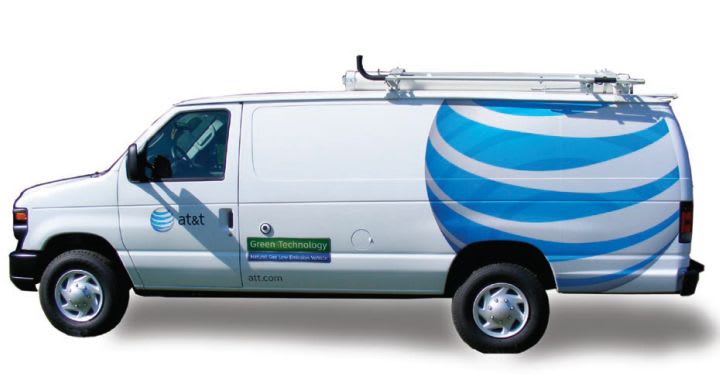
AT&T Van
AT&T maintains extensive telecommunications networks to keep nearly 300 million people around the world connected each and every day. That responsibility requires a large corporate fleet — approximately 80,000 vehicles in total.
Last June, the company added more than 100 alternative-fuel vehicles (AFVs)to its fleet, including compressed natural gas (CNG) vans, electric-hybrid OEM vehicles, and electric-hybrid conversion work trucks. Deployed throughout the country, the additional AFVs build on the company’s 2007 initial acquisition of Ford Escape Hybrids.
Considering that the 109 hybrids (four in 2007 and 105 in 2008) constitute only about a tenth of a percent of AT&T’s fleet, this may seem like a slow change. However, the strategy is deliberate. AT&T fleet managers know any implemented change will yield positive and negative outcomes on a large scale, and they must carefully select the right vehicles for their unique purposes. “Even the smallest improvement in fuel use across our corporate fleet can make a meaningful impact,” said Jerome Webber, vice president of fleet operations, AT&T Services Inc.
“We require a fleet with multiple vehicle types, and one alternative-fuel technology does not fit all solutions,” Webber said. “For a relatively large number of our vehicles, no alternative vehicle substitutes are available from U.S. vehicle manufacturers at this time.”
To tackle this problem, AT&T is working with several key domestic suppliers to upfit vehicles into alternative-fuel vehicles for fleet use. “We can’t wait until the manufacturing of these vehicles is standard to start using them. We need to understand now how they work for our business, and we hope to signal to the manufacturers that there is a need for these vehicles,” Webber said.
Webber and his team conducted exhaustive research to accurately weigh the benefits and costs associated with different types of vehicles. “We were very selective in choosing which types of alternative-fuel and more fuel-efficient vehicles to deploy and where,” Webber said. “We’re exploring multiple fuel-saving and emissions-reducing solutions suited for diverse driving situations and locations.”
In their research, Webber and his team investigated vehicles for:
Commercial availability.
Technology maturity.
Vehicle acquisition costs.
Average cost per gallon.
Greenhouse gas emissions.
Associated tax benefits.
Average miles per gallon.
Additional anticipated infrastructure (i.e., mechanic training, equipment, inspections, or refueling stations).
It was important for Webber and his team to find vehicles that supported their unique needs, particularly since AT&T has a relatively low-mileage fleet, and many AFVs are geared toward fleets that log significant miles and make frequent stops and starts.
“Most of our vehicles travel relatively short distances each day, primarily in concentrated neighborhoods. That’s why we’re placing our electric-hybrid vehicles in locations with a lot of stop-and-go traffic,” said Webber.
Just as electric vehicles are suited to particular environments and roadway conditions, CNG vehicles demand their own requirements, too.
“You have to look at the infrastructure needed to support certain types of AFVs. We wanted to deploy CNG vehicles, but they require a refueling station infrastructure. That’s why we’re rolling out 25 vehicles in California, which has more CNG refueling stations than any other state in the country,” Webber said.
AT&T will realize several benefits beyond the bottom line with AFVs. “We recognize the importance of reducing our environmental footprint. It makes sense from both a business and environmental perspective,” said Webber. “To this end, there are three principal reasons why we’re investing in alternative-fuel vehicles, to reduce operation costs per vehicle, dependence on fossil fuels, and emissions. It’s the right thing to do for the environment and for our business.”
AT&T estimates overall use of alternative-fuel vehicles instead of conventional vehicles will cut its fleet fuel consumption by 34,395 gallons — a savings of $137,580 at $4 per gallon. Moreover, reducing fuel consumption will also reduce CO2 emissions by more than 300 metric tons each year, the equivalent of taking 56 passenger vehicles off the road for one year. Specifically, the numbers break down as follows:
CNG vans are expected to reduce CO2 emissions by nearly 30 percent compared to traditional gasoline vans.
Electric-hybrid OEM vehicles are expected achieve more than a 39 percent improvement in fuel economy, reducing CO2 emissions by 29 percent.
Electric-hybrid conversion work trucks are expected to get up to 38-percent better fuel economy and reduce CO2 emissions by 28 percent.
AT&T will track metrics such as fuel efficiency, greenhouse gas emissions, operating costs, performance, and driver satisfaction for each vehicle.
“One important, but often overlooked, benefit of sustainable business initiatives like this is that they boost employee pride. Many people want to work for a company that is a good corporate citizen and a responsible steward of the environment, and we’re working hard to live up to that promise,” Webber said. “Since publicly announcing our ‘green’ fleet initiative, our employees have become so energized that we are receiving unsolicited, innovative green ideas — including ideas that extend beyond the fleet side of our business.”
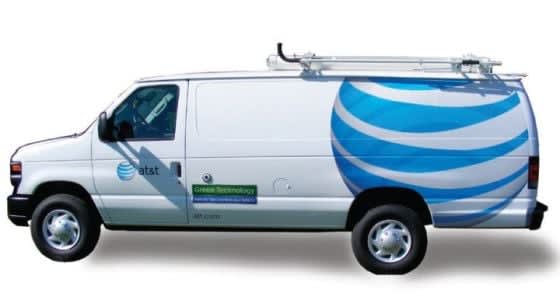
AT&T’s alternative-energy vehicles will feature a “Green Technology” logo, raising their profile in the public eye.
“We certainly hope the ‘Green Technology’ logo on our vehicles will draw visibility and inspire others to consider alternative-fuel and more fuel-efficient vehicles,” Webber said.
Webber offered some key pieces of advice for fleet managers considering investing in alternative-fuel vehicles:
Do your homework. “Industry research and consultation on available technology is critical to understanding different vehicle opportunities and costs and determining which vehicles will work best for your company,” Webber said.
Build internal support. Help management understand how greening the fleet can improve its financial well-being and sustainability.
Take small steps. “Develop a strategy and set goals that work for your company. It’s about taking steps in the right direction not determining a one-time, one-size-fits-all solution,” Webber said.
If fleets aren’t ready to invest in alternative-energy vehicles, they can look to Webber’s team for easy-to-implement initiatives that reduce fuel costs, fuel consumption, and emissions. For example, Webber’s team assisted in developing a Daily Best Fuel Price tool, which allows drivers to check the cheapest fuel stations within their assigned routes. Pricing information is updated every seven minutes so drivers get the most accurate pricing information.
Webber’s team is also developing an idling reduction policy and encourages drivers to heed well-known fuel-saving steps, such as avoiding fast acceleration and hard braking, keeping tires properly inflated, and reducing the weight of loads carried in fleet vehicles.
While AT&T has made significant progress in greening its fleet, the company’s initiative is likely to lead to further progress in the future. “We view our deployment of alternative-fuel vehicles as an important step in the right direction, and we’re committed to identifying other smart ways to improve the efficiency of our fleet down the road,” Webber said.
More Green Fleet

Turning Connected Vehicle Data Into Decisions That Matter
Fleet leaders have more data than ever, but turning that data into clear, actionable decisions remains a challenge. This white paper shows how leading organizations are using connected vehicle data to improve safety, reduce costs, and optimize fleet performance. Learn how to turn insight into action across your fleet.
Read More →
Are You Tracking Your Fleet's True Total Cost of Ownership?
Bobit Business Media surveyed 190 fleet professionals and found that while most fleets are tracking costs, fragmented systems and data gaps are keeping true TCO visibility out of reach. With rising pressure to control spend in an increasingly volatile environment, the gap between what fleets think they know and what the data actually shows is wider than you might expect. See how your peers are managing costs today and where the industry still has room to improve.
Read More →
Hybrids: Electrification Without the Challenges
For fleet managers, fuel is one of the biggest line items in the budget — and it's one hybrids can shrink without changing how your people work. Download the eBook to see the numbers, understand the technology, and get a step-by-step guide to making the switch.
Read More →
Startup ZMD Motors Developing Electric Conversion for Ram 5500 Work Trucks
Detroit-based company says it has begun early development of a system to convert internal combustion Ram 5500 chassis-cab trucks to electric power.
Read More →
U.S. EV Adoption Is Climbing, but Commercial and Passenger Markets Diverge
New industry group data revealed that light-duty electric vehicle sales are hitting record market share and volumes, while commercial EV volume dipped. What’s driving the fluctuations?
Read More →
How To Upfit Electric Work Trucks and Vans
The biggest challenge lies in balancing additional equipment and accessories with EV battery capacity and range.
Read More →
How Fleets Can Adjust Approaches To EV Adoption
With the expiration of federal incentives, EV success now hinges less on government policy and more on discounts, battery tech progress, increased range, and broader infrastructure.
Read More →
Despite World Troubles, Forward Thinking Guides Fleets
Fleet operators shared their challenges during an annual conference that embraced the latest advances across all aspects of running private- and public-sector vehicles.
Read More →
GM Energy Details Partnerships and Targets for Public Charging Build-Out
EVgo, Pilot, ChargePoint and IONNA named; goal is 35k GM-invested DC stalls by 2030, with customer-experience upgrades at sites.
Read More →
Q3 Electric Vehicles Sales Hit Record High
EV buyers took advantage of the final federal tax credit days, while average prices edged up for new EVs and continued to decline for used models.
Read More →