




Want More? The Changing World of Fuel Management
How to Select a Fuel Management Provider
Choosing the right fuel management provider can save you valuable time and money.
by Lisajoyce Vergara
September 1, 2007
Choosing your fueling provider is essential in cost savings and operational efficiency.
Photo: Automotive Fleet
5 min to read
Since fuel is your largest operating expense, it is important to choose the right fuel management provider to make sure your needs are met. The research and selection process may be a tedious job, but the end results benefit you and your company.
First Things First: Assess Your Fleet and Fuel Needs
Formulate a list of questions that pertain to your fleet:
How many and what type of vehicles does your company have? Fleet size can affect the kind of program and vehicle model or fuel services you’ll require.
How many drivers?
What types of drivers? Example: sales, service technicians, etc.
How many miles per week/month/year do your vehicles travel?
What kind of budget do you require to effectively manage drivers and how often do you need this information?
How do you currently track fleet fueling procedures?
What fueling controls are in place now? Are they effective?
How do you pay for fuel bills?
Reviewing these simple questions will help facilitate the decision-making process.
Research All Available Fuel Management Programs
Once you’ve assessed your fleet’s requirements, it’s time to select a program from a long list of fuel management suppliers. Fuel companies and major credit card companies all have programs to manage fuel purchases. Some companies specialize only in fleet fuel management.
Read through the companies’ Web sites for insight of what their programs offer. If some materials aren’t clear, listed on the site should be a phone number to contact a company representative to answer any questions.
It is best to write all your questions down before you call, to ensure all your concerns will be addressed.
Choosing Your Convenience
The next step is to determine how you would like to pursue selection of a fuel card. Buy it online or through a sales representative? Mark Lavin, senior vice president of FleetCor Technologies, says having a sales representative can provide more insight. “If you choose to go it alone, an alternate self-service sales channel may be just fine, such as business reply or a phone call to a toll-free phone number.”
When it comes to fuel card accessibility, keep in mind that in the market today, there is no such universal acceptance, said Lavin. This introduces areas of card coverage:
Near-Universal Coverage is a card accepted at most retail fueling stations.
Limited Network uses a network built to serve specific fleet customers and is expandable as needed.
A limited network generally avails the fleet customer to better economics and oftentimes brings better front-end controls or hard controls as it is likely a closed or proprietary network.
Customer Services Vary
When it comes to fleet needs, a variety of services are available. Bob Cavalli, vice president sales Northeast, U.S. Bank Voyager Fleet Systems Inc., highlights the different types:
Customer service should be available to fleets and merchants 24 hours a day, seven days a week. Some hours may vary depending on providers.
Client service provides one-on-one service with an account representative familiar with your account and can help with your fleet’s day-to-day issues, such as problems with the account, transactions, unauthorized use of fuel cards, stolen cards, etc.
Relationship management provided by a fuel management company functions as a consultant to fleet managers to advise the best approach for strategic fuel program management, use of cards, program reviews, etc. It is an ongoing relationship that helps maximize the effectiveness of the program.
Hard Controls vs. Soft Costs
When it comes to card usage control, a system must be implemented. Lavin explains the type of controls.
Hard controls enforce policy, allowing fleet managers to stop unauthorized fuel purchases. Hard controls may include purchase restrictions on:
Gallons or dollars per transaction.
Transaction per day.
Time-of-day or day-of-week.
Geographic restrictions.
“Fuel only” purchase control.
Soft controls effectively report on transaction activity that falls out of an expected range, generally referred to in the industry as exception reporting, meaning it can be reported, but can’t be stopped.
Some fleet card providers are limited to reporting unauthorized purchases (soft controls) rather than stopping unauthorized purchases from occurring (hard controls).
According to Lavin, it is not uncommon for providers with limited networks to deploy hard controls.
Managing Your Account
A fuel program’s account management tool is both essential and beneficial. You can manage your account on the phone or online. More common is online account management.
This feature allows review of your account and to make changes. Whether it’s ordering, replacing, or canceling cards, you have access to your account with just a few keystrokes. Also, you can communicate with a card provider to review statements and bills.
A few points to consider when dealing with online account management, according to Lavin:
Make sure you like the look and feel of the online account management tool, as you or your staff will spend a fair amount of time using the tool to make ongoing changes to your account, whether in card controls, driver PINs, or reviewing transaction data.
Timeliness is key. Are changes made to your account, such as adding or deleting driver PINs, effective in real time? Can a terminated driver be locked out in real-time? Is there a way to alert you immediately of an infraction to your driver's fuel policy?
Can transaction detail be easily downloaded into a usable format?
Along with account management comes another program that some providers offer — data mining. Cavalli says it is a featured program that providers offer to help fleet managers track reports, savings, fraud, violations, policy, data, etc.
Structuring Prices
Lavin explains that there are two pricing structures and they are:
Retail-Based. The fleet customer is charged the posted retail price or some derivative of retail such as a $0.02 discount to retail. While this is the most prevalent price structure available, it leaves the fleet subject to paying a price based on the driver's selection of fueling station.
Cost-Plus Program. Typically in this arrangement, a fleet pays a price that includes the wholesale price published by a third party, plus an agreed-upon fixed margin or “adder.” Under this program, a fleet may pay the same price for all transactions in a given week. The price is not linked to retail, rather it is a negotiated price formula applied to all transactions. This removes the variance in retail pricing found in the marketplace.
Bottom line is that you want to have trust in the provider and be confident in the choice you made. Also, the card is easy to use and accessible.
Subscribe to Our Newsletter
More Fuel
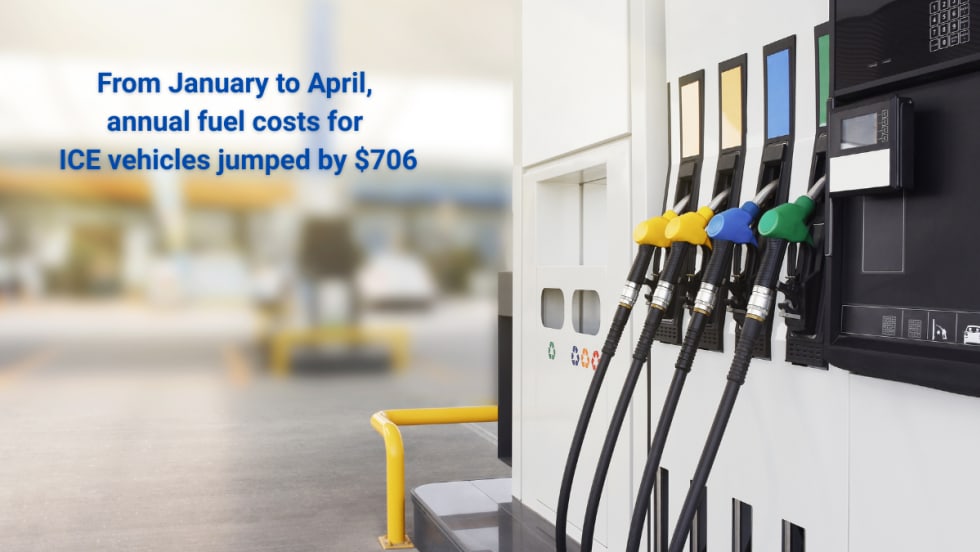
Study: How 2026's Gas Price Hikes Affect Different Vehicle Types
New data from iSeeCars reveals how rising fuel costs have affected different vehicle segments as gasoline prices climbed nearly 46% over the past four months.
Read More →
Sponsored•May 29, 2026
Are You Tracking Your Fleet's True Total Cost of Ownership?
Bobit Business Media surveyed 190 fleet professionals and found that while most fleets are tracking costs, fragmented systems and data gaps are keeping true TCO visibility out of reach. With rising pressure to control spend in an increasingly volatile environment, the gap between what fleets think they know and what the data actually shows is wider than you might expect. See how your peers are managing costs today and where the industry still has room to improve.
Read More →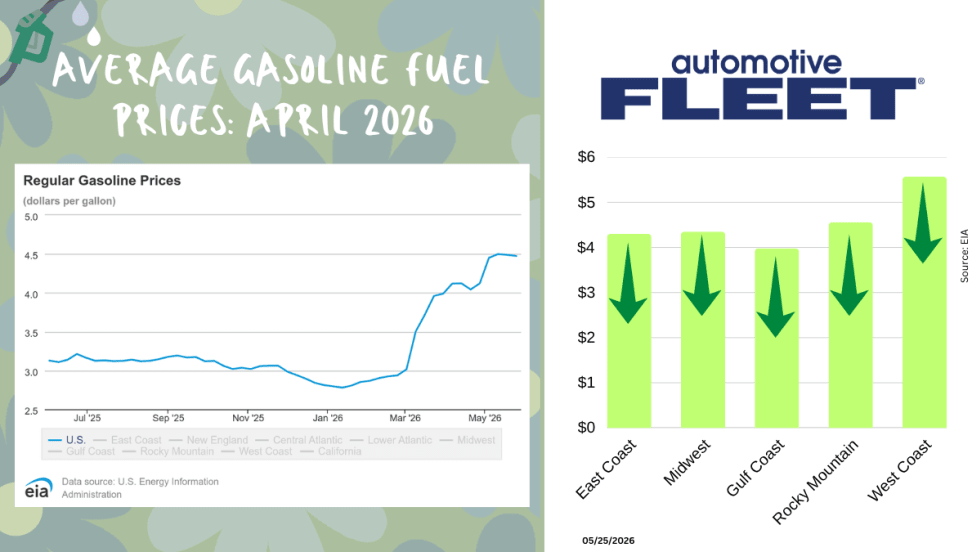
May Fuel Update: All Regions Experience Declines
Gas prices are finally easing in much of the country, but experts warn global tensions could quickly reverse the trend as the national average remains well above last month’s levels.
Read More →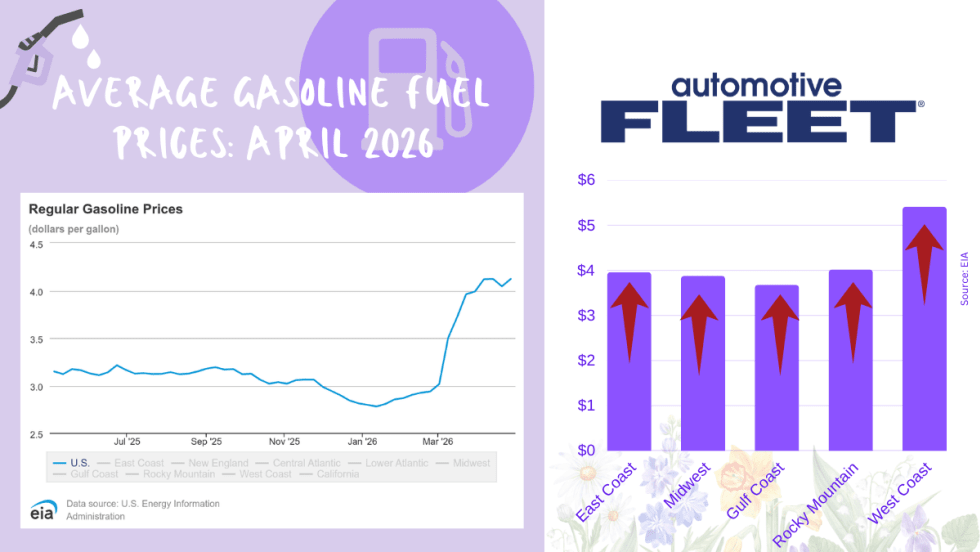
April Fuel Update: Prices Climb Above $4 as Spring Surge Accelerates
National average jumps to $4.04 per gallon, up sharply from last year, with West Coast prices topping $5 and further increases expected amid rising oil tensions.
Read More →
Tips from Fleet Managers on Saving Fuel Costs
Fleet leaders share practical strategies to reduce fuel spend through smarter policy, routing, and driver guidance.
Read More →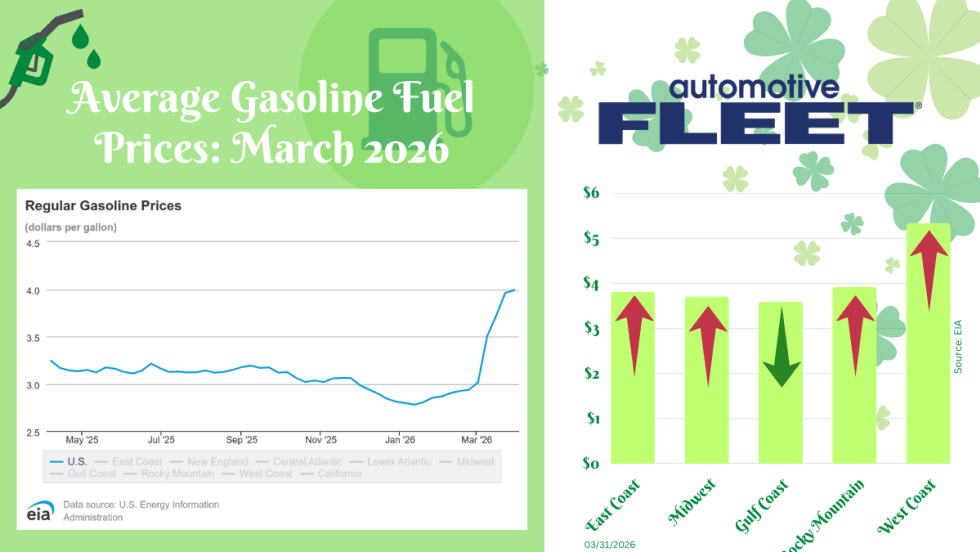
March Fuel Update: Prices Settle With a $4 Average
Fuel prices significantly slowed this week, but a $4 national average is still expected.
Read More →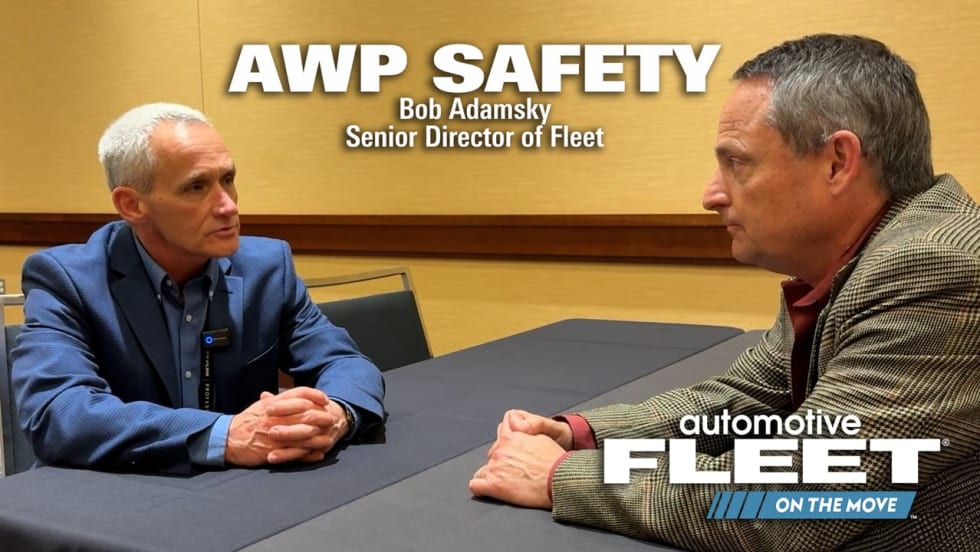
Bob Adamsky on Fuel Volatility: “Don’t Panic — Have a Plan”
With oil prices rising again, AWP Safety’s fleet manager shares how to respond to rising fuel costs and how the right strategy can turn fuel spikes into cost-saving opportunities.
Read More →
Oil Market Turbulence Is Complicating Fleet Cost Planning
Rapid swings in crude oil prices driven by the conflict in the Middle East could create longer-term cost pressures for fleets, affecting fuel prices, supply chains, and vehicle strategy, says NTEA’s Andrew Wrobel.
Read More →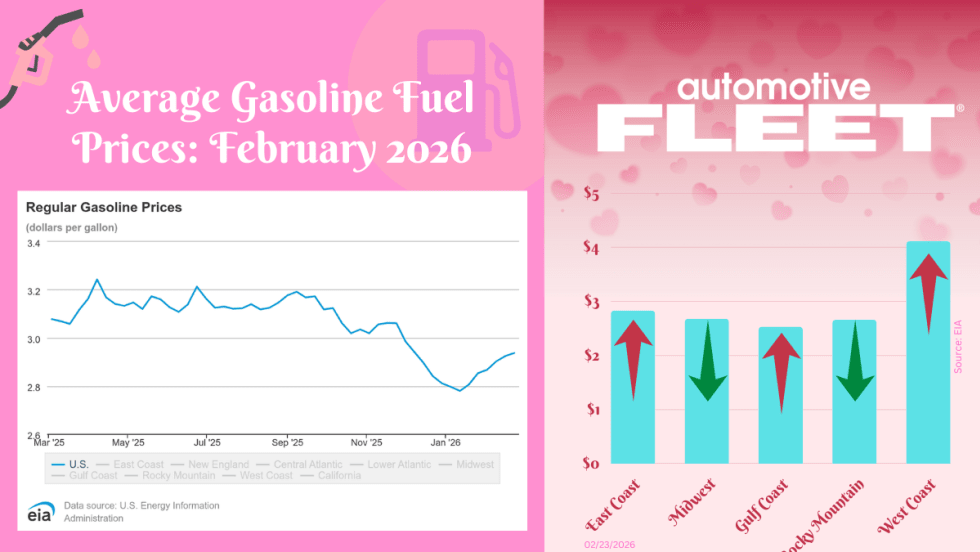
February Fuel Update: Prices Inch Higher for Third Week in a Row
The final February fuel update reveals prices continuing to inch higher for the third week in a row.
Read More →
The 2026 Fuel Economy Guide: Updated Cost and Efficiency Benchmarks for Fleets
Fleet managers can use the DOE’s 2026 Fuel Economy Guide to benchmark MPG across powertrain types using side-by-side vehicle ratings and compare new model-year options.
Read More →