





Dig Deeper: Why and How to Re-Rated GVWR
Medium-Duty Chassis & Suspension Fundamentals
WIth the myriad options available when spec'ing medium-duty truck chassis and suspensions, stakes are high, leaving fleet managers little room for error.
September 1, 2008
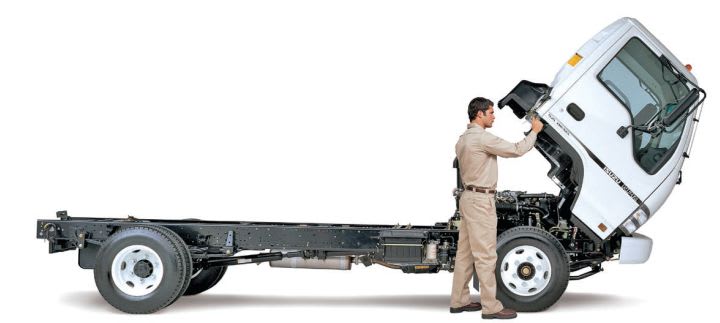
Where do you obtain frame strength numbers to review? Contact the chassis OEM or dealer rep for more information. In addition, consult your body and equipment upfitter to confirm the frame strength level to select.
Photo: Isuzu
8 min to read
If you feel overwhelmed by medium-duty truck specifications, there are others. While light-duty work trucks and cargo vans typically have a handful of total options to consider, medium-duties are more complex, with myriad options to filter through. When spec'ing a truck that costs $60,000-$100,000 or more, stakes are high, leaving fleet managers little room for error.
How can you make this process less intimidating? Begin by understanding the fundamentals of medium-duty chassis and suspensions. Then, the other options, which may seem complex at first (such as engine, transmission, and rear-axle ratio choices), will fall into place more easily.
How do you determine the right chassis and suspension specs for your application? Here are seven principles to follow.
1. Calculate Accurate Payload Needs
What exactly will your truck haul? How much do those items weigh?
Avoid thinking in general terms, such as, "I'm thinking maybe 4,000 lbs. or so," when you're looking at 6,500 lbs. Imprecise payload projections risk under-spec'ing the truck, causing potential safety and maintenance issues.
Here are key factors to include when projecting payload requirements:
Bed weight. The body manufacturer can provide this number.
Equipment weights. If hauling a Bobcat or other equipment, what's the curb weight? This is the weight of the equipment, including a full tank of fuel and fluids. Consult the equipment rep for these amounts.
Fluid weights. Suppose you're hauling a 600-gallon water tank. How much does that water weigh when the tank is full? Use 8.4 lbs. per gallon as the multiplier (See sidebar, Fluid Weight Multipliers.)
Weight of driver and occupants at all seating positions. Truck manufacturers attribute a nominal 150 lbs. per seating position in payload calculations. For five-passenger seating, multiply five by 150 lbs., which equals 750 lbs., the minimum amount to factor in payload projections.
As-spec'd chassis curb weight. This factor is defined as the shipping weight of the cab and chassis (without body and aftermarket upfits), including all standard equipment and options, fluids, and a full tank of fuel. Consult the truck OEM or dealer rep for curb weight estimates on the chassis closest to your spec requirements.
Totaling these components helps accurately assess what gross vehicle weight rating (GVWR) truck best suits your needs. As determined by the manufacturer, GVWR is the maximum allowable weight (chassis, occupants, and payload) for the vehicle to start and stop safely.
Your objective is to select a truck that offers a slight buffer in payload capacity but is manageable, which would unnecessarily drive up cost.
2. Verify Sufficient GVWR
If the truck will pull a trailer, verify the GCWR is sufficient to meet both payload and trailer needs. Gross combination weight rating (GCWR) is the maximum allowable weight (as determined by the manufacturer) of the chassis, fluids, occupants, and body (including equipment and payload) combined with the weight of the trailer at maximum load. This is the critical number from which you calculate trailer capacities.
To illustrate, take two chassis with the same GVWR. The Isuzu NRR W-5500 cab-over (also known as low cab forward) and Chevy C5500 Kodiak conventional cab offer the same 19,500 lb. GVWR. However, if you're pulling a heavy trailer regularly, which fits your application better?
At this point, GCWR becomes important. The combined weight rating for the W-5500 is 21,000 lbs. and the C5500 is 26,000 lbs., or a 5,000-lb. difference. Since the W-5500 cab weighs approximately 1,500 lbs. less than a comparably equipped C-series, there is a 3,500 lbs. net trailering advantage for the C-Series.
Do you need that additional trailer capacity? Factor GCWR in spec requirements.
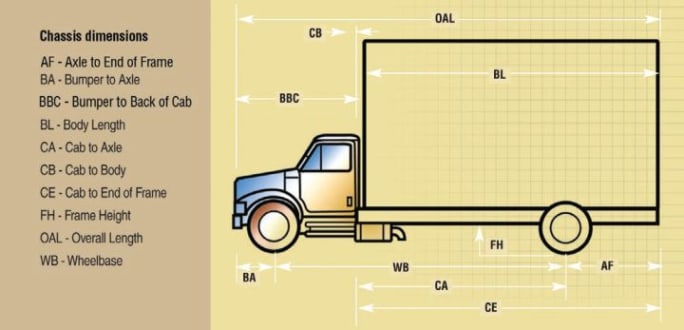
Understanding Chassis Dimensions: A guide to key truck measurements including wheelbase, body length, and overall length to ensure proper fit and functionality for your fleet needs
Source: Work Truck
3. Select Rear Suspension
Choose a rear suspension that best matches your application. Too much suspension rigidity for the wrong application may cause driver complaints and discomfort. Yet, if the truck will handle constant, heavy loads, you may need to spec a stiffer, heavier-duty suspension or risk premature performance and maintenance issues.
The following terms detail three primary rear suspension choices for most medium-duty truck manufacturers and when to spec each.
Taper leaf – best fits a shuttle bus, any application that transports people, or an application for which you don't want the back end bouncing hard. A taper leaf is spec'd for a smoother ride, not maximum loads.
Multi-leaf – provides extra stability and rigidity for dump bodies or other applications requiring heavier loads on the rear axle. To mitigate harshness in the ride, some truck manufacturers offer rear shock absorbers as a compatible option.
Air suspension – typically available on Class 6 trucks and larger. In addition to contributing to greater driver comfort without sacrificing stability under maximum loads, air suspension can lower truck height for easier loading and unloading.
Which type of suspension would work best for your truck's purpose? The right suspension for a trucking fleet operation comes down to cost, maintenance, application, and personal preferences.
4. Confirm Wheel & Tire Size

Exploring Body Types: A visual breakdown of common truck configurations, from platform and stake to van, dump, utility, catering, and specialized wreckers.
Source: Work Truck
You've ordered a Class 6 (26,000 lb.- GVWR) truck from dealer stock, initially spec'd for a rollback application, but you intend to put an 18-foot box on it for a warehouse delivery truck. The rollback spec seems a good fit for your driver because it offers better comfort and convenience options with power windows, locks, and air-ride seats.
When you take delivery, however, you notice a problem: the truck is not dock high. Instead of the 22.5-inch wheels your application requires to achieve proper loading and unloading height, the truck sits on the smaller 19.5-inch wheels. You now must deal with crew productivity and efficiency issues.
The opposite also holds true. If you intend to upfit the truck as an industrial rollback to load and transport Bobcats and other heavy equipment, the tire size directly impacts the body load angle as it tilts. If you spec the 22.5-inch tires, the tilt angle will be too steep to roll the equipment up.
Avoid this mistake by double-confirming that the wheel and tire size fit your application.
5. Select the Frame Strength
For some applications, the standard frame strength may be sufficient. Why pay several hundred to more than a thousand dollars additionally for a stronger frame without a corresponding benefit? Yet, if you're using the truck for a heavier-duty application, you may compromise the frame's integrity, contributing to increased maintenance issues and shortened truck life.
The following are terms and measures to know in reviewing frame strength options.
Section modulus. This measurement, in cubic inches, is based strictly on frame side-rail height, width, and thickness. As a frame of reference, the section modulus for the standard frame on a Chevrolet Kodiak C7500 is 9.58 cubic inches, while the strongest frame option for that chassis offers a section modulus of 17.93 cubic inches.
Yield strength. This factor refers to the maximum weight in pounds per square inch (psi) that can be placed on the frame, allowing it to return to its original position without permanently bending or creasing. Typical yield strengths for Class 4-7 trucks range from 50,000-120,000 psi.
Resistance bending moment (RBM). This calculation combines section modulus and yield strength and seems a fair and accurate measure when comparing frame strengths between truck manufacturers. The formula: Section Modulus x Yield Strength = RBM. Revisit the previous example with the standard frame strength of the C7500. Here's how the numbers are computed: 9.58 cubic inch (Section Modulus) x 50,000 psi (Yield Strength) = 479,000 RBM. In comparison, the strongest frame option on that truck offers 2,151,600 RBM, based on a section modulus of 17.93 cubic inches and 120,000 psi yield strength.
Where do you obtain frame strength numbers to review? Contact the chassis OEM or dealer rep for more information. In addition, consult your body and equipment upfitter to confirm the frame strength level to select.
6. Review Fuel Tank Capacity & Placement
A single 25-gallon fuel tank in a Class 5 truck equipped with a service body and crane for on-site equipment repair may be sufficient. The truck primarily stays on the job site, not required to travel many miles during the day. Fueling intervals aren't a critical issue.
However, this 25-gallon fuel capacity in another Class 5 truck designed for on-highway transport of pipe and other electrical supply materials presents a productivity and efficiency problem. The driver must stop frequently to refuel during routes, causing slower delivery times and greater crew frustration and complaints.
Another fuel tank issue is placement on the chassis frame. If the tank configuration gets in the way of the body company's requirements, you pay to modify it. It costs significantly more labor and downtime to alter the configuration after the fact than to get it directly from the factory. Ask your upfitter up-front what tank configuration your equipment requires.
Here are the common terms to know when discussing fuel tank positioning:
Side saddle. This tank is mounted outside the frame rails and placed on the driver's, passenger's, or both sides.
Mid-ship. This refers to tank placement inside frame rails toward the middle of the chassis, before the rear axle.
Aft axle. This tank is mounted behind the rear axle.
7. Select Compatible Exhaust Systems
As with fuel tank configurations, the wrong exhaust placement drives up truck costs.
Two options are available with exhaust systems: horizontal and vertical. The horizontal exhaust is often standard and works fine for most applications.
It makes sense to select a vertical exhaust when exhaust heat can become a safety issue for a crew operating truck-mounted equipment, such as a crane, from outside the cab. The vertical exhaust diverts the heat away from the driver and equipment.
However, depending on the chassis manufacturer, the vertical exhaust option may shorten effective cab-to-axle (CA), requiring body modification to fit properly. Therefore, work closely with your upfitter to ensure sufficient CA to mount the required equipment.
Put it All Together
With knowledge comes confidence. Focus on the fundamentals of medium-duty chassis and suspensions, and you'll spec a truck that offers improved vehicle safety, better performance, lower operational costs, and fewer crew complaints.
Originally posted on Work Truck Online
Subscribe to Our Newsletter
More Operations

How to Manage Conflict for Your Fleet Operations
Conflict management is becoming a core leadership skill. Here are five strategies fleet leaders should know.
Read More →
Sponsored•June 1, 2026
Turning Connected Vehicle Data Into Decisions That Matter
Fleet leaders have more data than ever, but turning that data into clear, actionable decisions remains a challenge. This white paper shows how leading organizations are using connected vehicle data to improve safety, reduce costs, and optimize fleet performance. Learn how to turn insight into action across your fleet.
Read More →
Sponsored•June 1, 2026
Cameras, Safety and Insurance: From Reactive Claims to Real-time Prevention
Commercial auto remains one of the most challenging and costly lines of coverage for fleet operators and insurers alike. Learn more about how to effectively address these issues from Onur Aksan, Enterprise Business Development Executive, Geotab.
Read More →

Sponsored•May 29, 2026
Are You Tracking Your Fleet's True Total Cost of Ownership?
Bobit Business Media surveyed 190 fleet professionals and found that while most fleets are tracking costs, fragmented systems and data gaps are keeping true TCO visibility out of reach. With rising pressure to control spend in an increasingly volatile environment, the gap between what fleets think they know and what the data actually shows is wider than you might expect. See how your peers are managing costs today and where the industry still has room to improve.
Read More →
Sponsored•May 28, 2026
Turn Fleet Data Into Smarter Decisions
Fleet leaders have access to more operational data than ever, but disconnected systems and unclear metrics often slow decision-making instead of improving it. This article outlines five practical steps fleets can take to transform fragmented data into actionable insights that improve planning, safety, utilization, and long-term performance.
Read More →
Sponsored•May 15, 2026
Hybrids: Electrification Without the Challenges
For fleet managers, fuel is one of the biggest line items in the budget — and it's one hybrids can shrink without changing how your people work. Download the eBook to see the numbers, understand the technology, and get a step-by-step guide to making the switch.
Read More →
How NOV Uses Telematics to Improve Fleet Safety Across 160 Locations
James Victory of NOV discusses how the company manages fleet safety, maintenance, and telematics across more than 150 locations supporting oilfield operations throughout the U.S.
Read More →
Fleet Meets: Steven Santostasi
This edition of the Fleet Meets series features Steven Santostasi, the current TSP channel manager for Ford Pro.
Read More →
Sponsored•May 13, 2026
Why Fleet Managers Are Replacing Departmental Vehicles with Shared Motor Pools
Departmentally assigned vehicles often create hidden costs through underutilization, poor visibility, and increased administrative burden. This white paper explores how shared motor pool strategies help fleets reduce costs, improve accountability, and optimize vehicle utilization.
Read More →
Soap Box Derby Challenge: Assembling the Crew
Meet Gabriel, Matthew, and Angel — the team helping bring this soap box derby build to life.
Read More →