




Brigher Future Ahead for Domestic OEMs
Automotive industry analyst John McElroy is “bullish” about the future of the Detroit 3, forecasting a “perfectly aligned” market for Ford, GM, and Chrysler and record profits in 2013-2015, if industry-wide sales increase again to 14 million units.

McElroy

McElroy
The future is bright for the Detroit 3 - Ford, General Motors, and Chrysler - says automotive industry analyst John McElroy.
A 30-year veteran journalist, McElroy hosts the online Web cast "Autoline Daily," and the weekly television program "Autoline Detroit," a half-hour discussion program featuring automotive executives and journalists.
A car enthusiast at heart, McElroy "found that the industry that makes the cars is more interesting than the cars themselves. So I've tried to figure out what makes this industry tick for the last 30 years. Every time I think I have it figured out, there's always something new to learn about it."
The following interview is based on a keynote address McElroy presented at the recent Automotive Fleet & Leasing Association (AFLA) annual conference in Phoenix.
Automotive Fleet: New-car sales in the U.S. have been inching up in the last few months. Do you see this trend continuing?
McElroy: I do. I think we're going to see a very slow and very weak, but ongoing recovery in both the new-car and fleet markets. We're seeing a little more travel on the part of business people. They're going to need to rent cars; the daily rentals are going to be back in the market to a degree. Corporations are going to be replacing their fleet vehicles going forward. This should bode well for all automakers, but again, new-car sales are still going to be very weak.
AF: What is the near-term future - over the next five years - for the domestic automakers
McElroy: For the first time in a long while, the Big 3 are in fighting shape for several reasons:
Their debt levels have been slashed.
Labor costs have been reduced dramatically.
Work rules have been fixed.
Job banks have been eliminated.
Excess capacity has also been eliminated.
The EBITDA (Earnings Before Interest, Taxes, Depreciation, and Amortization) for the OEMs means they can break even at a 10-million SAAR (seasonally adjusted annual rate).
The Detroit 3 now have the capability to at least break even, even at disastrously low sales levels. And so for the first time, in arguably 30 years, they now have a level playing field when it comes to competing with foreign automakers.
This assumes, of course, the economy does come back.
As we know in the last 30 years, the Detroit automakers have done nothing but lose market share. That's going to change the dynamics in the American market. Now they finally have a chance to defend that part of the market they still hold.
This market is perfectly aligned for the car OEMs. They will need to strain to meet demand. There will be no need for incentives to produce bigger sales and profits. The industry should record profits in about three years, with Ford leading the way, then GM and Chrysler.
I am bullish about the new car industry in the next few years.
AF: How does this brighter future for the domestic automakers impact fleet sales?
McElroy: The fleet business has been critically important to the Big 3. While they lost retail market share, they did a reasonably good job holding on to their fleet market share. And they used the fleet market to absorb their excess capacity. Now they no longer have excess capacity. So while the fleet market will still be important to them, they'll be able to demand higher prices than they did in the past. At the same time, we're seeing some of the foreign automakers now have excess capacity, and they're going to want to get into the fleet market.
AF: You forecast pent-up demand for new vehicles over the 2013-2015 time frame, can you elaborate?
McElroy: The U.S. fleet of automobiles is shrinking for the first time as the population has been increasing. Demand will build as capacity is reduced. We've seen such a dramatic drop-off in sales in the last year, we know pent-up demand is going to build. People can only postpone the purchase of a new car for so long. While there's no question that millions of consumers have dropped out of the new-car market, probably never to return, there's still going to be a lot of pent-up demand that will drive sales higher than we're at right now, again providing the economy recovers.
When you couple the fact that the Detroit automakers are able to break even at today's sales levels, and when you look at how pent-up demand is likely to have sales grow over the next three years, GM and Ford, to be sure, are in a position where they can be extremely profitable, if the market gets back to, say, only 14 million units a year.
AF: How will foreign-badged OEMs share in the better times you predict for new-car sales?
McElroy: Some of the foreign brands are going to do extremely well. Companies that have been going strong all along, I would expect them to continue to do so - OEMs such as Toyota, Honda, and Hyundai. But some of the more marginal brands are really going to struggle.
AF: What changes do you see in the U.S. car market?
McElroy: A long-term shift in the U.S. car market is occurring. The CAFE and CO2 legislation will force a shift from trucks and SUVs. The question remains, however, will Americans buy smaller cars?
New-car prices must increase to offset lower profits from decreasing sales of the highly profitable trucks and SUVs. In addition, the increasing amount of technology in vehicles because of environmental regulations (hybrid, plug-in electric) will add to vehicle prices, as much as $5,000 to the price of a new car by 2015, not counting inflation.
Can U.S. households keep up with that pace of price increase? I do not believe so.
The question becomes, "Can auto manufacturers in the U.S. survive at 11 million SAAR?" This is where the market will settle.
AF: Which vehicle segment will benefit as the demand for new cars builds?
McElroy: If we look at what's going on right now, crossovers have been one of the hottest segments of the market, especially compact and mid-size crossovers. We also saw a big shoot-up in compact cars during Cash for Clunkers. But I think that spike is short-lived, unless gas prices really start to go up in a big way, which they're not doing right now. The two areas I'd keep an eye on are compact cars and compact crossovers.
People like SUVs, and what they've come to realize is SUVs are big, they're heavy, and they're gas-guzzlers. But they still like SUVs, and rather than walk away from them altogether, American consumers are looking for vehicles that will give them as much as possible what an SUV provides, but a vehicle that will also get better fuel economy, not be quite as big, certainly on the outside, and maybe not be as heavy. Crossovers fit the bill. So we're seeing good strength in that part of the market, in comparison with the rest of the market.
AF: What was the impact of the federal government's Cash for Clunkers program?
McElroy: The Cash for Clunkers program brought in a great many people who don't normally buy a new car or only buy a new car every 10 years or so. These buyers only came in because of this incredible deal the government offered. They're not likely to come back, and they're the kind of people who can't afford to buy an expensive car. They had to go with the cheapest car available, and those are compact cars.
I think even though we saw a big spike in compact cars in the July-August timeframe, I don't see compact car sales being that strong, unless or until gas prices start to go up again.
AF: What's your assessment of alt-fuel technologies?
McElroy: The huge area to watch here is electric and plug-in cars. All OEMs around the world are starting from scratch with this technology.
The only disadvantage I see for the Detroit 3 is the infrastructure issue with electric vehicles. Even though the grid can accommodate millions of electric cars, it's that last five feet of plugging the car into the grid that's going to have to be installed.
Most people's garages, certainly their homes, are not set up to easily plug in their vehicles. Yes, everyone's got outlets and so on, but are you going to go plug something in during a driving rain or freezing snow? And aren't you going to want 220 volts so you can charge your vehicle in a few hours, instead of waiting all night long to do it? Even if you take it to work or shopping, where are you going to plug this thing in? There is still a huge infrastructure that must be developed and built.
And who's going to pay for that? Every state and the feds are flat broke. Maybe the utilities are going to pay for that, but they're not going to start installing these things until electric cars show up. And people are not going to buy electric cars until the charging stations show up.
It's going to be a slow rollout. Contrast that to say, Germany or Japan, where their federal governments are making a big investment into putting that infrastructure into place. There may well be a bigger market for electric vehicles in Japan and Germany, as an example, than in the U.S. That will give German and Japanese automakers a head start on everyone else.
That said, of all the alt-fuel technologies, the easiest transformation from an infrastructure point will be with electricity, even though we have to wire that last five feet to the car.
Individual homeowners will pony-up the bill. I can see where shopping centers will view charging stations in their parking lots another way of getting revenue, if they see there's enough demand for it.
Contrast that to CNG where big infrastructure has to be put in place, even though much of it is already there. With hydrogen, an even a bigger infrastructure would have to be put in place. The only alternative energy that might be the best from an infrastructure standpoint is the electric grid. Additionally, if cellulosic ethanol really turns out to be everything it is anticipated or if fuel from algae turns out to be everything it's supposed to be, then the infrastructure is pretty much already in place.
AF: What developments would promote a wider acceptance and implementation of electric vehicles and plug-ins?
McElroy: The only thing that I can see will help speed this along is a big increase in the price of oil. Then everybody hits the panic button and wants to see action immediately and decisions get made.
But the problem right now is in this country we still haven't committed to any one kind of alternative. Should it be electricity? Biofuel? CNG? Hydrogen? Until we decide where we're going, we're going to have to put in four or five different infrastructures at a time when every municipality and government is broke. And I just think it's going to be enormously difficult to move forward on this issue, again, until the price of oil skyrockets, and we all hit the panic button again.
AF: Will use of diesel fuel become as widespread as it is in Europe?
McElroy: Diesel will not catch on big in the U.S. as it has in Europe because environmentalists in this country don't like diesel. They're into electric. The one scenario that might change this situation is research now underway to use algae to produce fuel, research that offers a bit of potential in the alt-fuel area. Ten-percent of the land mass in the state of Michigan can grow enough algae to supply fuel for the entire U.S. Researchers are looking into using algae to produce biodiesel.
More Operations

How to Manage Conflict for Your Fleet Operations
Conflict management is becoming a core leadership skill. Here are five strategies fleet leaders should know.
Read More →
Turning Connected Vehicle Data Into Decisions That Matter
Fleet leaders have more data than ever, but turning that data into clear, actionable decisions remains a challenge. This white paper shows how leading organizations are using connected vehicle data to improve safety, reduce costs, and optimize fleet performance. Learn how to turn insight into action across your fleet.
Read More →
Cameras, Safety and Insurance: From Reactive Claims to Real-time Prevention
Commercial auto remains one of the most challenging and costly lines of coverage for fleet operators and insurers alike. Learn more about how to effectively address these issues from Onur Aksan, Enterprise Business Development Executive, Geotab.
Read More →

Are You Tracking Your Fleet's True Total Cost of Ownership?
Bobit Business Media surveyed 190 fleet professionals and found that while most fleets are tracking costs, fragmented systems and data gaps are keeping true TCO visibility out of reach. With rising pressure to control spend in an increasingly volatile environment, the gap between what fleets think they know and what the data actually shows is wider than you might expect. See how your peers are managing costs today and where the industry still has room to improve.
Read More →
Turn Fleet Data Into Smarter Decisions
Fleet leaders have access to more operational data than ever, but disconnected systems and unclear metrics often slow decision-making instead of improving it. This article outlines five practical steps fleets can take to transform fragmented data into actionable insights that improve planning, safety, utilization, and long-term performance.
Read More →
Hybrids: Electrification Without the Challenges
For fleet managers, fuel is one of the biggest line items in the budget — and it's one hybrids can shrink without changing how your people work. Download the eBook to see the numbers, understand the technology, and get a step-by-step guide to making the switch.
Read More →
How NOV Uses Telematics to Improve Fleet Safety Across 160 Locations
James Victory of NOV discusses how the company manages fleet safety, maintenance, and telematics across more than 150 locations supporting oilfield operations throughout the U.S.
Read More →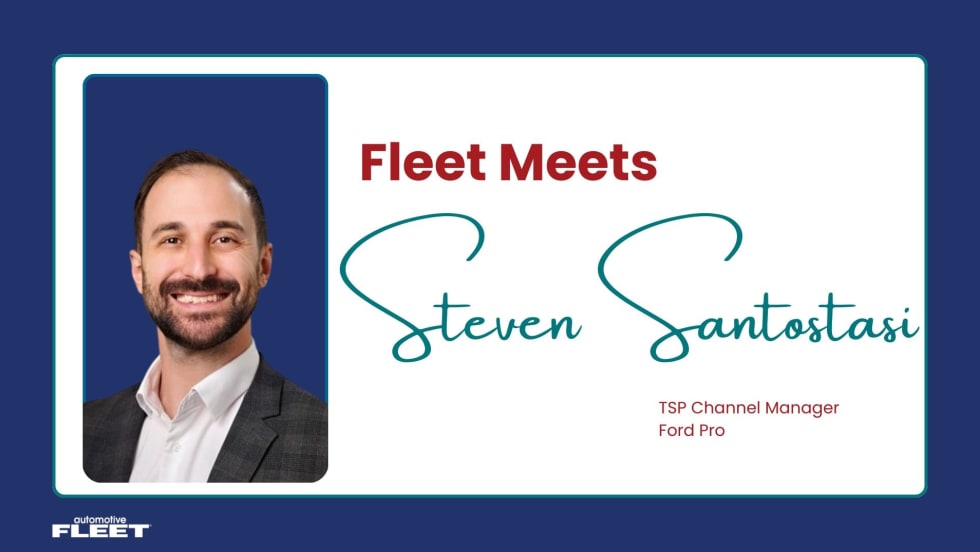
Fleet Meets: Steven Santostasi
This edition of the Fleet Meets series features Steven Santostasi, the current TSP channel manager for Ford Pro.
Read More →
Why Fleet Managers Are Replacing Departmental Vehicles with Shared Motor Pools
Departmentally assigned vehicles often create hidden costs through underutilization, poor visibility, and increased administrative burden. This white paper explores how shared motor pool strategies help fleets reduce costs, improve accountability, and optimize vehicle utilization.
Read More →
Soap Box Derby Challenge: Assembling the Crew
Meet Gabriel, Matthew, and Angel — the team helping bring this soap box derby build to life.
Read More →