




NHTSA Updates 5-Star Safety Rating Program for 2011-MY
Program enhancements will impact requirements auto-makers must meet to achieve high safety ratings. With new judging criteria, earning 5 stars on 2011-MY vehicles may be more challenging than previous model-years.

Originally scheduled for implementation on 2010 model-year vehicles, the National Highway Traffic Safety Administration (NHTSA) postponed for one year changes to its 5-star government safety rating program - offering automakers more time to meet the agency's requirements and enabling drivers to become familiar with the revised safety ratings before purchasing a vehicle.
Changes include new test dummies and injury criteria for the frontal crash test and side impact program, an additional new side pole test, an overall summary rating, and a new program to promote advanced crash avoidance technologies.
Protecting Passengers
All vehicles sold in the United States must comply with Federal Motor Vehicle Safety Standards, covering a broad range of safety concerns from windshield wipers and brakes to crashworthiness and fuel integrity. To rate compliance with these standards, the NHTSA's New Car Assessment Program (NCAP) provides "government 5-star ratings" with vehicle safety information, primarily front and side crash rating results, and more recently rollover ratings. Results are relayed to consumers via a recognizable star rating system of 1 to 5 stars, with 5 being the highest.
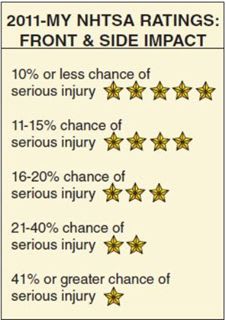
Shown below, both frontal crash and side impact ratings for 2011-MY vehicles will become more stringent, most noticeably when compared to the current side impact ratings (2010-MY). 2011-MY percentages displayed for frontal crash are approximately 4 percentage points higher than the existing program's.
Initiated in 1978 with the primary purpose of providing consumers a measure of the relative safety potential of vehicles in frontal crashes, the NCAP later added side crash rating results to the program beginning with model-year 1997 vehicles. Rollover ratings were added with model-year 2001 vehicles.
With the NCAP's system, vehicle manufacturers are driven by market incentives - rather than regulatory directives - to voluntarily design vehicles to better protect occupants in a crash and be less susceptible to rollover.
Rating Safety Effectiveness
Starting with 2011-MY vehicles, NHTSA will implement the following changes.
Frontal crash. NHTSA will maintain the 35-mph full frontal barrier test protocol, but will update the test dummies to include a female dummy and associated injury criteria used to assess and assign a vehicle's frontal impact star rating.
Crash-rating dummies representing an average-sized adult are placed in driver and front passenger seats, secured with the vehicle's seatbelts, and vehicles are crashed into a fixed barrier, equivalent to a head-on collision between two similar vehicles each moving at 35 mph.
Instruments measure the force of impact to each dummy's head, neck, chest, pelvis, legs, and feet. Frontal star ratings indicate the chance of a serious head and chest injury to the driver and right front seat passenger. A serious injury is one requiring immediate hospitalization and may be life-threatening.
Side impact. NHTSA will maintain the current moving deformable barrier test at 38.5 mph, but will update to include new side impact test dummies and new injury criteria used to assign a vehicle's side impact rating. Additionally, vehicles will be assessed using a new pole test and small female crash test dummy.
Crash-rating dummies are placed in driver and rear passenger seats (driver's side) and secured with the vehicle's seat belts. The side crash rating represents an intersection-type collision with a 3,015-lb. barrier moving at 38.5 mph into a standing vehicle. The moving barrier is covered with material with "give" to replicate the front of a vehicle.
Instruments measure the force of impact to each dummy's head, neck, chest, and pelvis. Side-collision star ratings indicate the chance of a serious chest injury for the driver, front seat passenger, and the rear seat passenger (first- and second-row occupants). Head injury, although measured, is not currently included in the star rating. An excessive head injury score (HIC greater than 1,000) is reported separately as a safety concern. As with the frontal crash ratings, a serious injury is one requiring immediate hospitalization and may be life-threatening.
Rollover. The agency will continue to rate vehicles for rollover propensity, but will wait to update its rollover risk model to allow for more real-world crash data of vehicles equipped with electronic stability control. It will also implement a new ratings program to rate vehicles on the presence of select advanced technologies and establish a new overall Vehicle Safety Score combining star ratings from the front, side, and rollover programs.
Finally, for the agency's vehicle labeling program, the side score will be based on the combination of the moving deformable barrier test and the pole test, rather than just the moving deformable barrier test. Additionally, NHTSA will initiate rulemaking to include the new overall crashworthiness rating on the Monroney label.
More Safety

Nominations Open for 2026 Fleet Safety Award
Nominations have officially opened for the 2026 Fleet Safety Award Winner.
Read More →
Turning Connected Vehicle Data Into Decisions That Matter
Fleet leaders have more data than ever, but turning that data into clear, actionable decisions remains a challenge. This white paper shows how leading organizations are using connected vehicle data to improve safety, reduce costs, and optimize fleet performance. Learn how to turn insight into action across your fleet.
Read More →
Cameras, Safety and Insurance: From Reactive Claims to Real-time Prevention
Commercial auto remains one of the most challenging and costly lines of coverage for fleet operators and insurers alike. Learn more about how to effectively address these issues from Onur Aksan, Enterprise Business Development Executive, Geotab.
Read More →
NAFA Fleet Safety Symposium to Collocate With 2026 Fleet Forward Conference
The daylong certificate program will precede the Fleet Forward Conference at the Gaylord National Harbor in Maryland.
Read More →
The Distractions You Can’t Turn Off: What Drivers Face Outside the Vehicle
Fleet drivers face constant visual, cognitive, and environmental interruptions the moment they hit the road. From roadside chaos to mental fatigue and digital overload, today’s biggest driving risks often come from outside the vehicle itself.
Read More →
FLASH Weather AI Launches First Deep-Learning Hail Prediction Model With High-Resolution Forecasting
FLASH Weather AI has launched a first-of-its-kind hail prediction model capable of forecasting hail size and arrival time at 1-kilometer resolution up to 55 minutes ahead, giving fleets and insurers critical time to prepare for severe storms.
Read More →
How Coca-Cola United Protects Its Fleet from Growing Legal Risk
As litigation risk rises, vehicles are increasingly targeted. This Coca-Cola bottler shares how it’s reducing exposure through driver training, technology, and a proactive risk management approach.
Read More →
How to Speak the Same Language on Fleet Safety
Drivers, supervisors, and data often speak different safety “languages.” Getting on the same page will drive better results.
Read More →
Fleet Cybersecurity 101: What You Need from Your Technology Vendors
From identity management to third-party certifications, the right technology partner should make security easier to manage. Here are the three building blocks that fleet managers need to stay in control as connected systems scale.
Read More →
Reducing Risk by Eliminating Phone Use Behind the Wheel
Distracted driving remains one of the most persistent risks in fleet operations. New approaches focus on removing mobile device use entirely while adding real-time safety support.
Read More →